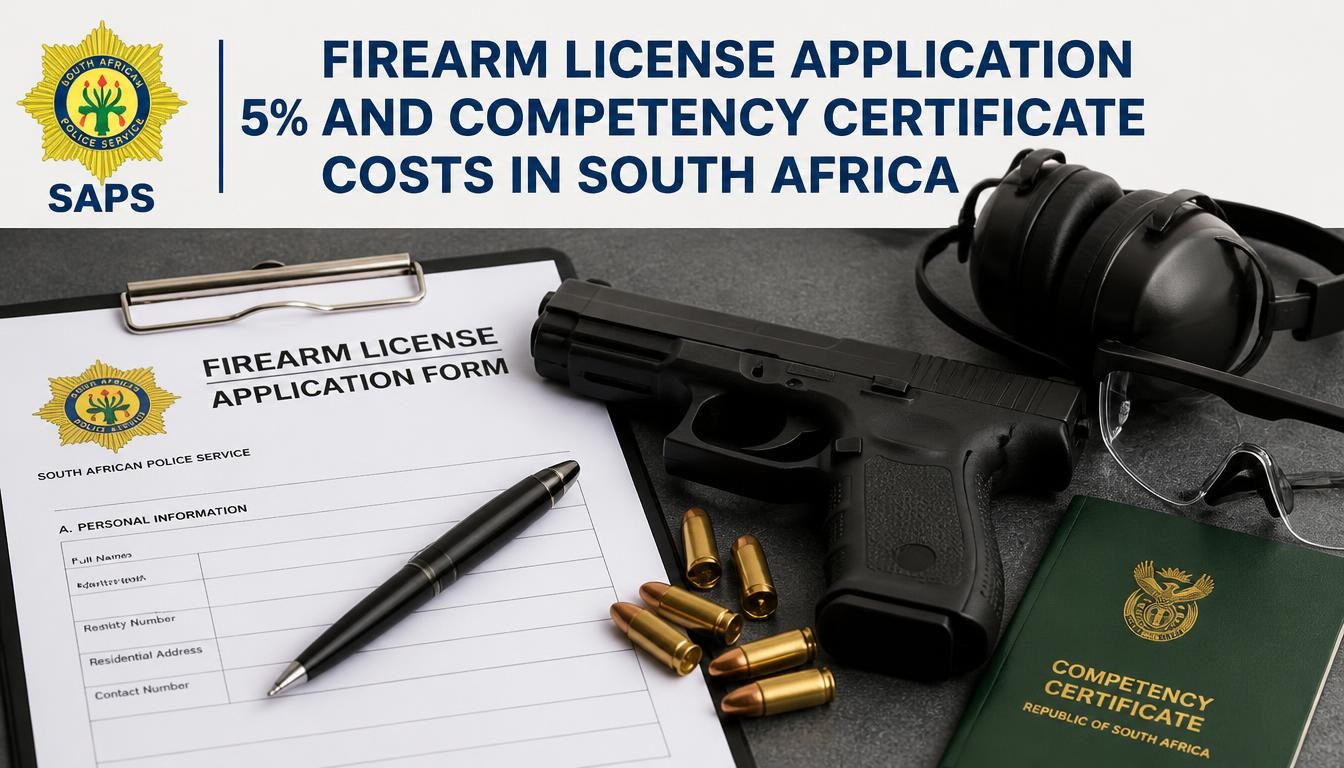
Quick Answer: The total realistic cost to legally license a firearm in South Africa ranges from R4,500 to R12,500+ all-inclusive. While official SAPS application administrative statutory fees are nominal (R92 for a Competency Certificate and R183 for a License Application), the true financial burden lies in mandatory accredited PFTC training courses (R1,200 – R2,800), SABS-approved gun safes (R1,800 – R4,500), professional motivation writing services (R800 – R1,800), and peripheral administrative expenses.
Acquiring a firearm license in South Africa under the Firearms Control Act 60 of 2000 (FCA) is an intensive, multi-phase journey. While many prospective gun owners focus solely on the retail purchase price of the handgun or rifle itself, the hidden administrative, training, and compliance costs associated with securing your Competency Certificate and SAPS License Application often catch applicants completely off guard.
Below is an exhaustive, real-world cost breakdown of every direct, indirect, and hidden expense involved in navigating the South African Police Service (SAPS) Central Firearms Register (CFR) licensing pipeline.
Comprehensive Market Price Summary Table
| Cost Category | Estimated Price Range (ZAR) | Key Cost Factors & Nuances |
| PFTC Accredited Training | R1,200 – R2,800 | Includes Law (Knowledge of FCA) + 1 to 2 firearm unit standards (Handgun, Rifle, Shotgun). |
| SAPS Competency Fee | R92 | Official statutory fee payable in cash directly to SAPS Designated Firearms Officer (DFO). |
| SAPS License Application Fee | R183 | Official statutory fee per firearm license application (SAPS 271 form). |
| SABS-Approved Gun Safe | R1,800 – R5,000+ | Type B or C safe complying with SANS 953-1 specifications; wall/floor rawl bolts required. |
| Professional Motivation Writing | R800 – R2,000 | Optional but highly recommended expert drafting to prevent administrative rejections. |
| Photos, Printing & Notary Fees | R150 – R350 | Passport photos, police certified copies of ID, proof of address, and character references. |
| Dealer Storage Fees | R150 – R350 / month | Charged by gun shops while holding your paid firearm during SAPS processing (6 to 12+ months). |
| Range Time & Range Ammunition | R400 – R900 | Practice rounds, range access fees, and target purchases prior to practical evaluation. |
| Total Estimated Investment | R4,625 – R13,125+ | Excludes the purchase price of the actual firearm itself. |
First-Hand Consumer Insights & Real-World Experience
Navigating the South African firearm licensing process requires equal parts financial planning and patience. Anyone who has handed over paperwork at their local station’s DFO knows that official checklists rarely paint the full picture.
During field tests across various police stations in Gauteng, Western Cape, and KwaZulu-Natal, several practical friction points routinely surface:
-
Cash-Only Statutory Payments: DFO offices almost exclusively accept exact cash or physical state revenue stamps. Card machines are notoriously offline or non-existent at most SAPS stations. Arriving without exact change can cost you half a day in queueing.
-
Dealer Storage Surcharges: When you purchase a firearm from a retailer like City Guns, Safari & Outdoor, or Hunters Boma, you must pay for the firearm upfront to receive the serial number required for your SAPS 271 application. If SAPS processing delays stretch to 9 or 12 months, accumulated dealer storage fees can add R1,500 to R3,000 to your final bill unless negotiated upfront.
-
Safe Inspection Realities: The SABS rawl-bolting rule is strictly enforced during DFO home inspections. If your safe is installed into brick plaster without anchoring deep into solid concrete or load-bearing wall studs, your DFO inspection report will fail, freezing your application indefinitely.
-
Fingerprint Smeares and Re-submissions: SAPS uses digital electronic fingerprint scanners in urban stations, but rural stations still rely on ink. Ink smudges frequently result in fingerprint rejection at national headquarters, forcing applicants to return months later for a re-take—extending lead times significantly.
Deep-Dive Price Analysis
Understanding the process requires breaking down the two non-negotiable legal phases: Phase 1: Competency and Phase 2: License Application.
The application path moves sequentially through three steps:
-
Phase 1: Training & Competency
-
Phase 2: Safe, Firearm & Motivation
-
SAPS CFR Final Review
1. Professional Training & PFTC Unit Standards
Before applying for a SAPS Competency Certificate, South African law dictates that you must pass training through a Quality Council for Trades and Occupations (QCTO) accredited provider recognized by the Professional Firearm Trainers Council (PFTC).
-
Basic Legal Test (Knowledge of the FCA 60/2000): R350 – R500 (Compulsory for all applicants).
-
Single Firearm Category (e.g., Self-Defense Handgun): R800 – R1,200 (Includes manual, open-book test, practical shooting test, and target fee).
-
Multi-Firearm Bundle (Handgun + Shotgun + Manual Rifle + Self-Loading Rifle): R2,200 – R3,500. Bundling all four unit standards upfront is considerably cheaper than doing them individually later.
2. SAPS Administrative & Statutory Fees
SAPS application fees are set nationally and adjusted periodically based on the Consumer Price Index (CPI).
-
Application for Competency Certificate (SAPS 517): R92
-
Application for a License to Possess a Firearm (SAPS 271): R183
-
Application for License Renewal: R92
-
Duplicate License Card / Certificate: R92
3. Secure Storage (SABS-Approved Gun Safes)
Under SANS 953-1 standards, you cannot possess a firearm without an inspected, accredited safe.
-
7-Handgun Safe (B-Type, 6mm door / 3mm body): R1,800 – R2,800 from Builders Warehouse or Makro.
-
Rifle Safe (C-Type, holds 3 to 5 long guns): R3,500 – R7,500.
-
Installation Hardware & Labor: Heavy-duty M10 or M12 rawl bolts cost R120 – R250. Professional handyman installation averages R600 – R1,200 if you do not drill into structural concrete yourself.
4. Motivation Drafting Fees
Your motivation dossier is the single most critical document in your application. It establishes your “need” for a firearm (Section 13: Self-Defense; Section 15: Occasional Hunting/Sports Shooting; Section 16: Dedicated Sportsman/Hunter).
-
DIY Motivation: R0 (High risk of refusal if legal precedents and crime mapping statistics are omitted).
-
Professional Consultant Package: R800 – R2,000. Experienced lawyers or specialized agencies (like Gunowners SA or private firearm legal consultants) draft 15-to-30-page evidence-backed dossiers complete with localized SAPS crime stats, mapping, and personal risk profiles.
Key Cost Drivers & Market Influences
-
Crime Statistics & Localized Risk Context: To prove “need” for a Section 13 Self-Defense license, applicants frequently need to pay for official crime statistics reports or community policing forum (CPF) letters showing elevated incident rates in their specific neighborhood or business district.
-
Dedicated Status Accreditations (NHSA / Natshoot / NSA): If applying under Section 16 (Dedicated Sports Shooting or Hunting), you must join an accredited association. Annual membership fees run R400 – R900 per year, plus initial join fees. However, this allows you to bypass the strict limit of possessing only 1 self-defense firearm.
-
Ammunition Market Volatility: Training schools must buy commercial ammunition for your practical shooting assessment. Exchange rate fluctuations (USD/ZAR) directly impact brass and powder import costs, causing training course prices to shift annually.
-
Time-Value & Inflation Adjustments: SAPS administrative fees rise predictably each year based on CPI metrics published in government gazettes.
Major Retailer & Service Provider Comparison
When purchasing your training modules, gun safes, and application kits, choosing the right dealer impacts both your budget and your timeline.
| Provider / Channel | Product / Service Offered | Average Pricing (ZAR) | Value Verdict & Standout Feature |
| Builders Warehouse / Makro | SABS Handgun & Rifle Safes | R1,800 – R4,500 | Best for off-the-shelf certified safes; frequent seasonal promotions. |
| Local Accredited Shooting Academies | PFTC Competency Training Courses | R1,200 – R2,500 | Hands-on range time, flexible weekend classes, handles study material submission. |
| Specialist Gun Shops (e.g., Safari & Outdoor) | Firearm Purchase + Free Storage Deals | Varies (Glock 19: ~R10,000–R13,000) | Often waives storage fees if you purchase the firearm and motivation package through them. |
| Independent Legal Motivation Consultants | Custom SAPS 271 Dossier Writing | R800 – R1,800 | High conversion rates; recommended for complex applications or prior refusals. |
Smart Consumer Cost-Saving Strategies
-
Bundle Your PFTC Unit Standards Upfront: Do not just take the Handgun module. Even if you only want a self-defense pistol today, spend an extra R600 – R1,000 to complete Shotgun, Manually Operated Rifle, and Self-Loading Rifle during the same weekend session. Doing them later requires re-buying study manuals, paying secondary range fees, and submitting a “Further Competency” application.
-
Negotiate Storage Fees Before You Pay a Deposit: Before purchasing a firearm, get a written agreement from the gun shop explicitly capping or waiving storage fees for the first 12 months. Many premier dealers offer free storage as long as you purchase your ammunition and accessories from them.
-
Self-Install Your Gun Safe (Correctly): Save R1,000 in handyman fees by renting a rotary hammer drill from Hire-It or Coastal Hire for R150/day. Purchase certified M10/M12 expansion rawl bolts, drill into solid concrete walls or floor slabs, and document the installation with clear photos before plastering over bolt heads.
-
Leverage National Hunting/Shooting Association (NHSA) Resources: Joining recognized online associations like NHSA gives you access to automated, self-service motivation templates, endorsed activity logs, and legal frameworks tailored for SAPS Section 15 and 16 applications at a fraction of private legal consultant costs.
Frequently Asked Questions (FAQ)
Q1: How much is a SAPS firearm competency certificate in South Africa?
The official SAPS statutory fee for a new Competency Certificate or a Further Competency Certificate is R92. However, you must first complete PFTC accredited training at a private shooting school, which costs between R1,200 and R2,800 depending on the number of firearm types included.
Q2: Can I pay my SAPS firearm application fees with a credit card?
In most cases, no. The vast majority of SAPS stations require payment in exact cash at the station cash office or DFO desk, where you will be issued an official SAPS 523(a) remittance receipt. Always carry exact cash to avoid delays.
Q3: How long is a SAPS Firearm Competency Certificate valid for?
Under current law, a Competency Certificate remains valid for the same duration as the license issued for the firearm to which it relates. For instance, a Section 13 Self-Defense license is valid for 5 years, while Section 15 (Occasional Sport/Hunting) and Section 16 (Dedicated Sport/Hunting) licenses are valid for 10 years.
Q4: What happens if my firearm license application is refused?
If SAPS refuses your application, you will receive an official written notification outlining the grounds for refusal. You have the right to lodge an appeal with the Firearm Appeal Board within 60 days. An administrative appeal typically costs between R1,500 and R4,500 if handled by an accredited firearm attorney or legal consultant.
Q5: Are there extra fees if I buy a firearm from an estate or private individual?
Yes. While the SAPS license application fee remains R183, a private transaction usually requires a dealer transfer fee (typically R300 to R600) to store the firearm on dealer stock (SAPS 534 transfer) while your application is processed.
MANDATORY LEGAL & FINANCIAL DISCLAIMER
Disclaimer: The pricing data, statutory SAPS fees, and procedural requirements detailed in this guide reflect official tariffs and general South African market conditions. SAPS fees are subject to annual CPI inflation adjustments under Government Gazette regulations. Private service fees—including training academies, legal consultants, and retail safe pricing—fluctuate independently. Prices In South Africa is an independent consumer research portal and is not affiliated with the South African Police Service (SAPS) or the Central Firearms Register (CFR). Always verify current requirements directly with your station’s Designated Firearms Officer (DFO).
Navigating the financial and administrative roadmap of South African firearm ownership requires careful budgeting well beyond the price tag on the dealer shelf. By accounting for accredited PFTC training, secure SABS storage, and comprehensive motivation preparation from day one, you avoid costly delays and ensure a smooth approval process through your local DFO.
Have you recently applied for a competency certificate or firearm license at your local station? What did your total real-world costs add up to, and how long did your DFO take to process your fingerprints? Share your experiences, station feedback, or questions in the comments section below to help fellow South African gun owners navigate the process!

Joseph Mathebula is a consumer analyst and market researcher at Prices in South Africa. He specializes in tracking local service costs, retail pricing, and travel budgets, helping everyday shoppers navigate the market to secure the best value.