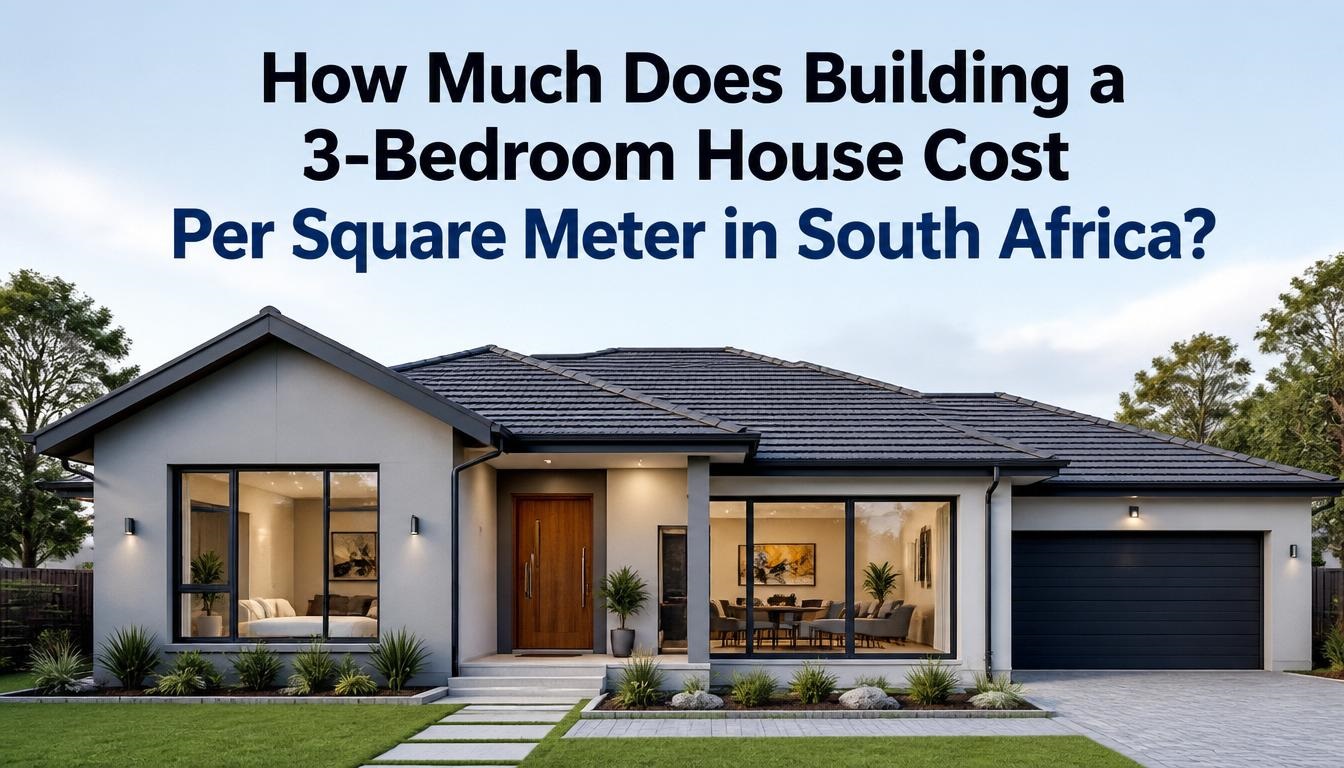
Building a home in South Africa is one of the most rewarding journeys you can undertake, but it can also feel like a financial rollercoaster if you enter the process without clear, current numbers. Whether you are planning a modest family starter home in Polokwane, a stylish suburban residence in Midrand, or a coastal retreat in George, understanding the realistic building cost per square meter ($m^2$) is the absolute bedrock of a successful build.
If you ask five different contractors for a single rate per square meter, you will likely receive five completely different answers ranging anywhere from R7,500 to R22,000+ per $m^2$. Why is the gap so vast? Because a square meter quote means nothing without defining structural requirements, geotechnical conditions, finished specifications, professional fees, and municipal compliance costs.
This detailed guide breaks down the true, unvarnished costs of building a standard 3-bedroom house in South Africa. We combine real site experience, current market data, provincial price variances, hidden municipal expenses, and itemized material breakdowns to give you total control over your home-building budget.
The Direct Answer: 2026 Average Building Costs per $m^2$ in SA
To give you an immediate baseline before diving into the detailed breakdown, here is where South Africa’s residential construction market sits:
-
Budget / Economic Build (Basic Finishes): R7,500 to R9,500 per $m^2$
-
Standard Mid-Range Build (Quality Suburban Finishes): R10,000 to R15,000 per $m^2$
-
High-End / Luxury Build (Upmarket Estate & Custom Architecture): R16,000 to R25,000+ per $m^2$
For a standard 3-bedroom house measuring 150 $m^2$ (including 3 bedrooms, 2 bathrooms, an open-plan kitchen/living area, and a single garage), your estimated total construction cost (excluding land) ranges between R1,500,000 and R2,250,000 for mid-range finishes.
1. Understanding 3-Bedroom House Sizes & Total Project Estimates
When calculating building costs, floor area is king. In South Africa, a 3-bedroom layout can range from a compact 90 $m^2$ starter home to an expansive 250 $m^2$ double-storey estate residence.
Below is a reality check on total build costs based on size and finish tier:
Estimated Total Construction Cost Matrix (Excluding Land)
| House Size (m2) | Description / Layout | Budget Tier (R8,500/m2) | Mid-Range Tier (R13,000/m2) | Luxury Tier (R20,000/m2) |
| 100 $m^2$ | Compact 3-bed, 1.5-bath, no garage / carport | R850,000 | R1,300,000 | R2,000,000 |
| 130 $m^2$ | Standard 3-bed, 2-bath, single garage | R1,105,000 | R1,690,000 | R2,600,000 |
| 150 $m^2$ | Comfortable 3-bed, 2-bath, patio, double garage | R1,275,000 | R1,950,000 | R3,000,000 |
| 180 $m^2$ | Spacious 3-bed, 2.5-bath, scullery, double garage | R1,530,000 | R2,340,000 | R3,600,000 |
| 220 $m^2$ | Large 3-bed (all en-suite), study, covered braai patio | R1,870,000 | R2,860,000 | R4,400,000 |
Real-World Note: A standard double garage adds roughly 36 $m^2$ to 40 $m^2$ to your total floor slab. While garages are slightly cheaper per square meter to finish than living spaces (no plastering inside, basic screed floor, simple roof ceiling), contractors typically calculate the entire footprint at a single blended square-meter rate unless specifically unbundled by a Quantity Surveyor (QS).
2. Regional & Provincial Price Variations Across South Africa
Building costs are not uniform across the Republic. Material transport costs, localized labor demand, municipal tariff structures, and municipal council turnaround times create substantial price differences between provinces.
Urban areas like Johannesburg, Cape Town, and Durban command higher rates due to strict estate architectural guidelines, higher labor wages, and elevated compliance costs. Conversely, provinces like Limpopo and the North West frequently offer more cost-effective building rates due to lower labor overheads.
Provincial Average Building Cost Comparison
| Province | Average Cost per m2 (Standard Build) | Estimated Cost for a 150 m2 3-Bed House | Main Cost Drivers |
| KwaZulu-Natal | R14,500 – R15,500 | R2,175,000 – R2,325,000 | Steep site topographies, clay soil conditions, high humidity waterproofing needs |
| Gauteng | R13,000 – R14,500 | R1,950,000 – R2,175,000 | High labor demand, strict estate rules, heavy clay/dolomite ground engineering |
| Western Cape | R13,000 – R14,200 | R1,950,000 – R2,130,000 | High architectural standard demand, winter rainfall delays, expensive contractor overheads |
| Free State | R11,000 – R12,500 | R1,650,000 – R1,875,000 | Moderate labor rates, localized material availability |
| Eastern Cape | R10,500 – R12,000 | R1,575,000 – R1,800,000 | Transport logistics in rural areas, moderate coastal city pricing |
| Mpumalanga | R9,500 – R11,000 | R1,425,000 – R1,650,000 | Lower suburban overheads, competitive brick suppliers |
| Limpopo | R8,500 – R10,000 | R1,275,000 – R1,500,000 | Affordable local labor, simpler soil profiles in many regions |
| North West | R8,000 – R9,500 | R1,200,000 – R1,425,000 | Competitive construction pricing, lower entry-level labor costs |
3. Itemized Breakdown: Where Does Your Money Actually Go?
When a principal builder gives you a quote of R1,800,000 for a 150 $m^2$ house (roughly R12,000/$m^2$), where is every Rand being allocated?
The construction process is broadly divided into six primary phases:
[1. Substructure (Foundations)]  --->  [2. Superstructure (Brickwork & Frame)]
                                                    |
[4. Electrical & Plumbing]       <---  [3. Roof & Envelope]
             |
[5. Finishes & Fixtures]          --->  [6. External Works & Compliance]
Typical Cost Distribution for a Standard Brick-and-Mortar Build
| Building Stage | Percentage of Total Budget | Estimated Cost (on R1.8M Build) | What It Covers |
| 1. Substructure (Foundations & Slab) | 15% – 20% | R270,000 – R360,000 | Site excavation, trenching, steel rebar, concrete footings, soil poisoning, damp-proof membrane (DPM), ready-mix concrete slab. |
| 2. Superstructure (Walls & Shell) | 20% – 25% | R360,000 – R450,000 | Clay stock bricks / facebricks, cement mortar, lintels, internal partition walls, air vents. |
| 3. Roof Structure & Covering | 12% – 16% | R216,000 – R288,000 | Prefabricated timber trusses, concrete tiles / chromadek sheeting, underlayment, fascia boards, gutters, downpipes. |
| 4. Plumbing & Electrical First/Second Fix | 10% – 14% | R180,000 – R252,000 | Copper/PEX piping, geyser installation, DB board, wiring, light switches, plug points, sanitaryware fittings. |
| 5. Windows, Doors & External Openings | 8% – 10% | R144,000 – R180,000 | Powder-coated aluminum window frames, solid exterior timber doors, internal hollow-core doors, glazing, ironmongery. |
| 6. Plastering, Ceilings & Finishes | 18% – 22% | R324,000 – R396,000 | Plastering, rhino-board ceilings, cornices, floor/wall tiling, built-in cupboards (BIC), kitchen cabinets, interior/exterior paint. |
| 7. Contractor Profit & Site Supervision | 10% – 15% | R180,000 – R270,000 | Site manager salary, builder’s margin, site security, health & safety compliance, scaffolding rental. |
The biggest trap for first-time builders in South Africa is assuming that the builder’s square meter quote covers the total cost of moving into the house. In reality, professional fees, municipal service connections, and site prep can easily add 15% to 25% on top of your base construction cost.
If your construction quote is R1.8 Million, you should have an additional R300,000 to R400,000 reserved for administrative, legal, and site preparation fees.
1. Professional & Design Fees (SACAP & ECSA)
-
Architect / Architectural Technologist: R35,000 to R90,000+ depending on whether you use stock draughting services or full SACAP-registered custom architectural design.
-
Structural Engineer: R12,000 to R30,000. Required by law for concrete foundation design, roof truss sign-offs, and double-storey suspended slabs.
-
Quantity Surveyor (Optional but Recommended): R15,000 to R45,000. Creates a precise Bill of Quantities (BOQ) to ensure your contractor doesn’t overcharge.
2. Municipal & Statutory Compliance
-
Municipal Plan Submission Fees: R5,000 to R18,000 depending on your local council (e.g., City of Johannesburg, City of Cape Town, eThekwini).
-
NHBRC Registration (National Home Builders Registration Council): Roughly 0.55% of the total build value (e.g., R9,900 on an R1.8M project). Mandatory by South African law for any bond approval or residential build.
-
Geotechnical Soil Test: R6,000 to R14,000. Essential to determine if your land has active clay, collapsing sand, or rock, which dictates foundation thickness.
3. Service Connections & Off-Grid Utility Prep
-
Eskom / Municipal Electricity Connection: R15,000 to R45,000 depending on distance to transformer and three-phase needs.
-
Water & Sewage Meter Hookup: R12,000 to R25,000.
-
Solar / Backup Power Pre-Wiring: R15,000 to R80,000+ (Essential in SA to combat loadshedding or grid downtime).
-
Rainwater Harvesting Tanks (JoJo Tanks & Pump): R12,000 to R28,000 installed.
5. Standard Finishes vs. Luxury Finishes: Where the Money Goes
The single biggest lever you have in controlling your cost per square meter is your choice of finishes. Two houses with the exact same floor plan and brick structure can differ in cost by over R700,000 purely based on what is installed inside.
Materials & Finishes Cost Comparison
| Element | Budget Option (R8,000/m2) | Mid-Range Option (R13,000/m2) | High-End Option (R20,000+/m2) |
| Flooring | Ceramic tiles (R90–R150/$m^2$) or basic laminate | Porcelain tiles (R200–R400/$m^2$) or SPC Vinyl | Engineered hardwood or imported large-format porcelain (R600+/$m^2$) |
| Kitchen Countertops | Formica / Postform laminate tops | Engineered Quartz (e.g., Caesarstone / EeziQuartz) | Granite, Marble, or Premium Quartz with waterfall edges |
| Windows & Doors | Standard bronze/white aluminum slider frames | Heavy-duty powder-coated aluminum, folding-stacking doors | Thermal-break double-glazed aluminum or custom hardwood joinery |
| Roofing | Concrete double-roman tiles or corrugated IBR | Harvey tiles or quality Chromadek concealed-fix sheeting | Slate tiles, zinc standing seam, or flat concrete slab with waterproofing |
| Sanitaryware | Standard acrylic tubs, top-flush toilets, basic chrome taps | Wall-hung toilets, frameless glass showers, black/brushed brass taps | Freestanding bath, concealed shower valves, imported designer taps |
| Built-in Cupboards | Melamine interiors with impact edging | Wrapped MDF / Textured melamine with soft-close hinges | Custom veneered / duco-painted cabinetry with integrated LED lighting |
6. How to Save R150,000+ Without Compromising Structural Quality
If your initial builder quotes come back higher than your approved bank home loan or savings budget, don’t panic. You can trim costs significantly without sacrificing structural integrity by employing strategic building principles:
1. Keep the Building Envelope Simple (Rectangular vs. Complex Shapes)
Every corner, angle, indent, or overhang requires additional concrete, corner brickwork, cutting of roof tiles, and complex truss design. A clean square or rectangular floor plan is dramatically cheaper to construct per square meter than a sprawling H-shape or U-shape design with multiple roof valleys.
2. Standardize Window and Door Sizes
Custom-sized windows and oversized glass doors require bespoke manufacturing and non-standard concrete lintels. Sticking to standard catalog sizes from major South African manufacturers (like Swartland, Van Acht, or local aluminum suppliers) reduces material costs by up to 30%.
3. Use “Provisional Sums” (PC Items) Wisely
When looking at your contractor’s tender document, pay close attention to Prime Cost (PC) sums for items like light fittings, tiles, and sanitaryware. Builders often budget generous allowances. Sourcing your own tiles on promotional sale from suppliers like CTM, Builders Warehouse, or Tile Africa allows you to pocket the difference directly.
4. Build Single-Storey Unless Ground Area is Extremely Limited
Double-storey homes require engineered concrete first-floor slabs (e.g., beam-and-block systems like Echo or decking slabs), scaffolding rentals, safety netting, and expensive staircases. A single-storey 150 $m^2$ home will almost always cost 12% to 18% less per square meter than a 150 $m^2$ double-storey home.
5. Separate the Garage or Build a Carport Initially
If financing is tight, remove the brick double garage from the main house plans or convert it to a double carport. You can always add the fully enclosed garage later once your finances stabilize, saving over R150,000 on your initial construction loan.
7. Alternative Building Methods (LGS & Wood) vs. Traditional Brick
While traditional clay brick and cement blocks dominate 85% of South African residential builds, alternative building technology (ABT) systems are gaining traction due to rising cement prices and energy-efficiency standards (SANS 10400-XA).
-
Traditional Brick & Mortar:
-
Cost: R9,500 – R15,000 per $m^2$
-
Pros: Unmatched resale market trust, high thermal mass, structural durability, easy bank bond approval.
-
Cons: Slower build times (4 to 8 months), heavy water usage on site, vulnerable to rain delays.
-
-
Light Gauge Steel Framing (LGSF):
-
Cost: R8,500 – R13,500 per $m^2$
-
Pros: Up to 30% faster construction, precision engineering, excellent insulation (lower heating/cooling bills).
-
Cons: Requires specialized Agrément SA-certified installers; some South African banks require extra verification for bonds.
-
-
Nutec / Fibre Cement Wall Systems:
-
Cost: R7,000 – R11,000 per $m^2$
-
Pros: Great for granny flats or coastal cottages, low dead-weight load.
-
Cons: Lower perceived resale value in standard suburban markets compared to facebrick.
-
8. Step-by-Step Checklist for Building Your 3-Bedroom Home in SA
-
Secure Land & Verify Zoning: Check title deeds, building lines, coverage allowances, and estate guidelines before buying land.
-
Conduct Geotechnical Soil Testing: Identify ground conditions early to avoid surprise foundation costs.
-
Appoint a Registered Architectural Professional: Ensure they are registered with SACAP and draft plans that meet your exact budget limits.
-
Obtain Engineer Sign-Off & Municipal Approval: Never allow a builder to break ground before municipal approval is granted.
-
Get 3 Itemized Quotes from NHBRC-Registered Builders: Check their previous completed projects, talk to past clients, and verify their active NHBRC membership.
-
Sign a JBCC Construction Contract: Never pay large upfront lump sums. Structure payments in strict stages (Foundations, Slab, Brickwork, Roof, Plaster, Final Completion) after inspection by your bank’s valuer or your engineer.
Interactive Reader Discussion: What Is Your Building Experience?
To help other South African home builders navigate the real cost of building across different municipalities and estates, let’s turn this into an active community resource!
We want to hear from you in the comments section below:
-
If you’ve built recently: What province/city did you build in, what was your actual final cost per square meter, and did your builder stay within budget?
-
Finishes vs Structure: Did hidden expenses (like soil conditions, municipal water connections, or electrical hookups) catch you off guard?
-
Alternative methods: Are you considering Light Gauge Steel or stick-frame building, or are you sticking strictly to traditional clay brick?
Drop your questions, cost quotes, or experiences below, and our team as well as fellow community members will offer direct feedback and advice!
Summary Key Takeaways
-
Standard Cost Baseline: Expect to pay between R10,000 and R15,000 per $m^2$ for a standard mid-range 3-bedroom house in South Africa.
-
150 $m^2$ Average Cost: A typical 3-bedroom, 2-bathroom home with a garage usually totals between R1.5M and R2.2M for construction alone.
-
Add 20% Contingency: Always budget an extra 15% to 20% above your build quote to cover professional fees, municipal connections, NHBRC fees, and unforeseen ground engineering.
-
Region Matters: KZN and Gauteng tend to be pricier on average than inland provinces like Limpopo or the North West.
-
Verify Compliance: Always use NHBRC-registered builders and SACAP-registered draughtspeople to ensure your home loan is approved and your investment is protected legally.

Joseph Mathebula is a consumer analyst and market researcher at Prices in South Africa. He specializes in tracking local service costs, retail pricing, and travel budgets, helping everyday shoppers navigate the market to secure the best value.