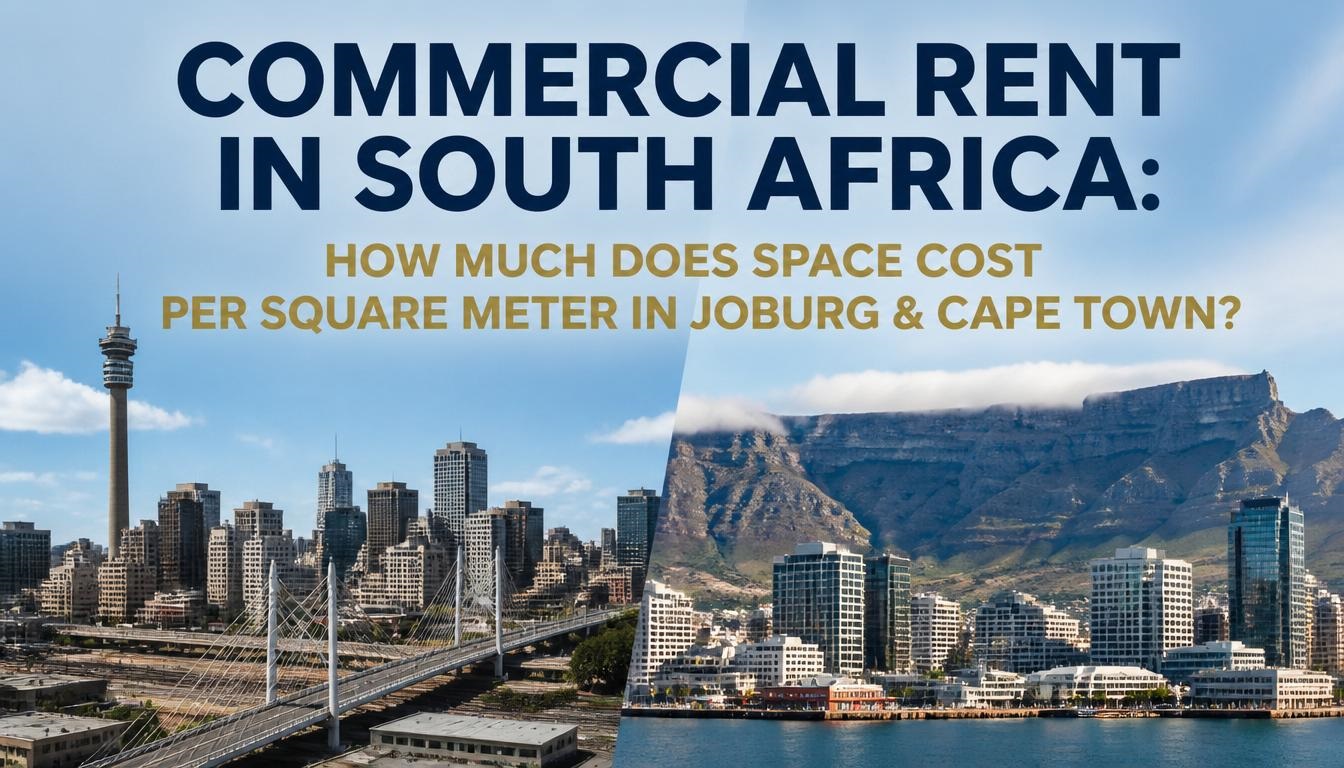
Navigating the commercial property market in South Africa requires balancing strategic location with long-term financial commitments. Whether you are expanding a tech hub, relocating a corporate team, or opening a flagship retail store, commercial rental rates vary drastically depending on the city, node, building grade, and additional operational costs.
Over the past three years, the commercial real estate landscape in South Africa has experienced a structural shift. Cape Town has seen heightened demand driven by corporate “semigration” and low vacancy rates in premier precincts like the V&A Waterfront and Foreshore. Meanwhile, Johannesburg remains Africa’s financial powerhouse, offering highly competitive rates and generous tenant incentives across key nodes such as Sandton, Rosebank, and Waterfall City.
This guide breaks down current commercial lease rates per square meter ($\text{m}^2$) across Johannesburg and Cape Town, exposes the hidden costs behind gross vs. net rentals, and provides actionable negotiation strategies to optimize your operational expenses.
Quick Reference: Average Commercial Rent Per $\text{m}^2$
All figures represent typical gross monthly rental rates (excluding VAT, utility consumption, and dedicated parking bays).
| Commercial Property Category | Johannesburg Rate Range (R/m2/month) | Cape Town Rate Range (R/m2/month) |
| Prime / Premium-Grade Office | $\text{R}180 – \text{R}260$ | $\text{R}250 – \text{R}440$ |
| Grade A Office Space | $\text{R}130 – \text{R}190$ | $\text{R}160 – \text{R}240$ |
| Grade B Office Space | $\text{R}80 – \text{R}130$ | $\text{R}110 – \text{R}160$ |
| Prime Destination Retail | $\text{R}250 – \text{R}600+$ | $\text{R}300 – \text{R}800+$ |
| High Street / Strip Retail | $\text{R}140 – \text{R}280$ | $\text{R}170 – \text{R}350$ |
| Light Industrial & Warehousing | $\text{R}65 – \text{R}110$ | $\text{R}85 – \text{R}145$ |
Key Market Takeaway: Cape Town currently commands a $20\%$ to $35\%$ premium over Johannesburg for Grade P and Grade A office spaces due to lower overall vacancy rates, limited prime land availability, and strong demand from international firms and domestic relocations.
Johannesburg Commercial Rent Breakdown
Johannesburg’s commercial office space remains an buyers’ and tenants’ market in several key corridors. Landlords in Gauteng frequently offer substantial Tenant Installation (TI) allowances and rent-free periods (Beneficial Occupation) to secure long-term leases.
1. Sandton Central & Rosebank
Sandton remains the premier banking and corporate center of Gauteng, though high office inventory has kept rental rates stable. Rosebank has seen surge popularity among tech companies and boutique agencies due to its walkable streets, high density of lifestyle amenities, and direct access to the Gautrain station.
-
Prime Grade (P-Grade): $\text{R}190 – \text{R}260\text{ per m}^2$
-
Grade A: $\text{R}140 – \text{R}185\text{ per m}^2$
-
Grade B: $\text{R}95 – \text{R}130\text{ per m}^2$
2. Waterfall City & Midrand
Positioned between Pretoria and Johannesburg, Waterfall City is one of Gauteng’s fastest-growing commercial nodes. It offers modern, energy-efficient corporate campuses with backup power infrastructure built directly into the base build.
-
Grade P / Modern Corporate: $\text{R}175 – \text{R}235\text{ per m}^2$
-
Grade A Office / Logistics Hubs: $\text{R}120 – \text{R}160\text{ per m}^2$
3. Johannesburg CBD & Parktown
The inner city of Johannesburg offers high-value options for non-profits, legal firms, government suppliers, and educational institutions looking for lower per-square-meter overheads.
-
Grade A / Refurbished: $\text{R}90 – \text{R}130\text{ per m}^2$
-
Grade B / Heritage Buildings: $\text{R}65 – \text{R}95\text{ per m}^2$
Cape Town Commercial Rent Breakdown
Cape Town’s commercial sector is constrained by geographic boundaries—sandwiched between Table Mountain and the ocean—which drives up commercial space valuations in core business districts.
1. V&A Waterfront & Foreshore
The V&A Waterfront represents the most expensive commercial real estate in South Africa. Blue-chip multinational consultancies, venture capital firms, and private equity offices favor this location for its high security, precinct management, and lifestyle appeal.
-
Waterfront Prime Office: $\text{R}280 – \text{R}440\text{ per m}^2$
-
Foreshore / CBD Grade A: $\text{R}160 – \text{R}250\text{ per m}^2$
-
Foreshore Grade B: $\text{R}120 – \text{R}155\text{ per m}^2$
2. Century City & Claremont (Southern Suburbs)
Century City provides a self-contained, high-security ecosystem preferred by financial services and call centers. Meanwhile, Claremont and Menlyn-style decentralised nodes in the Southern Suburbs cater to businesses seeking proximity to top schools and residential areas.
-
Century City Grade A: $\text{R}180 – \text{R}240\text{ per m}^2$
-
Claremont / Kenilworth Grade A: $\text{R}170 – \text{R}220\text{ per m}^2$
3. Montague Gardens, Epping & Paarden Eiland (Industrial & Warehousing)
Cape Town’s industrial nodes near major harbors and distribution arteries carry higher prices per square meter than Gauteng’s equivalents due to supply shortages.
-
Modern Logistics / High-Spec Warehousing: $\text{R}105 – \text{R}145\text{ per m}^2$
-
Standard Industrial / Light Manufacturing: $\text{R}80 – \text{R}105\text{ per m}^2$
When reviewing commercial real estate listings in South Africa, a quoted figure is almost always either a Gross Lease or a Net Lease. Misunderstanding this distinction can result in an unexpected $20\%$ to $35\%$ increase in your monthly overheads.
Gross Lease
The quoted per-square-meter rate includes the Base Net Rent plus standard operational expenses (Ops Costs) and municipal rates/taxes paid by the landlord.
Net Lease
The quoted rate covers only the space itself. You will be billed separately for operational costs, property taxes, building insurance, refuse, and security.
Line-Item Expenses to Account For:
-
Operational Costs (Ops Costs): Covers common area cleaning, building security, lift maintenance, and property management fees. Usually ranges between $\text{R}20$ and $\text{R}45\text{ per m}^2/\text{month}$.
-
Municipal Rates & Taxes Surcharges: Landlords pass on annual municipal valuation increases directly to tenants.
-
Generator & Power Backup Contributions: Due to energy reliability considerations, most Grade A buildings levy a backup generator fee (fuel usage plus maintenance pro-rated per square meter) or a solar grid contribution fee.
-
Parking Bay Rentals: Unlike international markets where parking is bundled, South African commercial properties bill parking per bay per month.
-
Joburg (Sandton/Rosebank): $\text{R}750 – \text{R}1,300\text{ per bay/month}$
-
Cape Town (CBD/Waterfront): $\text{R}1,200 – \text{R}2,100\text{ per bay/month}$
-
-
Value Added Tax (VAT): Standard $15\%$ VAT applies to all commercial leases and must be added to your final budget calculation.
-
Annual Escalation Clauses: Standard commercial leases in South Africa carry an annual rental escalation rate of $6.5\%$ to $8.0\%$.
Real-World Cost Calculation: 200 $\text{m}^2$ Office Space
To illustrate the true monthly cash outlay, let’s compare renting a modern $200\text{ m}^2$ Grade A office in Sandton (Joburg) versus Century City (Cape Town).
| Expense Item | Sandton (200 m2 Grade A) | Century City (200 m2 Grade A) |
| Quoted Gross Base Rent | $\text{R}160\text{ per m}^2 = \text{R}32,000$ | $\text{R}200\text{ per m}^2 = \text{R}40,000$ |
| Parking Bays (6 Bays Required) | $\text{R}950/\text{bay} = \text{R}5,700$ | $\text{R}1,400/\text{bay} = \text{R}8,400$ |
| Generator / Utilities Surcharge (Est.) | $\text{R}15\text{ per m}^2 = \text{R}3,000$ | $\text{R}12\text{ per m}^2 = \text{R}2,400$ |
| Subtotal (Excl. VAT) | $\text{R}40,700/\text{month}$ | $\text{R}50,800/\text{month}$ |
| VAT ($15\%$) | $\text{R}6,105$ | $\text{R}7,620$ |
| Total Monthly Cash Outlay | $\text{R}46,805$ | $\text{R}58,420$ |
Takeaway: Even if base rental rates appear similar at first glance, parking costs and localized precinct levies can create a significant monthly difference between cities.
Strategic Negotiation Tips for Commercial Tenants
-
Leverage the Tenant Installation (TI) Allowance:
Landlords in high-vacancy areas like Johannesburg often offer a TI allowance equal to 1 to 3 months of base rent per year of the signed lease (e.g., a 5-year lease might yield 15 months of TI budget). Use this allowance to cover drywalling, IT cabling, air conditioning retrofitting, and flooring.
-
Negotiate Beneficial Occupation (BO):
Request a 30 to 60-day Rent-Free Beneficial Occupation period prior to lease commencement. This allows your contractors to complete fit-outs and install networking gear without paying double rent while transitioning out of your old premises.
-
Cap the Annual Escalation Rate:
While property brokers often present $8\%$ annual escalation as “standard,” aim to cap escalation at $6.0\%$ to $6.5\%$, aligning closer to inflation targets. Over a 5-year lease, a $1.5\%$ difference in annual escalation saves substantial capital.
-
Audit Parking Allocation Ratios:
Ensure the landlord grants an adequate parking ratio—typically 3 to 4 bays per $100\text{ m}^2$ of leased space. In central Cape Town or Sandton, securing guaranteed bays upfront is critical before signing.
What Is Your Experience in the South African Commercial Property Market?
Renting commercial space is one of the largest operational decisions a business makes in South Africa. Rates can fluctuate significantly depending on immediate precinct vacancy rates and economic conditions.
-
Are you currently looking for space in Joburg or Cape Town?
-
What rental rates per square meter are brokers quoting you in your specific sector?
-
If you recently negotiated a commercial lease, were you able to secure a rent-free period or higher TI allowance?
Drop your thoughts, current landlord quotes, or questions in the comments below! Share your insights to help fellow South African business owners compare actual market rates and negotiate better terms.

Joseph Mathebula is a consumer analyst and market researcher at Prices in South Africa. He specializes in tracking local service costs, retail pricing, and travel budgets, helping everyday shoppers navigate the market to secure the best value.