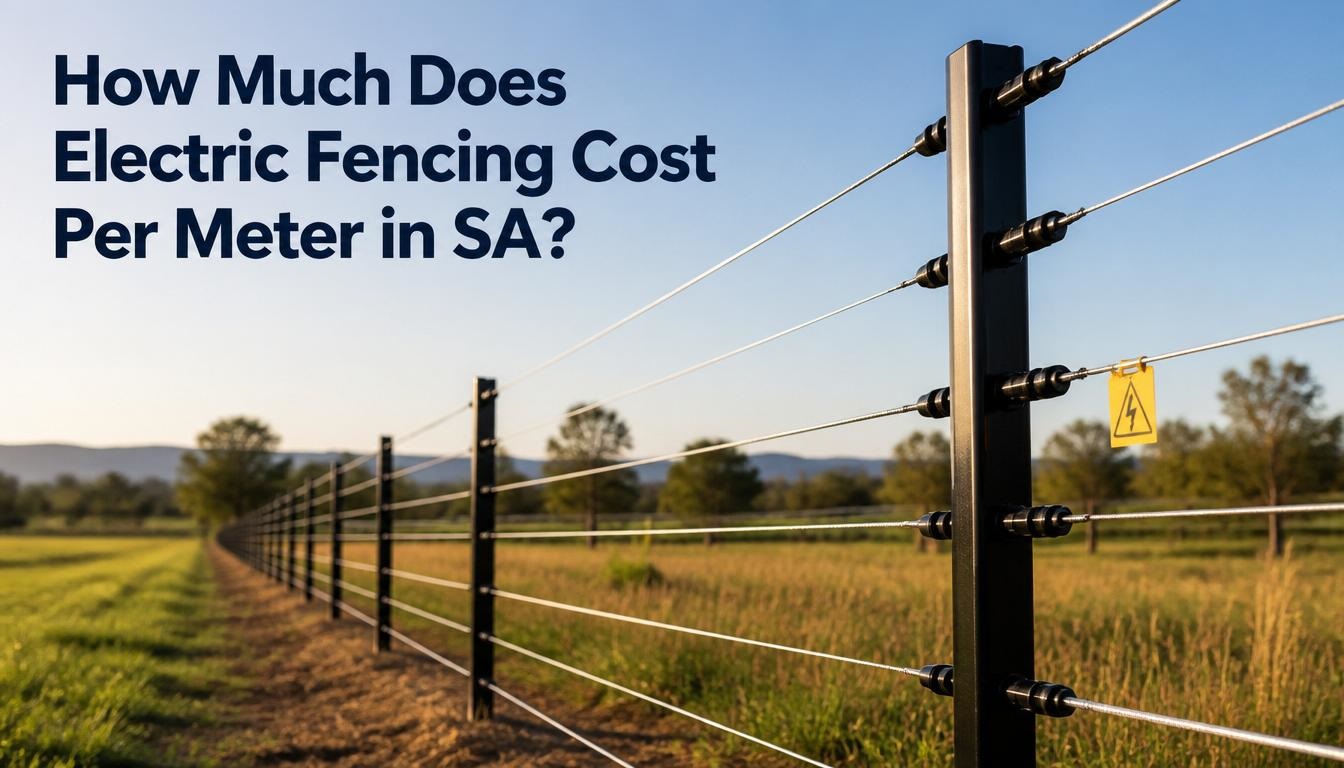
Securing a property in South Africa is no longer just an upgrade—it is a baseline requirement for peace of mind. Whether you are fortifying a suburban home in Sandton, securing a complex in Cape Town, or protecting a commercial perimeter in Durban, electric fencing remains your primary physical and psychological deterrent.
However, when you start requesting quotes from security contractors, the pricing can seem wildly inconsistent. One installer quotes R110 per meter, while another quotes R350 per meter for what seems like the exact same boundary wall.
As someone who has spent years testing perimeter security tech, smart home integrations, and remote GSM communicators across South African residential homes, I can tell you that the difference lies in the details: strand density, energizer capacity, bracket quality, load shedding backup, and legal compliance.
On average, installed electric fencing in South Africa costs between R100 and R400 per meter. However, a standard 6-strand wall-top installation typically sits around R105 to R130 per meter, while heavy-duty free-standing 18-to-30-strand perimeter fencing ranges from R215 to R395 per meter.
In this comprehensive, non-generic 2026 cost guide, we break down every single rand you will spend, including hardware, labor, smart app integrations, battery backup systems, and mandatory Certificate of Compliance (CoC) fees.
At-a-Glance: Electric Fencing Cost Breakdown per Meter (2026 Pricing)
Before diving into specific hardware, here is a quick snapshot of what you can expect to pay per linear meter across different fence configurations in South Africa. These figures include basic hardware and standard installation labor.
| Fence Type | Strand Count | Height / Spec | Cost per Meter (Under 100m) | Cost per Meter (200m+) |
| Wall-Top (Angled/Straight) | 6 Strands | 600 mm | R105 – R120 /m | R85 – R100 /m |
| Wall-Top (Standard Security) | 8 Strands | 800 mm | R120 – R150 /m | R105 – R125 /m |
| Wall-Top (High Security) | 10–12 Strands | 1000–1200 mm | R145 – R175 /m | R125 – R155 /m |
| Free-Standing (Medium) | 18 Strands | 1.8 meters | R215 – R300 /m | R200 – R250 /m |
| Free-Standing (High) | 24 Strands | 2.4 meters | R275 – R350 /m | R255 – R310 /m |
| Piggy-Back / Industrial | 30 Strands | 3.0 meters | R315 – R400 /m | R295 – R370 /m |
Pro Installer Insight: Electric fence installation costs benefit from economies of scale. Contractors have fixed setup costs (transport, tools, basic cabling runs). Consequently, fencing a 200m+ perimeter drops the per-meter labor and component cost by 10% to 20% compared to a small 20m townhouse job.
Detailed Cost Analysis: Wall-Top vs. Free-Standing Systems
Understanding the fundamental structural difference between wall-top and free-standing installations is crucial to budgeting effectively.
1. Wall-Top Electric Fencing (R105 – R175 per meter)
Wall-top systems are mounted onto existing masonry walls, precast concrete walls, or palisade fencing. Because the existing wall provides the physical height and structural barrier, wall-top electric fences only need lighter square tubing or flat bar brackets (angled or straight) to hold tensioned stainless steel or galvanized wire.
-
Best For: Suburban residential homes, townhouse complexes, and retail properties.
-
Why it’s cheaper: Requires fewer raw materials, smaller posts, less earth drilling, and less wire per meter.
-
Average 8-strand residential setup: R130 per meter (excluding energizer and CoC).
2. Free-Standing Electric Fencing (R215 – R400 per meter)
Free-standing fences do not rely on an existing wall. Steel posts are cemented directly into the ground, and 18 to 30 strands of wire are strung from top to bottom. This creates both a physical boundary and an electrified barrier simultaneously.
-
Best For: Agricultural holdings, plot perimeters, gated estates without boundary walls, and industrial warehouses.
-
Why it costs more: Requires heavy steel strainer posts, concrete footings, higher tensioning hardware, significantly more wire, and extensive ground labor.
-
Average 18-strand freestanding setup: R250 per meter.
Essential Components & Hardware Price Breakdown
When contractors quote you, the “per-meter” rate usually covers brackets, wire, bobbins, spring hooks, and basic labor. However, every functioning system requires core electronic hardware that is priced separately as fixed costs.
Here is a breakdown of what individual components cost in South Africa:
1. Electric Fence Energizers (R2,500 – R7,500)
The energizer is the heart of your security system, converting mains power into high-voltage DC pulses (typically between 5,000V and 10,000V). Brands like Nemtek, JVA, and Stafix (Tru-Test) dominate the South African market due to their reliability and availability of spare parts.
| Brand & Model | Joules Output | Typical Use Case | Estimated Price (Excl. VAT) |
| Nemtek Wizord 4i | 3.7 Joules | Small to Medium Wall-Top (Up to 80m perimeter) | R2,500 – R2,900 |
| Merlin Stealth M18S / M28S | 7.6 Joules | Medium Residential / Dual Zone Option | R3,800 – R4,500 |
| JVA Z18 Single Zone | 8.0 Joules | Large Residential / Commercial | R4,200 – R5,000 |
| Nemtek Druid 114 LCD | 14.0 Joules | High-Security Estates / Industrial Properties | R5,500 – R7,500 |
2. Backup Battery & Power Systems (R450 – R3,800)
With South Africa’s ongoing power grid challenges, a dead battery means a dead fence—leaving your property vulnerable.
-
Standard 12V 7Ah Lead-Acid / Gel Battery (R450 – R700): Provides approximately 6 to 12 hours of backup power depending on fence condition and energizer draw. However, repeated deep discharges during load shedding quickly degrade lead-acid batteries within 6 to 12 months.
-
12V 7Ah / 12Ah Lithium Iron Phosphate (LiFePO4) Battery (R850 – R1,600): Highly recommended. Lasts 3,000+ discharge cycles, charges rapidly between load shedding slots, and maintains consistent voltage.
-
Solar-Powered Energizer Conversion Kit (R2,500 – R6,000): Includes a 50W–140W solar panel, solar MPPT charge controller, and deep-cycle battery. This guarantees 24/7 off-grid fence operation regardless of Eskom power outages.
3. Brackets, Wire & Accessories
| Hardware Item | Description / Spec | Average Price (ZAR) |
| SMK / Nemtek 6-Line Angled Bracket | Black powder-coated or galvanized steel | R95 – R139 each |
| SMK / Nemtek 8-Line Square Bracket | Heavy-duty square tube bracket | R139 – R169 each |
| 316 Marine Grade Stainless Steel Wire | 1000m roll (Best for coastal regions like CT/Durban) | R1,800 – R2,500 |
| Galvanized / High-Tensile Steel Wire | 1000m roll (Ideal for inland dry climates like JHB/PTA) | R1,100 – R1,600 |
| Heavy-Duty Tension Springs | Stainless steel springs (maintains wire tension) | R15 – R25 each |
| Earth Spikes & Clamps | 1.2m copper/galvanized ground spikes (Crucial for shock) | R80 – R130 each |
| High-Voltage HT Cable (Undergate Cable) | Double insulated 50m roll | R400 – R650 |
Smart Integration: Mobile Phones, Keypads & Remote Monitoring
Modern South African homeowners no longer rely solely on a standard key switch or siren to monitor their perimeter. Integrating your electric fence with your smartphone adds a critical layer of real-time control.
How Smart Mobile Monitoring Elevates Perimeter Security
By pairing your energizer (such as a Nemtek Druid or JVA Z-series) with a GSM module or Wi-Fi smart communicator, you gain access to immediate smartphone notifications:
-
Instant Push & SMS Alerts: Receive instantaneous alerts for specific events: Fence Alarm (Cut Wire), Tamper Alarm, Mains Power Failure, or Low Battery Warning.
-
Remote Arming & Disarming: Turn the fence off directly from your phone when garden maintenance crews arrive, or re-arm it if you forgot after leaving home.
-
Zone Identification: On dual-zone energizers, your phone app tells you exactly which side of the property was triggered (e.g., “Zone 2: Back Garden Fence Triggered”).
-
Integration with Armed Response: GSM communicators can simultaneously alert your private armed response company (e.g., ADT, Fox, Fidelity ADT, Seven Day Security) the moment voltage drops below 3.0kV.
Smart Add-On Costs:
-
Wi-Fi / IP Smart Energizer Communicator: R1,200 – R2,200
-
GSM SIM Communicator (4G / LTE): R1,800 – R3,200 (Requires active SIM airtime/data)
-
Smart App Integration Setup Fee: R800 – R1,500 (Labor & programming)
Legal Requirements in South Africa: SANS 10222-3 & Certificate of Compliance (CoC)
Installing an electric fence is not a simple DIY project you can complete on a weekend without legal consequences. In South Africa, electric fences are legally governed by the Electrical Machinery Regulations (2011) and SANS 10222-3 safety standards.
Crucial Warning: If your electric fence causes accidental injury or property damage and does not have a valid Certificate of Compliance (CoC), your home insurance claim will be rejected, and you can face civil liability.
Key Legal Rules You Must Follow:
-
Minimum Wall Height: On private residential properties, the lowest wire on a wall-top fence must be at least 1.5 meters above ground level to prevent accidental contact by pedestrians on sidewalk paths.
-
Angled Brackets: Must be angled inward toward your property, not extending over your neighbor’s property line or the public sidewalk.
-
Warning Signs: Yellow regulatory warning signs (100mm x 200mm with the black hand/lightning symbol) must be installed at all entry gates and positioned every 10 meters along the perimeter line.
-
Registered Installer: A CoC can only be issued by an installer registered with the Department of Employment and Labour (holding an EFSI – Electric Fence System Installer certification).
Certificate of Compliance (CoC) Cost:
-
CoC Inspection & Certificate Fee: R1,200 – R2,500
-
If your existing fence fails inspection due to loose wires, bad earthing, or missing warning signs, repair costs to bring it up to standard usually range between R800 and R3,000.
Real-World Cost Examples (3 Typical South African Scenarios)
To give you a realistic budget forecast, here are three end-to-end installation scenarios calculated with current materials and labor rates in Gauteng, Western Cape, and KwaZulu-Natal.
Scenario A: Suburban Townhouse Wall-Top Installation (30-Meter Perimeter)
-
Configuration: 8-Strand Wall-Top Angled Brackets, 316 Stainless Steel Wire
-
Fencing Hardware & Labor (30m x R130/m): R3,900
-
Energizer: Nemtek Wizord 4i (3.7 Joules): R2,700
-
Battery: 12V 7Ah LiFePO4 Lithium Battery: R950
-
Siren, Strobe Light & Earthing Spikes: R650
-
CoC Certificate: R1,500
-
Total Estimated Project Cost: R9,700 – R10,500 incl. VAT
Scenario B: Standard Freestanding Suburban House Perimeter (80-Meter Perimeter)
-
Configuration: 8-Strand Wall-Top + Gate Contact Interlock
-
Fencing Hardware & Labor (80m x R120/m): R9,600
-
Energizer: Merlin Stealth M18S (Single Zone): R3,800
-
Smart App/GSM Communicator: R2,200
-
Battery: 12V 12Ah Lithium Battery: R1,400
-
Sliding Gate Contacts & HT Cabling: R850
-
CoC Certificate & Earth Spikes: R1,800
-
Total Estimated Project Cost: R19,650 – R21,500 incl. VAT
Scenario C: Agricultural / Plot Free-Standing Perimeter (250-Meter Perimeter)
-
Configuration: 18-Strand Free-Standing Heavy-Duty Posts
-
Fencing Hardware & Labor (250m x R215/m – Bulk rate): R53,750
-
Energizer: JVA Z18 Dual Zone (8 Joules): R4,800
-
Solar Power Setup: 100W Panel + MPPT Charger + 50Ah Deep Cycle Battery: R4,500
-
Heavy Duty Strainers & Ground Hole Concrete: R3,800
-
CoC Inspection & Legal Signage: R2,000
-
Total Estimated Project Cost: R68,850 – R72,500 incl. VAT
How to Avoid Getting Scammed or Overpaying
-
Verify Registration: Always ask the installer for their EFSI Registration Number. Unregistered handymen cannot legally issue a CoC.
-
Insist on Stainless Steel Wire for Coastal Regions: If you live within 15km of the ocean (Cape Town, Durban, Port Elizabeth, Garden Route), insist on 316 Marine Grade Stainless Steel wire. Galvanized wire will rust within 18–24 months near salt air. Inland regions (Gauteng, Free State) can safely use high-tensile galvanized wire.
-
Check the Earthing System: The most common failure point in electric fencing is poor earthing. Make sure your contractor installs at least 3 dedicated earthing spikes spaced 1.5m to 3m apart near the energizer, plus additional earth spikes every 30 meters along the fence line.
-
Upgrade to Lithium Batteries: Avoid cheap lead-acid backup batteries. Paying an extra R400–R600 upfront for a lithium (LiFePO4) battery saves you from replacing dead batteries every year due to load shedding.
Interactive Community Discussion: What Are Your Perimeter Security Experiences?
To ensure this guide continues to reflect real South African costs across different municipalities, we would love to hear from home and business owners across the country!
Share your experience in the comments below:
-
What city or neighborhood are you located in, and how much were you quoted per meter for your electric fence installation?
-
Have you upgraded your energizer battery to Lithium or Solar to handle power grid outages?
-
What smart monitoring features (app notifications, GSM alerts, armed response links) have proven most useful for your security setup?
Leave your questions and quotes below—our team and community of local security specialists are here to help review your estimates and provide expert feedback!

Joseph Mathebula is a consumer analyst and market researcher at Prices in South Africa. He specializes in tracking local service costs, retail pricing, and travel budgets, helping everyday shoppers navigate the market to secure the best value.