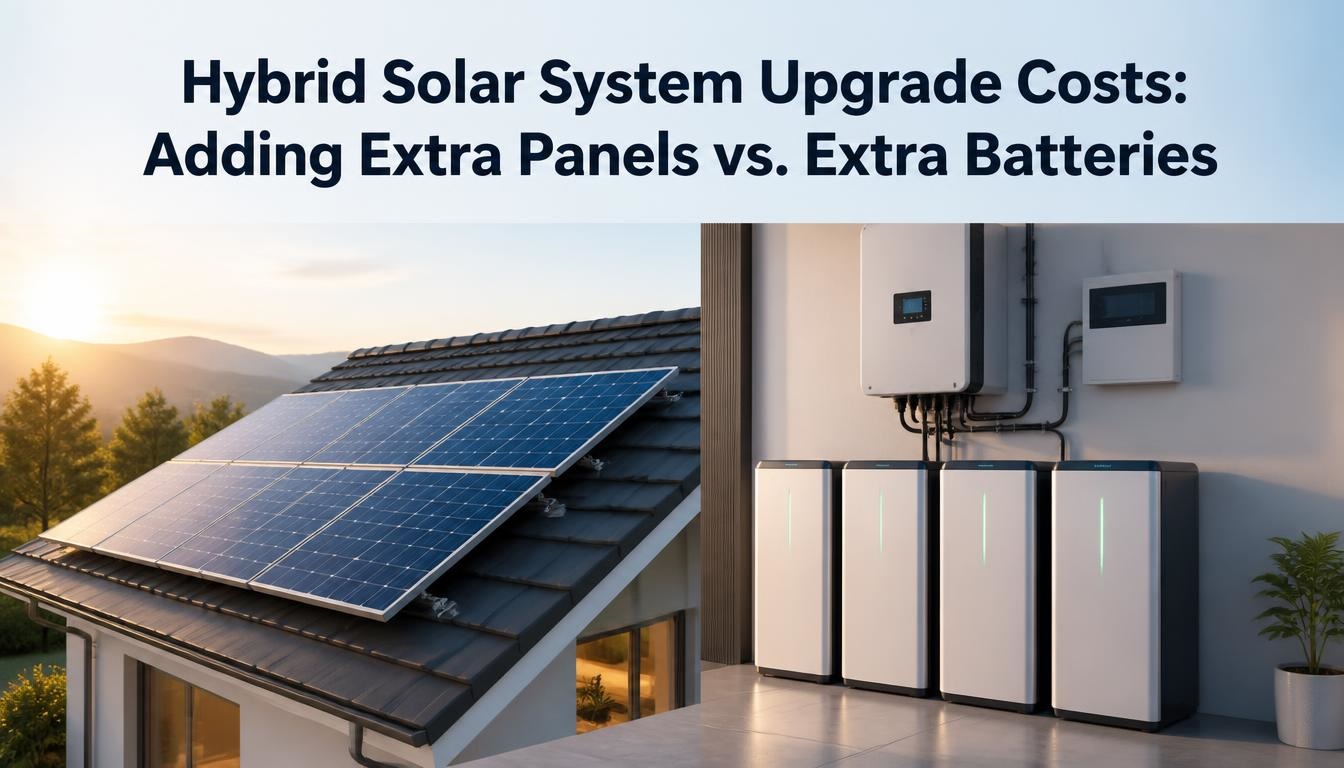
2026 ZAR Capital Outlay: R12,800 – R48,500 depending on upgrade path (PV Expansion vs. Energy Storage)
Primary Technical Surcharge Variable: Inverter MPPT Voltage Limit vs. Battery BMS Busbar / Paralleling Compatibility
Lowest Cost Entry Option: Adding 4 x 550W Tier-1 Panels from R12,800 installed (incl. mounting & mounting rails)
Core Value Recommendation: Prioritize PV expansion if daytime household consumption is high or batteries struggle to reach 100% state-of-charge before 14:00. Prioritize battery expansion if nighttime load shedding or high evening municipal tariffs drive your utility bills.
Existing hybrid solar owners in South Africa eventually hit an operational bottleneck. A standard 5kW Sunsynk, Deye, or Luxpower inverter paired with a single 5.12kWh lithium battery and a 3kWp panel array usually resolves early-stage load shedding woes. However, changing household dynamics—such as working from home, buying an electric vehicle, adding a heat pump, or facing higher Eskom municipal tariffs—force home managers to make a strategic choice: Do you install extra solar panels, or do you add another lithium battery?
Adding extra PV panels increases energy generation, whereas adding lithium storage increases energy retention. Choosing the wrong route leads to wasted capital, such as undercharged secondary batteries during cloudy winter stretches or excess solar generation clipping on fully charged banks by mid-morning.
Hybrid Solar System Expansion Costs in South Africa
The table below outlines real retail costs across South African suppliers (including Builders Warehouse, Takealot, Makro, and specialist solar stockists) for expanding an active hybrid solar installation.
| Expansion Component / Scope | Equipment Retail Cost (ZAR) | Additional Hardware & Cable (ZAR) | Qualified Electrician / Labor Fee | Total Installed Cost (Incl. VAT) |
| 4 x 550W Tier-1 PV Array Top-Up (Longi / JA Solar / Canadian Solar) | R6,800 – R8,400 | R2,500 (Roof rails, clips, 6mm² DC wire) | R3,500 – R4,500 | R12,800 – R15,400 |
| 6 x 550W Tier-1 PV Array Top-Up (Full String Expansion) | R10,200 – R12,600 | R3,800 (Roof rails, fused combiner box) | R4,500 – R6,000 | R18,500 – R22,400 |
| 5.12kWh Rack-Mount Lithium Battery (Hubble / Dyness / Shoto) | R18,500 – R24,000 | R2,200 (35mm² DC cable, KETO disconnector) | R2,500 – R3,500 | R23,200 – R29,700 |
| 5.12kWh Wall-Mount / High-Spec Battery (Freedom Won / Sunsynk / Deye) | R24,500 – R31,000 | R2,800 (Busbars, heavy-duty disconnector) | R3,000 – R4,500 | R30,300 – R38,300 |
| Combined Upgrade: 4 x 550W Panels + 5.12kWh Lithium Battery | R25,300 – R39,400 | R5,300 (Combined DC balance of plant) | R6,500 – R8,500 | R37,100 – R53,200 |
Real-World 2026 Upgrade Performance Dynamics
Choosing between panels and batteries comes down to identifying where your energy cycle is failing.
-
Problem 1: Battery empty by 21:00 with daytime load high and grid active at night
-
Solution: Option A — Extra Battery
-
Adds 5.12kWh usable capacity.
-
Extends nighttime backup through multi-stage outages.
-
Represents a higher capital cost per ZAR outlay.
-
-
Problem 2: Battery charges slowly with system idle by 11:00 AM
-
Solution: Option B — Extra Panels
-
Increases daily generation by 8kWh–12kWh.
-
Drives heavy daytime loads directly (air conditioning, pool pump, geyser).
-
Offers a lower cost per generation capacity unit.
-
Path 1: Adding Extra Solar Panels (PV Generation Expansion)
Adding panels is generally the most cost-effective way to lower monthly electricity bills if your system is under-generating during the day.
-
The Primary Advantage: Generating more kilowatt-hours during the day directly offsets high-tier Eskom or municipal tariffs. If you run air conditioners, pool pumps, washing machines, or an element-driven geyser between 09:00 and 15:00, extra solar panels feed those loads directly while ensuring your battery stays topped up.
-
The Technical Constraint: Your hybrid inverter’s MPPT (Maximum Power Point Tracker) voltage and amperage limits dictate how many extra panels you can add on a single string. A standard 5kW Deye or Sunsynk features 2 MPPTs with a max short-circuit current of 13A to 17A per MPPT. If you mismatch VOC (open-circuit voltage) or add panels with higher amp outputs to an existing series string of older panels, the inverter chokes the entire string down to the lowest-performing panel’s output.
Path 2: Adding Extra Lithium Batteries (Storage Expansion)
Adding extra battery storage targets self-sufficiency through peak evening hours and extended load shedding windows.
-
The Primary Advantage: A single 5.12kWh battery offers roughly 4.0kWh–4.5kWh of usable capacity at an 80%-90% Depth of Discharge (DoD). Paralleling a second 5.12kWh unit expands usable storage to ~8.5kWh–9.0kWh. This helps run evening entertainment setups, refrigeration, and security systems through multi-stage load shedding outages without relying on grid power.
-
The Technical Constraint: You cannot store energy you do not generate. If your current solar array yields only 12kWh on a typical sunny day and your daytime household loads consume 9kWh, you only have 3kWh of excess solar power to charge your batteries. Adding a second 5.12kWh battery in this scenario results in an undercharged secondary bank, leading to cell imbalance over time unless grid charging is enabled (which increases your Eskom bill).
Field Observations & Practical Technical Bottlenecks
The “Old Battery vs. New Battery” Paralleling Trap
When adding a second 5.12kWh lithium iron phosphate (LiFePO4) battery to an existing setup, internal resistance differences present a real-world hurdle. If your existing battery has logged over 1,200 cycles (roughly 3 years of daily load shedding use), its internal resistance will be higher than that of a brand-new module.
When connected in parallel via copper busbars, current flows faster into the new battery due to lower resistance. This can cause the new pack to carry an uneven amount of the load, potentially triggering a High Current Protection trip on its BMS (Battery Management System).
Installer Tip: When expanding a battery bank older than 24 months, update the firmware on both BMS units to ensure compatibility, charge both batteries to 100% individually before linking them in parallel, and use equal-length 35mm² or 50mm² DC power cables to balance voltage drop across the bank.
Roof Orientation & String Matching Quirks
If your original installation maxed out your north-facing roof space, adding extra panels usually requires utilizing east- or west-facing roof pitches.
-
Putting new panels on a different orientation on the same MPPT string will drastically degrade generation across the entire array.
-
Ensure new panels are installed on a dedicated, unused MPPT tracker on your inverter, or install microinverters for the expansion array.
-
Modern 550W–600W panels feature higher short-circuit currents (~13A–14A). Linking these with older 330W–380W panels (~9A–10A) on the same DC circuit clamps the output of the new panels down to the performance of the older units.
Retailer Pricing & Local Stockist Breakdown
Components for solar upgrades are available at major retail chains and specialized trade distributors across South Africa:
-
Major Chains (Builders Warehouse / Makro): Offer high convenience and off-the-shelf purchasing, but feature higher retail margins (R6.30–R8.50 per watt) alongside standard consumer delivery and pickup options.
-
Specialist Solar Wholesalers: Offer significantly lower per-watt hardware costs (R3.50–R5.00 per watt), but generally require an active trade account or installer link to purchase at trade counters.
Solar Panel Unit Costs (500W – 560W Tier-1 Mono PERC / N-Type)
-
Builders Warehouse: R1,899 – R2,499 per panel (Retail off-the-shelf single unit pricing).
-
Makro: R1,950 – R2,399 per panel (Often sold in packs of 2 or 4 for home delivery).
-
Takealot: R1,799 – R2,299 per panel (Frequent flash deals on JA Solar and Longi stock).
-
Specialist Solar Wholesalers (e.g., Solar Warehouse SA, Rubicon): R1,350 – R1,650 per panel (Trade counter rates for bulk/installer purchases).
Lithium Battery Unit Costs (5.12kWh 48V/51.2V LiFePO4)
-
Leroy Merlin: R21,999 – R26,999 (Dyness, Hubble AM-4).
-
Takealot: R18,999 – R23,500 (Econess, Felicity, Shoto, Luxpower).
-
Makro: R22,499 – R28,999 (Sunsynk, Freedom Won eTower).
-
Specialist Distributors: R16,800 – R21,500 (Dyness BX51100, Shoto 5.12kWh).
Capital Optimization Strategies for SA Homeowners
To maximize your return on investment when upgrading an existing hybrid solar system:
-
Time Solar Upgrades Around Tax Periods: Check current SARS regulations regarding residential solar incentives. While historic Section 25C rebates applied primarily to new PV panels, keeping tax-compliant invoices from SANS-certified installers ensures eligibility for any updated residential clean energy breaks.
-
Automate Heavy Daytime Loads: Instead of buying an expensive second battery to power resistive heating loads at night, install a smart timer or Wi-Fi relay (like a Sonoff POW or Tuya switch) on your geyser and pool pump. Running these loads during peak sunlight hours costs less than expanding your battery storage.
-
Consolidate SANS 10142-1 Compliance Costs: Every time you alter your solar installation’s DC or AC wiring, your Certificate of Compliance (CoC) must be updated by a registered electrician. If you plan on adding both panels and batteries over a 12-month period, install them together to pay for a single CoC sign-off and call-out fee (saving R2,500–R4,000).
-
Opt for Busbar Combiners Early: If you plan to expand from one battery to three or four over time, avoid daisy-chaining battery terminals directly. Install a dedicated 250A DC distribution busbar box from the start. This keeps line resistance equal, prevents cable clutter, and reduces safety risks.
Frequently Asked Questions
Can I add a different brand of solar panel to my existing array?
Yes, but they should share near-identical electrical specifications (VMP, VOC, and IMP ratings) if wired on the same series string. If panel specifications differ significantly, connect the new panels as an independent string into a second, unused MPPT input on your hybrid inverter.
Can I mix different battery brands on the same hybrid inverter?
It is not recommended. Hybrid inverters communicate via CANbus or RS485 protocols with the primary battery’s BMS. Mixing brands often disrupts this communication, forcing the inverter into voltage-based charging mode. This can cause premature balancing issues or unexpected shutdowns during load shedding outages.
How do I know if my system needs more panels or more batteries first?
Check your inverter’s monitoring app (such as SolarMan, Deye Cloud, or Sunsynk Connect). If your battery reaches 100% state-of-charge by 11:00 AM but empties before bedtime, add an extra battery. If your battery struggles to reach 100% by late afternoon, add extra panels first.
Do I need a new Certificate of Compliance (CoC) after adding panels or batteries?
Yes. Modifying DC solar arrays, altering battery storage sub-distribution boards, or increasing overall system capacity constitutes a structural change under SANS 10142-1 regulations. An updated or supplementary CoC is required to keep home insurance policies valid.
Disclaimer: Prices listed in this guide reflect real-world retail rates and verified shelf prices at the time of publication. Actual store rates may fluctuate due to regional store promotions, stock availability, or installer call-out charges. Always confirm final figures directly with your preferred retailer or service provider before purchasing.
Deciding between adding extra solar panels or expanding your lithium battery bank comes down to balancing your daily energy production against your nighttime energy needs. Matching your upgrade path to your real-world usage patterns keeps costs under control while improving overall energy security.
Have you recently expanded your home’s hybrid solar setup in South Africa? Share your installer feedback, actual hardware costs, or questions in the comments below to help other homeowners make informed decisions.

Joseph Mathebula is a consumer analyst and market researcher at Prices in South Africa. He specializes in tracking local service costs, retail pricing, and travel budgets, helping everyday shoppers navigate the market to secure the best value.