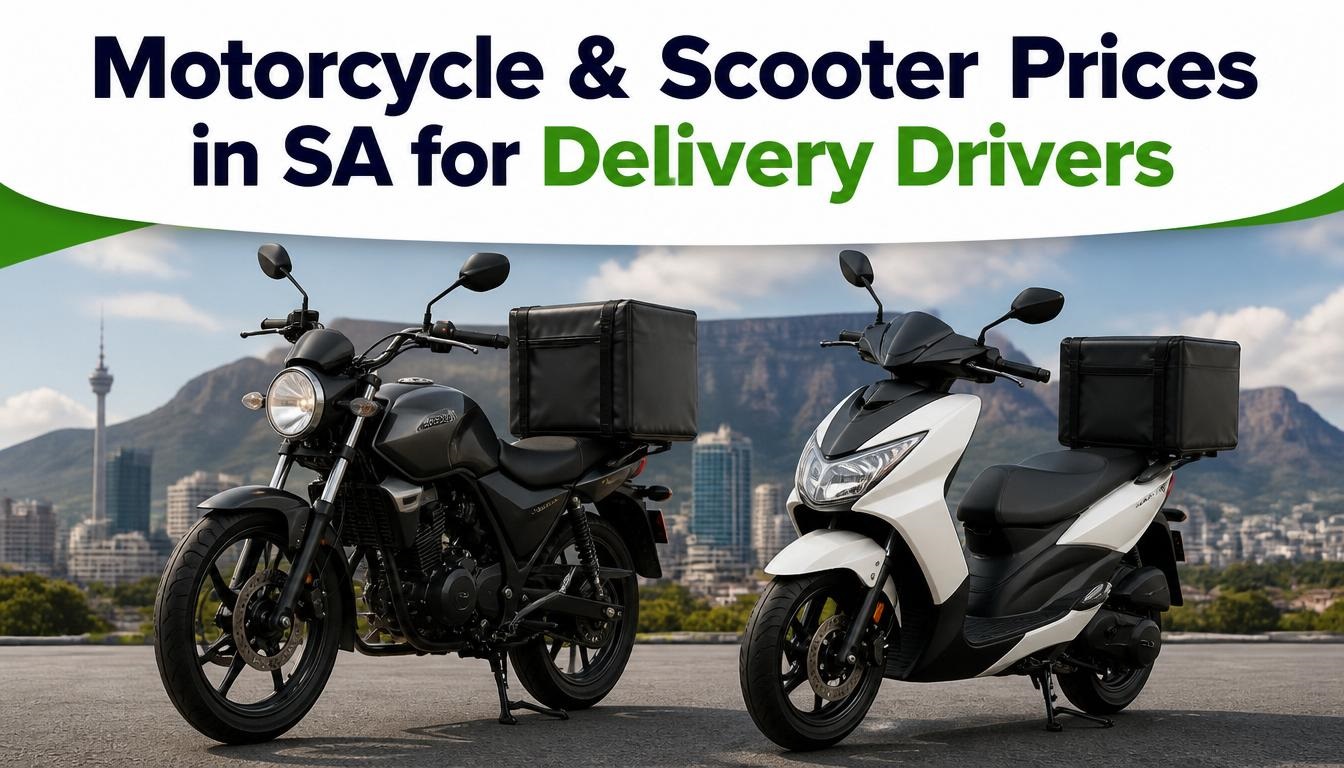
If you have spent any time navigating the congested streets of Johannesburg during afternoon rush hour, weaving through Cape Town’s coastal squalls, or climbing the steep hills of Durban, you already know one hard truth: delivery riding in South Africa is an absolute grind. Between the rising price of petrol at the pump, relentless pothole hazards, and the razor-thin profit margins on apps like Checkers Sixty60, Mr D, Uber Eats, and Bolt Food, your choice of two-wheeler can literally make or break your monthly income.
When I started evaluating commuter hardware and small-displacement fleet bikes in Mzansi, the conversation was very different. Today, every single rand counts. Buying the wrong motorcycle based on a flashy sticker price or an optimistic manufacturer brochure can leave you stranded with broken shocks, unobtainable replacement parts, or a fuel consumption rate that eats up half your daily earnings.
This guide provides an honest, field-tested breakdown of the real costs, practical specs, and day-to-day realities of buying and operating a delivery motorcycle or scooter in South Africa. Whether you are an independent driver buying your first bike or a fleet owner scaling up operations, here is everything you need to know.
1. Quick Takeaways: Choosing the Right Delivery Bike
Before diving into full technical specifications and cost analysis, here is a direct comparison of how the top delivery vehicles in South Africa rank based on operational priority:
-
Best Overall Value and Durability: Bajaj Boxer BM 150 (R21,950 – R22,990)
-
Best Ultra-Low Budget Entry: Big Boy Velocity 150 Cargo / D-Lite 125 (R17,299 – R18,999)
-
Best Fuel Efficiency & Range: SYM XS 125-K Delivery (R21,995 with 14.5L tank)
-
Best Premium / Heavy-Duty Fleet Choice: Honda Ace 125 (R24,500 – R26,500)
-
Best Automatic Twist-and-Go Scooter: Suzuki Avenis 125 / Burgman 125 (R30,950 – R33,500)
2. Buying New vs. Used: The South African Delivery Context
Before picking a model, you must decide between brand-new floor stock or a second-hand marketplace deal. In the commercial delivery sector, this decision impacts your uptime and net daily income.
Buying Brand New
-
Pros: Full manufacturer warranty (typically 2 years or 20,000 km), clean service history, zero wear on consumable parts (tyres, chain, sprockets, brake pads), and immediate platform approval.
-
Cons: Higher initial capital outlay, initial depreciation, and higher comprehensive insurance premiums.
Buying Second-Hand
-
Pros: Lower purchase cost (often 30% to 40% below retail), minimal further depreciation.
-
Cons: High risk of inherited mechanical abuse. Delivery bikes in South Africa endure high daily mileage, harsh road conditions, and minimal maintenance by previous contract riders.
Expert Field Advice: If you choose to buy used, inspect the frame alignment carefully around the steering headstock and swingarm pivot. Frame cracks from carrying heavy delivery boxes over speed bumps are common issues that sellers cover up with fresh spray paint.
3. Comprehensive Price & Performance Breakdown (2026 SA Market)
The table below breaks down current local pricing, engine displacement, estimated real-world fuel consumption, and primary platform suitabilities across top models available in South Africa:
| Make & Model | Category | Retail Price Range (ZAR) | Engine Size | Real-World Fuel Economy | Fuel Tank Size | Primary Best Use |
| Big Boy Velocity 150 Cargo | Manual Motorcycle | R17,299 – R18,499 | 149 cc | ~2.6 L / 100 km | 12.0 L | Short-haul urban delivery, strict entry budget |
| Big Boy D-Lite 125 | Automatic Scooter | R18,999 | 124 cc | ~2.8 L / 100 km | 5.5 L | Inner-city fast-food delivery, stop-start traffic |
| SYM XS 125-K Delivery | Manual Motorcycle | R21,995 | 124 cc | ~2.2 L / 100 km | 14.5 L | Long-distance suburban courier, long shift hours |
| Bajaj Boxer BM 150 | Manual Motorcycle | R21,950 – R22,990 | 144.8 cc | ~2.3 L / 100 km | 11.0 L | Heavy grocery delivery (Sixty60/Checkers), steep climbs |
| TVS HLX 150 / 125 | Manual Motorcycle | R22,500 – R24,000 | 147 cc / 124 cc | ~2.4 L / 100 km | 12.0 L | High-load cargo carrying, mixed urban terrain |
| Honda Ace 125 | Manual Motorcycle | R24,500 – R26,500 | 124 cc | ~2.1 L / 100 km | 10.0 L | High-mileage fleet operations, maximum engine longevity |
| Suzuki Burgman / Avenis 125 | Automatic Scooter | R30,950 – R33,500 | 124 cc | ~2.4 L / 100 km | 5.2 L | Premium quick-commerce, rider comfort emphasis |
4. Deep-Dive Analysis of Top Delivery Models
A. Bajaj Boxer BM 150
The Bajaj Boxer BM 150 has become an industry standard across South Africa’s courier landscape for a clear reason: pure torque and low running costs.
-
Engine & Drivetrain: 144.8 cc single-cylinder engine producing roughly 12 hp paired with a 4-speed manual gearbox.
-
Why It Works for Deliveries: The low-end torque allows you to carry heavy 20 kg+ grocery boxes up steep inclines (like Cape Town’s Kloof Nek or Johannesburg’s Northcliff) without thrashing the clutch. The heavy-duty rear frame and dual SNS (Spring-in-Spring) suspension handle corrugated backroads and heavy loads effortlessly.
-
The Drawbacks: The 4-speed transmission means the bike works hard at speeds over 90 km/h on highway stretches like the M1 or N2.
-
Ownership Cost Index: Low. Spares are widely available through nationwide dealer networks like Bikeshop Rivonia, Roodepoort Motorcycles, and local independent spares shops.
B. SYM XS 125-K Delivery
Taiwanese manufacturer SYM engineered the XS 125-K specifically with commercial logistics in mind.
-
Engine & Drivetrain: 124 cc 4-stroke air-cooled single-cylinder with a 5-speed manual gearbox.
-
Why It Works for Deliveries: Range anxiety is practically non-existent due to its massive 14.5-litre fuel tank. Combined with an impressive economy rate of roughly 2.2 L/100 km, a driver can easily cover over 600 kilometers on a single fill-up. This saves valuable time during peak lunch and dinner order rushes.
-
The Drawbacks: The 125 cc displacement requires full-throttle riding on steep highway inclines, especially when fully loaded.
-
Ownership Cost Index: Moderate to Low. Original replacement parts are affordable and readily stocked across major South African metro hubs.
C. Big Boy Velocity 150 Cargo & D-Lite 125
Big Boy remains a dominant player in South Africa’s lower-tier price segment, offering low entry costs for new drivers entering the delivery market.
-
Engine & Drivetrain: Velocity 150 features a 149 cc pushrod engine, while the D-Lite uses an automatic 125 cc CVT system.
-
Why It Works for Deliveries: The main selling point is the upfront purchase price. At roughly R17,299 for the Velocity Cargo, it requires the lowest initial capital outlay among full-sized commercial bikes in South Africa.
-
The Drawbacks: Build quality on fasteners, plastics, and electrical wiring harnesses requires closer attention. Fasteners tend to loosen from constant road vibrations, demanding regular bolt checks during weekly maintenance.
-
Ownership Cost Index: Extremely low unit prices, though service intervals must be strictly maintained to ensure longevity.
D. Honda Ace 125
Honda’s utility entry represents the gold standard for fleet durability, albeit at a higher upfront price point.
-
Engine & Drivetrain: 124 cc single-cylinder overhead valve engine built with heavy-duty internal bearings and a robust 4-speed transmission.
-
Why It Works for Deliveries: Indestructible build quality. The engine handles sub-optimal fuel quality and harsh operating conditions with minimal wear. The wide commercial seat design keeps drivers comfortable over 10 to 12-hour shifts.
-
The Drawbacks: Higher purchase price (R24,500 – R26,500) and slightly higher OEM replacement part prices compared to Indian or Chinese competitors.
-
Ownership Cost Index: Low over a 3-year period due to minimal unexpected repair downtime.
5. Total Cost of Ownership (TCO) Calculation
Many first-time drivers focus solely on the initial bike purchase price. However, in the delivery industry, ongoing operational expenses dictate your actual take-home profit.
Below is a breakdown of realistic monthly running expenses in South Africa, based on an average delivery distance of 3,500 km per month:
Estimated Monthly Operational Costs (ZAR)
-
Fuel Expense (3,500 km @ 2.4 L/100 km @ ~R22.50/L): ~R1,890
-
Routine Servicing (Oil change, valve check every 3,000–4,000 km): ~R450 (pro-rated)
-
Wear-and-Tear Reserve (Tyres, chain, sprockets, brake shoes/pads): ~R350
-
Commercial Insurance (Third-Party, Fire & Theft): ~R350 – R550
-
Tracking Unit Subscription (Required by most insurers): ~R150 – R250
-
Total Estimated Monthly Running Cost: ~R3,190 – R3,490
Calculating Net Earnings
If a full-time driver earns an average gross payout of R14,000 to R18,000 per month across platforms like Uber Eats, Mr D, and Checkers Sixty60:
-
Gross Monthly Income: R16,000
-
Less Operational Costs: -R3,300
-
Less Bike Finance / Rental Installment (if applicable): -R2,200
-
Estimated Net Take-Home Pay: R10,500
6. Critical Operational Requirements in South Africa
Operating a delivery vehicle legally and profitably in South Africa requires meeting specific statutory and platform compliance requirements.
Licensing Requirements
-
Code A1 License: Covers motorcycles and scooters up to 125 cc (minimum age 17).
-
Code A License: Covers all motorcycles exceeding 125 cc (minimum age 18).
-
K53 Test Reality: Driving with a learner’s license (Code 1) allows you to ride on public roads, but most major delivery platforms now strictly require a full Code A/A1 driver’s license to complete onboarding.
Insurance & Tracking Requirements
Standard personal motor vehicle insurance policies do not cover commercial delivery activities. If you crash while carrying a delivery box or executing an active order, a personal claim will be rejected immediately.
-
Commercial Delivery Cover: Ensure your policy specifically explicitly lists “commercial courier / food delivery delivery usage.”
-
Tracking Device: Due to high rates of vehicle theft and hijackings in urban centers like Johannesburg, Pretoria, and Durban, insurers mandate an approved GPS tracking unit installation (e.g., Matrix, Cartrack, Netstar).
Delivery Box Mounting & Weight Distribution
-
Weight Limits: Never exceed 25 kg inside a rear-mounted top box. Overloading the rear rack changes the bike’s center of gravity, causing front wheel lightness, unsafe head-shake at high speeds, and premature frame cracking.
-
Subframe Reinforcement: Standard passenger handrails are not designed to support dynamic delivery loads. Fit a dedicated tubular steel delivery bracket mounted directly to the main subframe.
7. Delivery Bike Maintenance Schedule
To avoid costly mechanical breakdowns during peak operating hours, follow this practical maintenance protocol designed for South African road conditions:
| Interval | Component | Required Action |
| Daily (Pre-Ride) | Engine Oil Level | Check dipstick on level ground; top up if low. |
| Tyre Pressure | Front: 2.0 bar (29 PSI), Rear: 2.4 bar (35 PSI when loaded). | |
| Lights & Indicators | Test brake light, headlight, and turn indicators for night visibility. | |
| Weekly | Drive Chain | Clean off grime, adjust tension (20–30mm slack), and apply chain lube. |
| Fasteners & Bolts | Inspect rear rack bolts, exhaust mounts, and footpeg brackets. | |
| Every 3,000–4,000 km | Engine Oil & Filter | Drain old engine oil, replace oil filter/clean oil strainer screen. |
| Air Filter | Inspect and blow out dust with compressed air; replace if heavily dirty. | |
| Every 8,000–10,000 km | Spark Plug & Valves | Check/adjust valve clearances (0.05–0.08mm typical) and replace spark plug. |
| Brake Linings | Measure front pad thickness and inspect rear drum brake shoe wear indicators. |
8. Frequently Asked Questions (FAQs)
What is the most fuel-efficient delivery motorcycle in South Africa?
The SYM XS 125-K and Honda Ace 125 consistently deliver real-world fuel consumption rates of around 2.1 to 2.2 litres per 100 km under normal riding conditions.
Can I do delivery work on a 125cc scooter with an automatic transmission?
Yes, automatic scooters like the Big Boy D-Lite 125 or Suzuki Avenis 125 are popular for dense urban inner-city routes. However, manual motorcycles with larger wheels (17-inch or 18-inch) handle deep potholes and high-speed freeway connectors significantly better than small-wheeled (10-inch or 12-inch) scooters.
How much does commercial delivery motorcycle insurance cost in South Africa?
Basic third-party, fire, and theft commercial insurance generally ranges from R350 to R550 per month, depending on your age, driving record, and primary operating city.
Is finance available for delivery bikes in South Africa?
Yes, major motorcycle dealers offer vehicle finance through institutions like Absa, Nedbank, or specialized fleet financiers. However, buyers typically need a valid South African ID or work permit, proof of income/bank statements, and a clean credit profile. Rent-to-own programs are also available through specialized delivery fleet companies.
Interactive Discussion: What’s Your Field Experience?
If you are currently delivering on South African roads, which bike or scooter are you using, and what real-world fuel consumption and reliability issues have you experienced? Are you finding Chinese, Indian, or Japanese brands more cost-effective in your city?
Drop your comments, maintenance tips, and questions below to help fellow drivers make informed decisions!

Joseph Mathebula is a consumer analyst and market researcher at Prices in South Africa. He specializes in tracking local service costs, retail pricing, and travel budgets, helping everyday shoppers navigate the market to secure the best value.