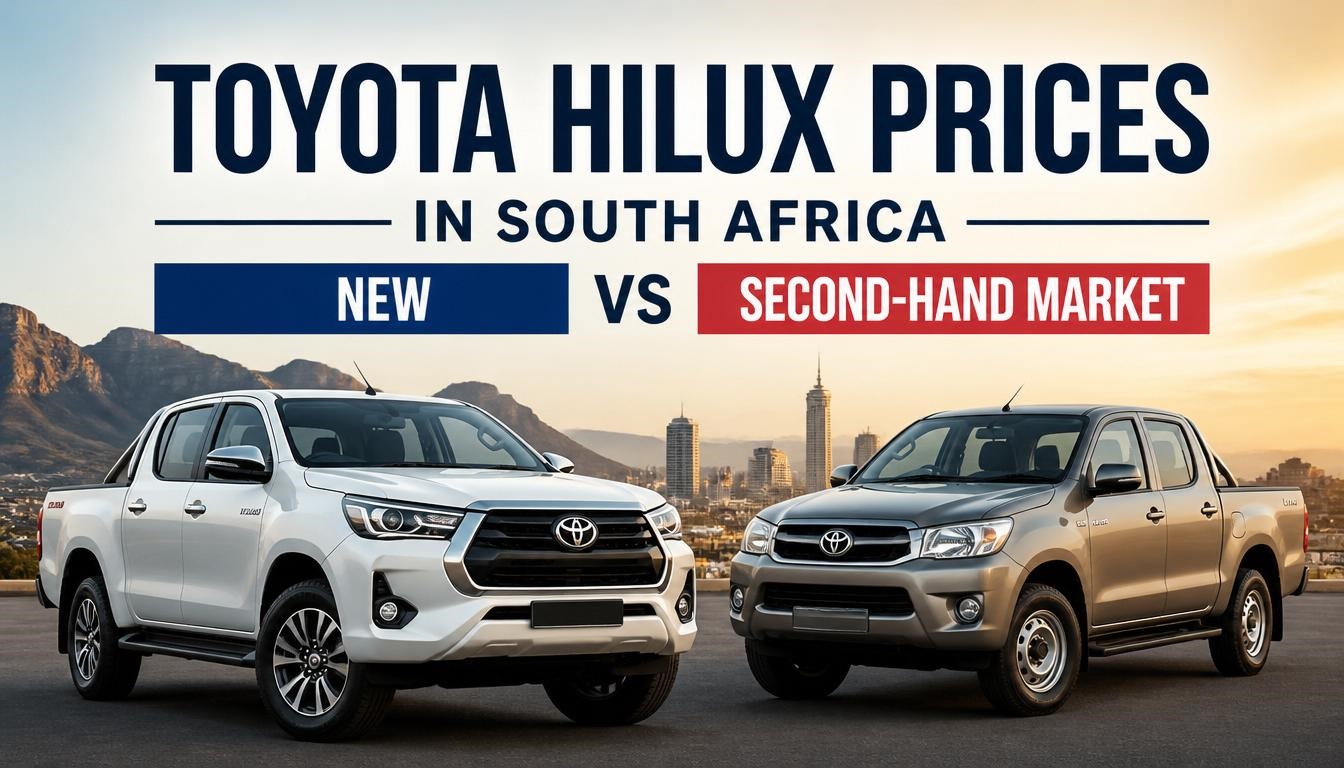
When you stand on a farm in the Free State, navigate a tight construction site in Sandton, or tackle an off-road trail in the Western Cape, one vehicle dominates the South African landscape: the Toyota Hilux. In South Africa, the Hilux is more than just a light commercial vehicle; it is a parallel currency. It holds its monetary value with a tenacity that bewilders financial advisors and gives second-hand buyers both confidence and headaches.
However, as vehicle financing interest rates remain high and factory sticker prices cross significant financial thresholds, South African buyers face a major decision: Should you purchase a brand-new Toyota Hilux off the showroom floor with a factory warranty, or buy a second-hand GD-6 or D-4D model in the pre-owned market?
This guide provides an expert breakdown of current 2026 pricing for both brand-new and pre-owned Toyota Hilux models in South Africa. We examine trim levels, real-world depreciation curves, hidden ownership costs, mechanical reliability across engine generations, and the exact financial trade-offs between new and pre-owned ownership.
2026 New Toyota Hilux Pricing Breakdown
Buying a brand-new Toyota Hilux guarantees factory peace of mind, access to the latest safety technologies (such as Toyota Safety Sense 3.0), and a standard 3-year/100,000 km warranty paired with a 9-service/90,000 km service plan. However, the new bakkie market spans a broad price spectrum, ranging from entry-level single-cab workhorses to high-performance, mild-hybrid double-cabs.
Below is the official pricing structure for new Hilux models across South African dealerships:
1. Single Cab Workhorse Models
Designed primarily for agricultural, fleet, and small-business operations, single-cab models prioritize load bed capacity and mechanical simplicity over luxury.
-
Hilux 2.0 VVT-i Single Cab S (Manual): R379,700
-
Hilux 2.4 GD Single Cab Flat Deck (Manual): R440,100
-
Hilux 2.4 GD-6 Single Cab SR 4×4 (Manual): R589,600
-
Hilux 2.8 GD-6 Single Cab Raider 4×4 (Automatic): R730,500
2. Xtra Cab (Extended Cab) Models
The Xtra Cab offers an extended cabin with extra storage space behind the front seats, making it a popular choice for contractors, tradespeople, and lifestyle buyers who need a long load deck alongside secure interior cabin storage.
-
Hilux 2.4 GD-6 Xtra Cab Raider (Manual): R574,500
-
Hilux 2.8 GD-6 Xtra Cab Raider X 4×2 (Automatic): R751,800
-
Hilux 2.8 GD-6 Xtra Cab Raider X 4×4 (Automatic): R842,200
3. Double Cab Lifestyle & Utility Models
Double cabs dominate the family and leisure market in South Africa. They range from work-oriented utility double cabs to high-spec luxury cruisers featuring 48V V-Active mild-hybrid technology.
-
Hilux 2.7 VVT-i Double Cab RB S (Manual): R534,100
-
Hilux 2.4 GD-6 Double Cab Raider 4×2 (Manual): R624,900
-
Hilux 2.8 GD-6 Double Cab SRX 4×2 (Automatic): R658,500
-
Hilux 2.4 GD-6 Double Cab Raider 4×4 (Automatic): R730,700
-
Hilux 2.8 GD-6 Double Cab Raider 4×4 (Automatic): R892,900
-
Hilux 2.8 GD-6 48V Double Cab Legend 4×2 (Automatic): R945,500
-
Hilux 2.8 GD-6 48V Double Cab Legend 4×4 (Automatic): R999,900
-
Hilux 2.8 GD-6 Double Cab GR-Sport / Top-Tier Specs: R1,050,000 – R1,278,200 (depending on specialized trim/BEV build variations)
Brand-New Toyota Hilux Range: Specifications & Price Comparison
| Trim Level | Engine & Fuel | Power / Torque | Transmission | Drive Type | Recommended Price (ZAR) |
| 2.0 S Single Cab | 2.0L Petrol | 102 kW / 183 Nm | 5-Speed Manual | 4×2 | R379,700 |
| 2.4 GD-6 Raider Single Cab | 2.4L Turbodiesel | 110 kW / 400 Nm | 6-Speed Manual | 4×2 | R553,800 |
| 2.4 GD-6 Raider Double Cab | 2.4L Turbodiesel | 110 kW / 400 Nm | 6-Speed Manual | 4×2 | R624,900 |
| 2.8 GD-6 SRX Double Cab | 2.8L Turbodiesel | 150 kW / 500 Nm | 6-Speed Auto | 4×2 | R658,500 |
| 2.8 GD-6 Raider X Xtra Cab | 2.8L Turbodiesel | 150 kW / 500 Nm | 6-Speed Auto | 4×4 | R842,200 |
| 2.8 GD-6 Raider Double Cab | 2.8L Turbodiesel | 150 kW / 500 Nm | 6-Speed Auto | 4×4 | R892,900 |
| 2.8 GD-6 48V Legend Double Cab | 2.8L Mild Hybrid Turbodiesel | 150 kW + 12 kW Assist | 6-Speed Auto | 4×2 | R945,500 |
| 2.8 GD-6 48V Legend Double Cab | 2.8L Mild Hybrid Turbodiesel | 150 kW + 12 kW Assist | 6-Speed Auto | 4×4 | R999,900 |
Second-Hand Toyota Hilux Market Analysis in South Africa
The pre-owned bakkie market in South Africa operates under unique conditions. While most passenger vehicles lose 20% to 30% of their retail value in their first year, a well-maintained Toyota Hilux depreciates far more slowly. Demand remains consistently high across private buyers, commercial fleets, cross-border traders, and agricultural enterprises.
To understand pre-owned pricing, we must categorize the second-hand market into distinct generation and mileage brackets.
Bracket 1: Legacy Generation 7 (2005–2015) — The 3.0 D-4D and 2.5 D-4D Era
The Generation 7 Hilux built the legendary reputation for durability that Toyota enjoys today. Models equipped with the 3.0 D-4D (1KD-FTV) engine remain sought after in the pre-owned market.
-
2008–2012 Single Cab 2.5/3.0 D-4D (200,000+ km): R140,000 – R210,000
-
2010–2014 Double Cab 3.0 D-4D Raider 4×2 (180,000 – 280,000 km): R220,000 – R290,000
-
2013–2015 Double Cab 3.0 D-4D Legend 45 4×4 (150,000 – 230,000 km): R295,000 – R365,000
Expert Market Take: The 3.0 D-4D is mechanically robust and simpler to service than modern common-rail diesels fitted with complex emissions systems. However, buyers must budget for potential maintenance items, including injector replacements, turbocharger checks, and clutch overhauls on manual models. Theft risk on Gen 7 models remains high due to older key encryption, making an aftermarket tracking unit and gear lock essential.
Bracket 2: Early Generation 8 (2016–2020) — Introduction of GD-6 Engines
In 2016, Toyota introduced the Generation 8 Hilux, replacing the D-4D engines with the 2.4 GD-6 (2GD-FTV) and 2.8 GD-6 (1GD-FTV) turbodiesel platforms. These models featured improved cabin refinement, higher torque figures, and stiffer chassis designs.
-
2016–2018 Single Cab 2.4 GD-6 S/SR (120,000 – 200,000 km): R270,000 – R330,000
-
2016–2019 Double Cab 2.4 GD-6 Raider 4×2 (100,000 – 160,000 km): R350,000 – R430,000
-
2017–2020 Double Cab 2.8 GD-6 Raider 4×4 Auto (90,000 – 150,000 km): R440,000 – R530,000
-
2019–2020 Double Cab 2.8 GD-6 Legend 50 4×4 Auto (80,000 – 130,000 km): R520,000 – R610,000
Expert Market Take: The Legend 50 special edition remains one of the fastest-selling pre-owned bakkies in South Africa. It sits right at the sweet spot of modern creature comforts and proven GD-6 reliability without reaching new-car price territory.
Bracket 3: Late Generation 8 Facelift (2021–2025) — High Power Outputs & Updated Tech
From late 2020 onward, Toyota upgraded the 2.8 GD-6 engine output from 130 kW to 150 kW and 500 Nm of torque. These models feature sharper front-end styling, improved infotainment with Apple CarPlay and Android Auto, and revised suspension tuning.
-
2021–2023 Single Cab 2.4 GD-6 Raider (50,000 – 100,000 km): R340,000 – R410,000
-
2021–2023 Double Cab 2.4 GD-6 Raider 4×4 Auto (40,000 – 80,000 km): R480,000 – R560,000
-
2022–2024 Double Cab 2.8 GD-6 Legend 4×2 Auto (30,000 – 70,000 km): R620,000 – R720,000
-
2023–2025 Double Cab 2.8 GD-6 Legend RS / GR-Sport 4×4 (10,000 – 40,000 km): R750,000 – R890,000
Pre-Owned Toyota Hilux Price Matrix by Year and Body Type
| Model Year | Body Style | Typical Mileage Range | Target Engine Option | Market Price Range (ZAR) |
| 2012–2015 | Single Cab | 180,000 – 260,000 km | 2.5 D-4D / 2.0 VVT-i | R150,000 – R210,000 |
| 2012–2015 | Double Cab | 160,000 – 240,000 km | 3.0 D-4D Legend 45 | R280,000 – R365,000 |
| 2016–2019 | Single Cab | 120,000 – 180,000 km | 2.4 GD-6 Workhorse | R260,000 – R320,000 |
| 2016–2019 | Double Cab | 100,000 – 160,000 km | 2.4 GD-6 / 2.8 GD-6 Raider | R360,000 – R480,000 |
| 2020–2022 | Xtra Cab | 60,000 – 120,000 km | 2.8 GD-6 Legend / Raider | R450,000 – R560,000 |
| 2020–2022 | Double Cab | 50,000 – 100,000 km | 2.8 GD-6 Legend 50 / Legend | R540,000 – R680,000 |
| 2023–2025 | Double Cab | 10,000 – 50,000 km | 2.8 GD-6 Legend RS / GR-S | R720,000 – R890,000 |
Financial Analysis: New vs. Second-Hand Ownership Costs
To determine whether buying new or pre-owned makes better financial sense, we must look beyond the initial purchase price and evaluate total cost of ownership (TCO).
1. Depreciation Rates
The Toyota Hilux boasts one of the lowest depreciation curves in the African automotive market.
-
New Hilux: Typically loses 12% to 15% of its value in Year 1, leveling off to roughly 6% to 8% per annum thereafter.
-
Pre-Owned Hilux (3 to 5 years old): Sits on the flattest part of the depreciation curve. A 2021 Hilux Double Cab bought second-hand in 2026 will retain a large percentage of its purchase price over a three-year ownership period if properly maintained.
2. Financing & Interest Rates
Financing a new vehicle often comes with dealership incentives, lower interest rates (prime or prime minus 1%), and flexible balloon payment structures.
By contrast, second-hand vehicles older than five years usually attract higher interest rates from South African banking institutions (prime plus 1.5% to 3.5%). The higher interest rate on a used vehicle can offset a portion of the initial price savings if financed over a maximum 72-month term.
3. Service & Warranty Coverage
-
New: Included 3-year/100,000 km warranty and 9-service/90,000 km service plan eliminate unexpected routine maintenance costs for the first few years.
-
Second-Hand: Out-of-warranty models require independent budgeting. While Toyota parts are widely available and relatively affordable across South Africa, component replacements on high-mileage modern diesels can be costly:
-
Injectors (Set of 4 for GD-6): R24,000 – R36,000
-
Dual-Mass Flywheel & Clutch Assembly: R18,000 – R28,000
-
Diesel Particulate Filter (DPF) replacement/cleaning: R12,000 – R25,000
-
Turbocharger Unit: R20,000 – R35,000
-
Direct Comparison: New 2.4 GD-6 Raider vs. 3-Year-Old 2.8 GD-6 Legend
A common dilemma faced by South African buyers with a budget of approximately R620,000 to R660,000 is deciding between a brand-new mid-spec model or a flagship pre-owned variant.
| Feature / Metric | Brand-New Hilux 2.4 GD-6 Double Cab Raider | 2023 Pre-Owned Hilux 2.8 GD-6 Double Cab Legend |
| Purchase Price | ~R624,900 | ~R640,000 – R680,000 |
| Engine Output | 110 kW / 400 Nm | 150 kW / 500 Nm |
| Factory Warranty | Full 3-Year / 100,000 km | Expiring or Expired (Options to extend) |
| Service Plan | Active (9-service / 90,000 km) | Remaining balance or self-funded |
| In-Cabin Tech | Standard 8-inch Display, Fabric Seats | Leather Trim, JBL Sound, Safety Sense |
| Towing Capacity | 2,750 kg (Braked) | 3,500 kg (Braked) |
| Insurance Cost | Standard Bakkie Rate | Slightly Higher (Higher Theft Profile) |
| Best For | Risk-averse buyers wanting predictable monthly running costs | Buyers requiring maximum towing power and premium cabin comfort |
Key Mechanical Considerations: 2.4 GD-6 vs. 2.8 GD-6 vs. 3.0 D-4D
Choosing the right Hilux requires understanding the engine platforms available in the market:
The 3.0 D-4D (1KD-FTV) — The Bulletproof Veteran
-
Years Active: 2005 – 2016
-
Output: 120 kW / 343 Nm
-
Pros: Highly reliable, tolerates varying diesel quality well, simpler mechanical architecture.
-
Cons: Higher fuel consumption (9.5L – 11.0L/100km real-world), lower torque than modern rivals, older interior styling.
The 2.4 GD-6 (2GD-FTV) — The Fleet & Efficiency King
-
Years Active: 2016 – Present
-
Output: 110 kW / 400 Nm
-
Pros: Exceptional real-world fuel economy (7.1L – 7.8L/100km), robust low-end pull, lower long-term maintenance costs.
-
Cons: Can feel laboring when towing heavy loads near its maximum rated limit over long mountain passes.
The 2.8 GD-6 (1GD-FTV) — Powerhouse Performance
-
Years Active: 2016 – Present (Upgraded to 150 kW in late 2020)
-
Output: 130 kW / 450 Nm (2016-2020) | 150 kW / 500 Nm (2020-Present)
-
Pros: Strong acceleration, effortless 3.5-ton towing capability, refined highway cruising.
-
Cons: Higher initial purchase price, higher insurance premiums, DPF regeneration cycles require regular highway driving to prevent clogging.
South African Ownership Realities: Insurance & Theft Risk
An essential factor when purchasing a Hilux in South Africa is insurance and security. Due to high demand for parts and vehicle export markets, the Hilux consistently ranks among the most targeted vehicles for theft and hijacking in Southern Africa.
Security Essentials for Hilux Owners
-
Dual Tracking Systems: Most South African insurers mandate at least one certified tracking device on a GD-6 Hilux. Many brokers require two independent trackers (one hardwired, one wireless beacon) for 2.8 GD-6 Legend models parked in high-risk areas.
-
Keyless Entry Protection: Modern Hilux models equipped with push-start buttons are susceptible to relay attacks. Investing in a signal-blocking Faraday pouch for key fobs and installing an aftermarket wireless immobilizer or ghost system is highly recommended.
-
Insurance Premium Spikes: Monthly insurance premiums for a Hilux can range from R1,400 to R3,200 per month, depending on your driver profile, location, and storage security. Factor this ongoing cost directly into your monthly budget alongside your finance repayment.
Essential Inspection Checklist for Buying a Second-Hand Hilux
If you decide the second-hand market offers the best value for your budget, never buy without running through this physical inspection checklist:
-
Check Service Book & Automark Verification: Ensure all service stamps are logged by accredited Toyota dealerships or recognized specialist workshops. Verify mileage history against national vehicle databases to prevent odometer rollback scams.
-
Inspect the Chassis & Undercarriage: Look for signs of severe off-roading, heavy rust from coastal exposure, or chassis straightening marks indicating a prior unreported accident.
-
Examine the Load Bed: Scratches and dents in the load bin are normal for a bakkie. However, deep structural bends or cracks around the rubberized lining can signal sustained overloading beyond payload capacities.
-
Monitor Cold Start & Exhaust Smoke: On turbodiesel GD-6 and D-4D models, start the vehicle when the engine is completely cold. Excessive white or blue smoke indicates failing injectors or worn turbocharger seals.
-
Test 4×4 Engagement: If buying a 4×4 variant, engage low-range (L4) and high-range (H4) on a loose surface to ensure the transfer case and front diff-lock engage smoothly without grinding sounds or dashboard error lights.
Final Verdict: Which Choice Fits Your Profile?
Buy a NEW Toyota Hilux if:
-
You plan to keep the vehicle for 6 to 10 years and want complete maintenance predictability.
-
You are buying through a registered business and can claim VAT back on single-cab or commercial utility configurations.
-
You want access to the latest tech, including the 48V V-Active mild-hybrid engine and active safety assistance suites.
-
You prefer low-stress motoring supported by a factory service plan and warranty.
Buy a SECOND-HAND Toyota Hilux if:
-
You want a top-spec 2.8 GD-6 Legend or Legend 50 model but want to avoid paying top-tier showroom prices.
-
You plan to fit heavy off-road modifications (aftermarket suspension, steel bumpers, roof tents) and want to start with a lower base investment.
-
You are comfortable using independent specialist workshops for servicing post-warranty.
-
You want to minimize immediate capital depreciation during your ownership cycle.
Community Discussion & Real-World Feedback
What is your experience with the Toyota Hilux market in South Africa? We want to hear directly from current owners, fleet managers, and prospective buyers:
-
Current Owners: What engine variant do you drive (2.4 GD-6, 2.8 GD-6, or 3.0 D-4D), what mileage is on your odometer, and what has your real-world maintenance cost been?
-
Prospective Buyers: Looking at current 2026 pricing, would you prefer paying ~R625k for a brand-new 2.4 GD-6 Raider Double Cab, or buying a 3-year-old 2.8 GD-6 Legend 4×4 with 60,000 km for similar money?
-
Insurance Insights: What are you currently paying for monthly insurance on your Hilux in your province?
Drop your thoughts, questions, and ownership experiences in the comments section below to help fellow South African bakkie buyers make informed decisions!

Joseph Mathebula is a consumer analyst and market researcher at Prices in South Africa. He specializes in tracking local service costs, retail pricing, and travel budgets, helping everyday shoppers navigate the market to secure the best value.