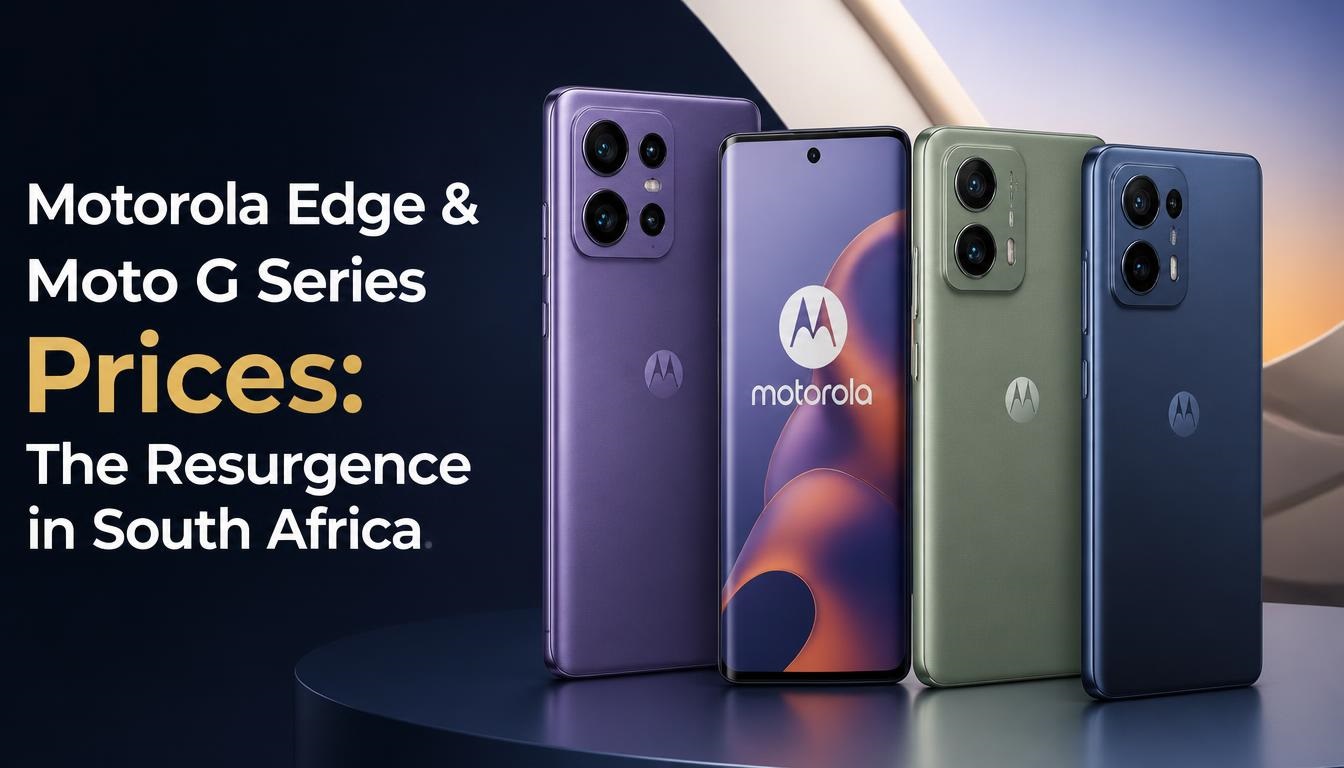
Tracking the exact Motorola Edge & Moto G Series Prices: The Resurgence in South Africa is currently a masterclass in separating genuine tech value from gray-market import traps. Local consumers are suffering from extreme mid-range shrinkflation. We are constantly expected to pay upward of R8,000 for phones that ship without chargers, feature plastic screens, and lack basic IP ratings.
Motorola’s aggressive, Lenovo-backed return to the South African cellular landscape completely flips this narrative. They are dumping high-spec, nearly stock-Android devices into local retail channels at highly disruptive price points. However, navigating the divide between a locally supported Moto G on a store shelf and a highly sought-after flagship Edge model imported from a boutique tech site requires serious buyer caution.
The Short & Sweet SA Market VerdictExpected Price Range: From an ultra-budget R1,799 (Moto E15) right up to R18,699 (Moto Edge 50 Ultra 5G).Top Overall Pick: Motorola Edge 50 Pro (~R7,550). The bundled 125W fast-charger is an absolute load-shedding lifesaver.Best Budget Pick: Moto G85 5G 256GB at R4,499. You cannot beat this physical storage and 5G network-hopping capacity for the price.Critical SA Buyer Warning: Beware of “Special Imports” for flagship models. If the device lacks official ICASA approval and local support, your CPA warranty rights are severely compromised when replacement parts are needed.
The Silent Retail Comeback: Why Moto is Disrupting the Mid-Range
For years, South Africans defaulted to Samsung for reliability, Apple for status, and Chinese giants like Xiaomi or Honor for budget hardware. Motorola essentially vanished from the local network operator booklets. Today, they are quietly dominating the prepaid and budget contract spaces without massive billboard campaigns.
Instead of fighting for premium shelf space in high-end cellular boutiques, Motorola partnered heavily with localized mass-market retailers. This grassroots approach means everyday South Africans can walk into a local store and buy a high-capacity, dual-sim smartphone without dealing with exorbitant mall markups or mandatory network contracts.
The strategy is incredibly practical for our current economy. By stripping away heavy, bloated software skins and prioritizing massive 5000mAh batteries, the Moto G series directly addresses the daily friction of living under the constant threat of load-reduction and infrastructure failure.
The Edge vs G Series ZAR Value Matrix
Pricing fluctuates wildly depending on whether you are buying local physical stock or a parallel import. All prices below include the standard 15% VAT and represent current independent market averages.
| Model Variant | Realistic SA Price (Incl. VAT) | Stock Source / Lead Time | Key SA Survival Feature | Value Rating |
| Moto G05 (128GB) | R1,999 | PEP Cell / Immediate | Stock Android, dual-SIM flexibility | ⭐⭐⭐ |
| Moto G24 Power | R2,260 | Independent Tech Retail / 2 Days | 6000mAh battery, MediaTek G85 | ⭐⭐⭐⭐ |
| Moto G85 5G (256GB) | R4,499 | PEP Cell / Immediate | 5G Network hopping, massive local storage | ⭐⭐⭐⭐⭐ |
| Moto Edge 50 Fusion | R5,790 | Tech Retailers / 3–5 Days | 68W charging (50% in 15 mins) | ⭐⭐⭐⭐ |
| Moto Edge 50 Pro | R7,550 | Specialist Importers / 7 Days | 125W charging, eSim support | ⭐⭐⭐⭐⭐ |
| Moto Edge 50 Ultra 5G | R18,699 | Special Import / 14-21 Days | Flagship 50MP camera, IP68 rating | ⭐⭐ |
Surviving the Grid: Load-Shedding and the Fast-Charge Factor
A smartphone’s battery capacity means nothing if it takes three hours to charge on a notoriously unstable grid. South African business operators and remote workers rely heavily on their phones as mobile hotspots when localized cable theft or Eskom cuts knock out fibre lines.
This is where the Motorola Edge series utterly decimates its Samsung and Apple rivals. The Moto Edge 50 Pro ships with a highly efficient 125W wired charging brick directly in the box. During an unexpected stage 6 implementation, a brief 15-minute window of power is all you need to push the battery past the 50% mark.
Furthermore, you are saving roughly R800 to R1,200 by not having to purchase a high-wattage, NRCS-compliant charger separately. The budget-friendly Moto G24 Power takes a different route, packing a massive 6000mAh Li-Po battery. It charges slower at 30W, but it is specifically engineered to outlast a 48-hour regional power outage without breaking a sweat.
Network hopping is another critical SA survival tactic. When a local MTN tower goes down because its backup batteries were stolen, you need the ability to seamlessly switch to Vodacom or Telkom. The dual-SIM and eSIM capabilities across the Edge series allow professionals to maintain unbroken connectivity during rolling blackouts.
Structural Stress Tests: Coastal Corrosion and Karoo Heat
South Africa’s climate is notoriously harsh on consumer electronics. A phone operating in the humid, salt-heavy air of the Durban coastline faces rapid port corrosion, while a device baking on a dashboard in the arid Northern Cape sun suffers immediate thermal throttling.
Motorola has aggressively moved away from fragile, fingerprint-magnet glass backs on their mid-to-high-end devices. The Moto Edge 50 Fusion and Edge 50 Pro utilize a silicone polymer “eco-leather” backing. This material offers vastly superior thermal dissipation compared to traditional glass, preventing the Snapdragon processors from overheating during heavy hotspot usage in summer.
It also provides immense tactile grip. If your hands are dusty from working on a farm, or sweaty from a humid commute, the phone remains firmly in your palm. Crucially, the Edge series boasts an IP68 dust and water resistance rating. It will comfortably survive a drop into a shallow puddle or sudden Highveld thunderstorm, whereas most competing devices in the R6,000 bracket offer zero official liquid ingress protection.
Red Tape and Headaches: NRCS LOA, ICASA, and CPA Traps
The biggest trap when evaluating Motorola Edge & Moto G Series Prices: The Resurgence in South Africa is the gray-market import pipeline. Because Motorola’s local footprint is heavily skewed toward the budget G-series, getting your hands on a premium Edge 50 Ultra usually requires buying a “Special Import” through independent local tech sites.
This introduces severe regulatory and warranty risks. The Consumer Protection Act (CPA) guarantees South Africans a 6-month implied warranty against manufacturer defects. However, if you buy a special import, that warranty sits squarely with the boutique importer—not with Motorola South Africa. If that small importer liquidates, your R18,000 flagship is entirely unsupported.
You must also consider network bands and ICASA (Independent Communications Authority of South Africa) compliance. A Moto Edge imported from the US or Asia might lack the specific LTE/5G carrier aggregation bands required to maximize speed on local Vodacom or MTN towers.
Finally, every electronic charging device brought into the country requires an NRCS LOA (Letter of Authority) to prove it won’t burn your house down during a post-load-shedding power surge. Gray-market chargers frequently bypass this vital safety check, putting your expensive hardware at extreme risk.
Buying a less mainstream brand in South Africa always incurs a “convenience tax” when it comes to accessories and maintenance. You cannot simply walk into a random mall kiosk and find a screen protector for a Motorola Edge 50 Fusion.
The local secondary market for Moto gear is growing, but it remains predominantly online. A basic shockproof magnetic flip cover for a Moto G model will cost you between R199 and R369 on Takealot, often requiring a 3-to-5-day delivery wait.
Screen replacements are the most glaring hidden cost. If you shatter the 144Hz P-OLED screen on a special import Edge 50, local repair shops simply do not carry the inventory. They will have to order the panel from overseas, subject you to heavy customs duties, and leave you without a phone for up to a month. Always factor the cost of a ruggedized case and comprehensive local device insurance into your initial purchase price.
Rapid-Fire Local FAQs
Are Motorola Android updates reliable in South Africa?
Yes, but they are undeniably slower than Samsung. Budget Moto G models typically receive one major OS update and three years of bi-monthly security patches. The Edge series promises longer support, but expect the rollouts to hit SA a few weeks after the global release.
Does Motorola Pay work with Capitec and FNB?
Motorola devices utilize standard NFC hardware powered by Google Wallet. If your SA bank card can be loaded into Google Wallet (which almost all major local banks support), tap-to-pay will work flawlessly at local tills.
How long does heavy freight or courier delivery take for special imports?
If you are ordering a flagship Moto from a local parallel importer, they usually consolidate orders to save on international freight. Expect a minimum wait of 10 to 21 working days for the device to clear OR Tambo customs and reach your door via The Courier Guy.
Your Turn: What’s Your Moto Verdict?
Have you recently picked up a new Moto G from a local retailer, or did you brave the special import route for a flagship Edge model? We want to know exactly how the battery is holding up during stage 4 load-shedding and whether the eco-leather back is surviving the local elements.
Drop your recent ZAR quotes, delivery timelines, and real-world performance feedback in the comments below to help other South Africans avoid gray-market pricing traps.
Disclaimer: Prices fluctuate and reflect independent market research at the time of publication. We may earn a small affiliate commission through qualified links at no extra cost to you.

Joseph Mathebula is a consumer analyst and market researcher at Prices in South Africa. He specializes in tracking local service costs, retail pricing, and travel budgets, helping everyday shoppers navigate the market to secure the best value.