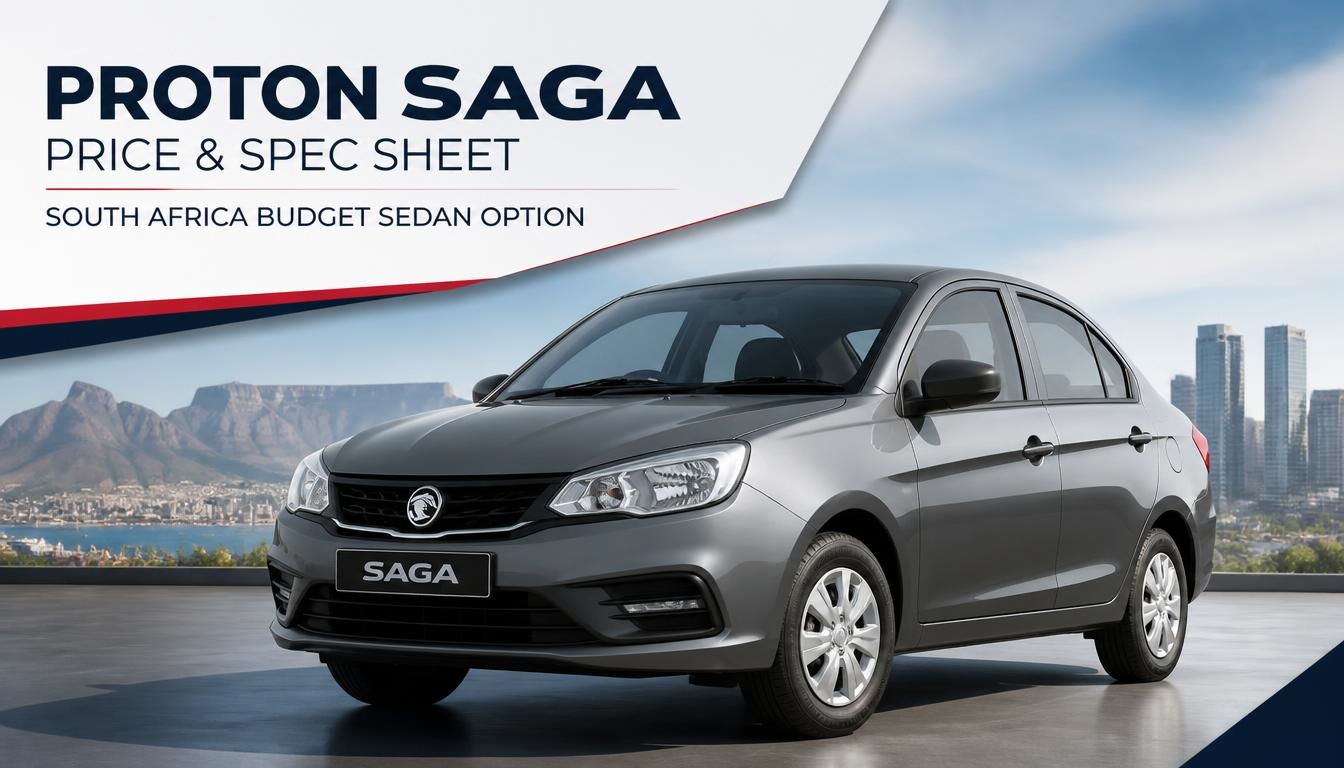
Key Vehicle Benchmark: ZAR 209,900 – ZAR 244,900
Target Consumer Profile: Entry-level commuter, ride-share fleet operator, or budget-conscious family buyer
Primary Retail Competitors: Suzuki Dzire, Toyota Vitz, Honda Amaze
Overall Market Assessment: Top-tier value proposition for sub-R250k sedan buyers seeking true boot capacity and standard safety features
Practical Hiring Insights & Budget Sedan Ownership Dynamics
The entry-level passenger vehicle segment in South Africa remains fiercely competitive. Budget-conscious consumers, fleet managers, and app-based ride-share operators continually weigh acquisition costs against long-term mechanical reliability, maintenance parts basket pricing, and daily fuel consumption.
Evaluating a budget sedan like the Proton Saga requires assessing total cost of ownership (TCO). While retail pricing forms the initial barrier to entry, secondary ownership costs—including vehicle insurance risk profiles, finance installment margins, and spare parts availability across major provinces—dictate long-term affordability.
Drivers and ride-share operators utilizing budget sedans must consider practical daily operational demands:
-
Fuel Efficiency Realities: Urban stop-and-start driving often increases consumption above factory figures; driving habits and load significantly impact real-world fuel economy.
-
Insurance Risk Categories: Compact sedans carry specific risk profiles depending on security features, parking storage, and driver history.
-
Routine Servicing Interval Compliance: Sticking to scheduled service intervals ensures manufacturer warranty retention and protects vehicle resale value.
-
Resale & Depreciation Curves: Newer entrants into the local market experience unique depreciation rates compared to established high-volume Japanese brands.
Proton Saga Vehicle Overview & Local Market Positioning
The Proton Saga serves as a budget-oriented 4-door notchback sedan designed to offer interior legroom, boot capacity, and mechanical simplicity. Powered by a naturally aspirated 1.3-litre 4-cylinder petrol engine outputting 70 kW and 120 Nm of torque, it balances daily commuting power with straightforward engineering.
Unlike modern subcompact hatchbacks that compromise on rear luggage room, the Saga provides a 420-litre boot capacity, making it a functional option for small families and transport services requiring ample cargo space.
| Vehicle Specification | Official Value / Detail | Practical Consumer Benefit |
| Engine Displacement | 1,332 cc (1.3L 4-Cylinder DOHC VVT) | Standard, non-turbo mechanicals for lower long-term maintenance costs |
| Power & Torque | 70 kW @ 5,750 rpm / 120 Nm @ 4,000 rpm | Adequate power delivery for city commutes and open highway cruising |
| Transmission Options | 5-Speed Manual / 4-Speed Torque Converter Auto | Proven gearboxes avoiding complex, costly repair mechanisms |
| Boot Space Capacity | 420 Litres | Accommodates large luggage, luggage bags, or commercial gear easily |
| Fuel Tank Capacity | 40 Litres | Cost-effective tank fill-ups with practical overall driving range |
| Standard Safety Kit | ABS, EBD, Brake Assist, Dual Airbags | Core baseline safety coverage for urban and long-distance driving |
2026 Proton Saga Retail Pricing & Monthly Installment Breakdown
Retail pricing across the model lineup spans from the entry-level Standard Manual up to the feature-rich Premium Automatic. The table below illustrates the updated 2026 pricing index alongside estimated monthly finance installments calculated at standard prime interest rates (11.75% baseline) over a 72-month period with a 10% deposit and no residual balloon payment.
| Variant Trim Level | Recommended Retail Price (ZAR) | Est. Monthly Installment (10% Deposit) | Target Buyer / Operational Fit |
| 1.3 Standard Manual | R209,900 | R3,850 – R4,100 pm | Budget commuters, high-mileage drivers, courier fleets |
| 1.3 Standard Automatic | R224,900 | R4,150 – R4,400 pm | Daily city commuters needing automated shift convenience |
| 1.3 Premium Automatic | R244,900 | R4,500 – R4,800 pm | Buyers wanting upgraded infotainment, reverse cameras, and alloys |
Finance Advisory Note: Actual monthly vehicle repayments vary depending on individual credit scores, negotiated interest rates from financial institutions (Absa, WesBank, Standard Bank, Nedbank), deposit amounts, and optional balloon payments. Always budget for mandatory comprehensive vehicle insurance and monthly fuel expenses.
2026 Specification Matrix & Trim Feature Breakdown
Selecting the right variant depends on balancing purchase price with functional features. The baseline Standard models cover basic necessities, while the top-tier Premium model adds exterior styling tweaks and interior driver-assist technologies.
Trim Comparison & Standard Features
-
1.3 Standard (Manual & Auto):
-
14-inch steel wheels with full covers
-
Halogen headlights with manual leveling
-
Fabric interior upholstery with manual seat adjustment
-
Standard audio system with Bluetooth and USB connectivity
-
Dual front airbags, ABS with EBD and Brake Assist
-
Rear parking sensors
-
-
1.3 Premium (Automatic Only):
-
15-inch alloy wheels
-
LED daytime running lights (DRLs)
-
7-inch touchscreen infotainment display with smartphone mirroring
-
Reverse parking camera integrated with rear park distance control (PDC)
-
Multi-function steering wheel with audio controls
-
Luggage area lamp and upgraded fabric seating
-
Comprehensive Long-Term Ownership Cost Analysis
Evaluating a budget sedan requires looking beyond the sticker price to consider running costs over a typical 3- to 5-year ownership cycle.
1. Fuel Economy Realities
The manufacturer claims a combined fuel consumption figure of roughly 6.7 to 7.0 litres per 100 km for the 1.3-litre powertrain. In real-world urban driving conditions—such as navigating peak-hour traffic in Johannesburg, Cape Town, or Durban—drivers should budget for real-world consumption between 7.2L/100km and 7.8L/100km.
2. Warranty & Service Plan Coverage
Proton South Africa backs the Saga range with standard manufacturer warranty and service coverage:
-
Mechanical Warranty: 5-Year / 150,000 km Warranty
-
Service Plan: Optional or variant-dependent service plans (typically 3-Year / 30,000 km)
-
Roadside Assistance: 5-Year complimentary breakdown assistance
3. Maintenance & Spare Parts Basket
Because the 1.3-litre engine uses a standard naturally aspirated design and a traditional torque-converter automatic or manual gearbox, routine servicing costs remain manageable compared to complex turbocharged engines. Filters, brake pads, spark plugs, and basic suspension components are reasonably priced, helping keep out-of-warranty servicing costs down.
Career Growth & Fleet Business Opportunities with Budget Vehicles
For entrepreneurs, transport operators, and independent contractors, acquiring a budget sedan under R250,000 presents several revenue-generating avenues within the South African market:
-
Ride-Hailing Operations: The 420L boot capacity and 4-door layout make the vehicle compliant with entry-level requirements for platforms like Uber Go and Bolt.
-
Private Shuttle & Courier Logistics: Low maintenance costs allow small business owners to run affordable delivery or passenger shuttles.
-
Field Sales & Company Mobility: Corporate fleets looking to minimize capital expenditure can deploy reliable, warrantied vehicles for sales reps and field technicians.
Frequently Asked Questions
What is the current starting price for a Proton Saga in South Africa?
The starting retail price for the entry-level Proton Saga 1.3 Standard Manual is approximately R209,900, with the top-spec Premium Automatic priced around R244,900.
Is the Proton Saga fuel-efficient for daily commuting?
Yes, it offers a practical balance with real-world fuel consumption averaging between 7.0L and 7.8L per 100 km in mixed urban driving conditions.
Does the Proton Saga come with a factory warranty in South Africa?
Yes, new models include a 5-year / 150,000 km mechanical warranty alongside complimentary roadside assistance.
Is the Proton Saga suitable for Uber or Bolt ride-hailing platforms?
Yes, the 4-door setup, comfortable rear seating, and 420-litre boot space meet the baseline criteria for entry-level ride-hailing categories like Uber Go and Bolt.
What are the main competitors to the Proton Saga in the local market?
Direct competitors in the sub-R250,000 budget segment include the Suzuki Dzire, Honda Amaze, Toyota Vitz, and Nissan Almera.
Disclaimer: Salary figures, job requirements, vehicle prices, finance estimates, and hiring indicators listed in this guide reflect real-world market averages and verified regional data at the time of publication. Actual vehicle pricing, dealer promotions, finance terms, and compensation figures may vary based on geographic location, individual credit profiles, dealership offers, and specific contract negotiations. Always verify final pricing and specs directly with accredited dealerships, finance providers, or official corporate postings.
Navigating the South African entry-level vehicle market requires balancing upfront costs against ongoing reliability and running expenses. Whether you are buying your first commuter car, adding a versatile runner to a corporate fleet, or launching a ride-sharing business, taking time to test drive different models, compare dealer finance offers, and inspect service plan terms is key to making a sound decision.
Have experience driving or managing a Proton Saga in your fleet? Share your real-world fuel consumption figures, service experiences, or questions in the comments below to help fellow buyers make informed choices.

Joseph Mathebula is a consumer analyst and market researcher at Prices in South Africa. He specializes in tracking local service costs, retail pricing, and travel budgets, helping everyday shoppers navigate the market to secure the best value.