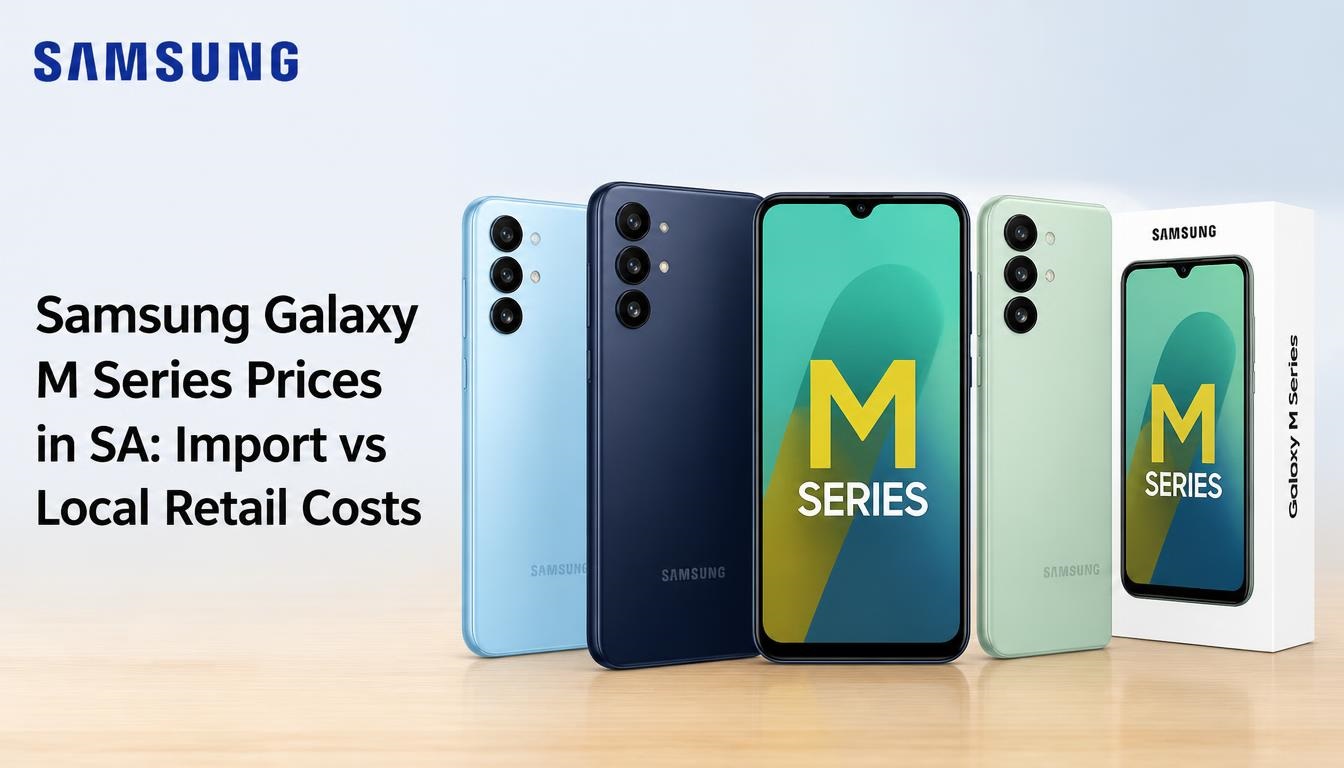
South African smartphone buyers face a unique dilemma when shopping for Samsung’s mid-range powerhouses. The Samsung Galaxy M series—renowned globally for combining massive batteries, crisp Super AMOLED displays, and reliable everyday performance—occupies a distinct position in the market.
While Samsung’s flagship S series and mid-tier A series dominate local operator store shelves, M-series availability in South Africa can be spotty. Local carriers often prioritize the Galaxy A series, leaving M-series models sparingly distributed through local online merchants or entirely absent. Consequently, South African tech enthusiasts frequently weigh the choice between sourcing locally through online channels or directly importing from international e-commerce platforms.
Here is a breakdown of the true total cost of ownership (TCO) for buying a Samsung Galaxy M series device locally in South Africa versus importing one, including hidden customs fees, network compatibility, and warranty protection.
1. Samsung Galaxy M Series Price Overview in SA
In South Africa, Galaxy M series smartphones target the budget to upper-mid-range tiers, generally spanning between R3,500 and R9,500 depending on the specific tier and configuration:
-
Entry Tier (Galaxy M14 / M15 5G): R3,500 – R4,800
-
Mid Tier (Galaxy M34 / M35 5G): R5,500 – R7,200
-
Upper Tier (Galaxy M54 / M55 5G): R7,800 – R9,500
Local Retail Availability
Unlike the Galaxy A series—which is available at virtually every Vodacom, MTN, and Telkom store—the M series is primarily distributed through targeted digital and retail stockists:
-
Major Online Outlets: Takealot and Amazon South Africa frequently list local or gray-market M-series stock.
-
Specialized Tech Retailers: Outlets such as JKPhones, Incredible Connection, and Makro occasionally list select M-series inventory.
-
Official Samsung Channels: Samsung SA’s official e-Store sporadically features selected M-series models during promotional windows or “Monster Battery” campaign pushes.
Purchasing an M-series phone directly from a local South African retailer involves a straightforward transaction with predictable financial bounds.
Key Advantages
-
Official ICASA Approval: Local models carry Type Approval from the Independent Communications Authority of South Africa (ICASA), ensuring full network functionality across all local spectrum bands.
-
Samsung SA Warranty Protection: Official local stock includes a 24-month Samsung South Africa manufacturer warranty, granting access to authorized local repair centers.
-
Fast Delivery & Easy Returns: Local orders ship via courier services (Ram, Courier Guy, Dawn Wing) within 1–3 business days with straightforward Consumer Protection Act (CPA) return policies.
Local Price Drivers
-
15% Local Value Added Tax (VAT): Standard output VAT is built directly into the shelf price.
-
Retailer & Logistics Margins: Local distributors account for clearance, holding costs, and local exchange rate volatility when setting ZAR price points.
-
Shipping Fees: Typically zero to minimal (R60–R100) for orders over threshold values on platforms like Takealot or Amazon SA.
3. Importing Samsung Galaxy M Series: Costs, Taxes & Logistics
For models not released locally in South Africa, buyers often turn to cross-border platforms like Amazon Global, AliExpress, eBay, or specialized import services like Postbox Courier. While the headline product price in USD or EUR may look significantly lower, calculating the final landed cost requires factoring in several obligatory fees.
Breakdown of Import Surcharges (SARS Formula)
The total landed cost is calculated by adding international freight charges, SARS import VAT, and courier clearance fees to the base price paid to the overseas seller:
-
Foreign Currency Conversion: South African banking cards charge a 2% to 3.5% foreign currency conversion fee on cross-border transactions.
-
International Shipping: Express couriers (DHL, FedEx, UPS) charge roughly R450 to R900 for secure electronics transport to SA.
-
SARS Customs Duty: Under standard tariff classification (HS Code 8517.13), smartphones attract 0% Customs Duty in South Africa.
-
SARS Import VAT (The ATV Formula): While duty is 0%, imports are subject to 15% Import VAT calculated on the Added Tax Value (ATV). SARS calculates ATV as the original price plus a mandatory 10% upliftment factor:
-
ATV = Customs Value (FOB) × 1.10
-
Import VAT = ATV × 0.15
-
-
Courier Clearance Fees: Delivery couriers charge an administrative fee (typically R150–R350) for submitting customs documentation to SARS on your behalf.
4. Local vs. Import Comparison
| Feature / Criteria | Local Retail Purchase (SA Stock) | Direct Overseas Import |
| Base Shelf Price | Moderate to High (Includes local margins) | Low to Moderate (Looks cheaper initially) |
| Customs & Taxes | 15% VAT included upfront; no extra fees | 15% VAT on ATV + clearance handling fee |
| Warranty & Repair | 24-Month Local Warranty via Samsung SA | No Local Warranty (Requires return shipping abroad) |
| ICASA Compliance | Fully ICASA Approved & Certified | Lacks ICASA certification mark |
| Network & VoLTE | Pre-configured for Vodacom, MTN, Telkom, Cell C | May require manual APN / VoLTE configuration |
| Delivery Timeframe | 1 to 3 Business Days | 7 to 21 Business Days |
| Overall Value | High total peace of mind; predictable cost | Riskier; value depends on currency rates |
5. Technical & Practical Considerations
Network Bands and Carrier Compatibility
South African networks rely on specific LTE and 5G frequency spectrum bands:
-
4G LTE: Band 1 (2100MHz), Band 3 (1800MHz), Band 8 (900MHz), Band 20 (800MHz), Band 40 (2300MHz), and Band 41 (2500MHz).
-
5G NR: Band n1, n3, n28, n41, and primarily n78 (3500MHz).
Imported M-series models intended for Asian or South American markets may lack coverage for Band 20 or Band 28, which local operators use for rural coverage and deep indoor penetration.
Regional Firmware, Samsung Pay & VoLTE
Samsung ties software features to CSC (Country Specific Codes). Importing a non-South African model can result in:
-
Samsung Wallet / Pay Regional Lock: You may be unable to load South African banking cards onto Samsung Wallet on non-XFA/XFE firmware.
-
VoLTE / VoWiFi Disablement: Voice over LTE (VoLTE) and Wi-Fi Calling configurations vary by region. If the imported device lacks local operator profiles, HD voice calls may revert to legacy 3G/2G networks.
Warranty Limitations
Samsung South Africa does not honor local warranty claims on grey-market or internationally imported devices. Should an imported device suffer a battery fault or display failure, repairs must be paid out-of-pocket at non-warranty rates, or the phone must be sent back to the country of purchase.
6. Practical Buyer’s Decision Matrix
Choose Local Retail If:
-
You prioritize a 24-month local warranty and local Samsung Service Center access.
-
You require Samsung Wallet / Pay functionality with SA banks out of the box.
-
You need the phone immediately and prefer transparent, all-inclusive pricing.
Consider Direct Importing If:
-
You are sourcing an exclusive variant (e.g., higher RAM/storage configurations) not offered locally.
-
The combined cost (Product + Shipping + SARS Import VAT + Clearance) remains at least 20% below local retail pricing.
-
You are comfortable troubleshooting network APNs and accepting out-of-warranty risks.
Important Price & Compliance Disclaimer
Prices, customs tariffs, exchange rates (USD/ZAR), and local retail availability fluctuate constantly. The financial calculations provided in this article serve informational purposes only. Prospective buyers must confirm final landed costs with customs clearance providers or local retailers prior to completing a purchase. Importing telecommunications equipment without proper clearance or ICASA type-approval may impact network performance, regulatory compliance, and local software features within South Africa.
Final Verdict
While importing a Samsung Galaxy M series phone can seem like an attractive route to access exclusive models or lower foreign listing prices, the added logistics costs—specifically international shipping, courier handling fees, and the SARS Import VAT formula—frequently erase initial savings.
When combined with the risk of losing local warranty coverage, regional firmware restrictions, and potential VoLTE incompatibilities, purchasing from a verified local retailer generally delivers the best overall total cost of ownership (TCO) and long-term peace of mind for South African consumers.

Joseph Mathebula is a consumer analyst and market researcher at Prices in South Africa. He specializes in tracking local service costs, retail pricing, and travel budgets, helping everyday shoppers navigate the market to secure the best value.