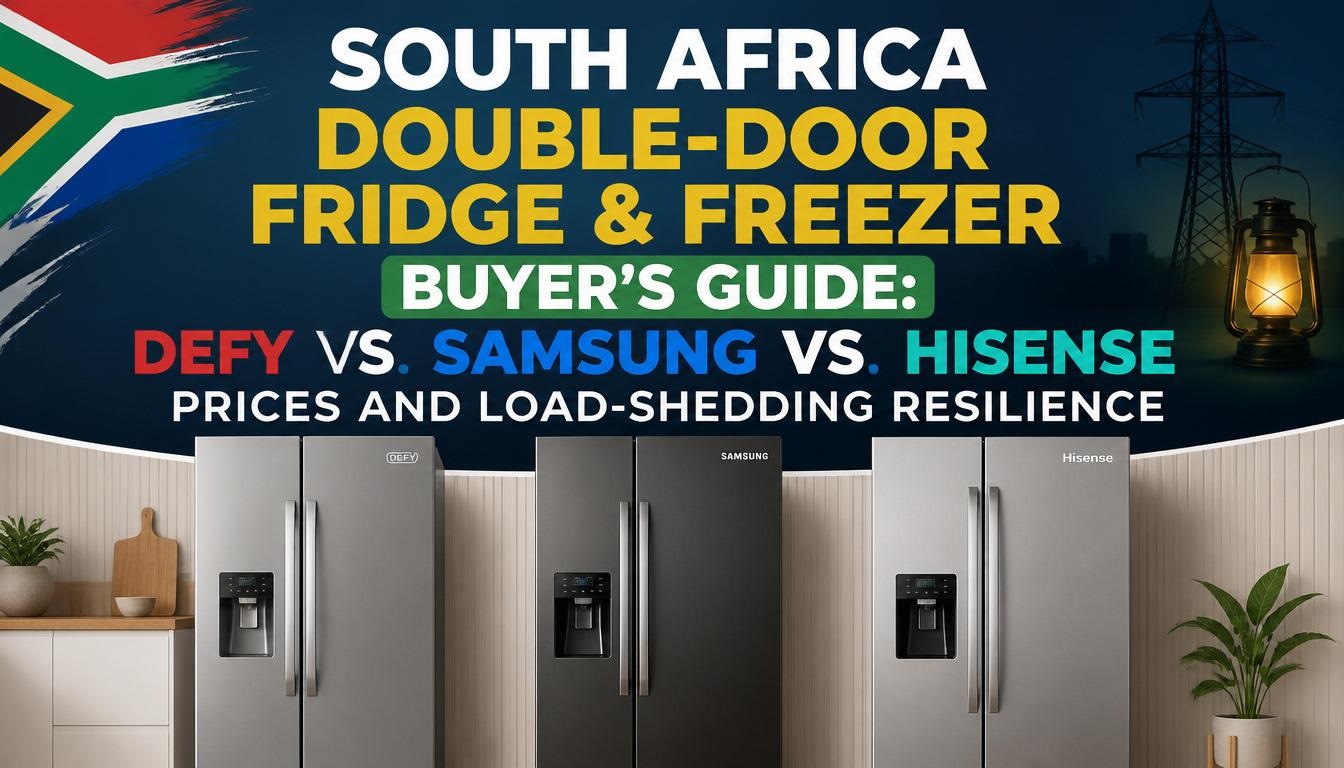
Choosing the right double-door fridge-freezer in South Africa is no longer just a matter of matching kitchen aesthetic or picking a familiar brand name. Between persistent power grid fluctuations, voltage spikes during rotational load-shedding restoration, high ambient summer temperatures exceeding 35°C in regions like Gauteng and Limpopo, and rising Eskom electricity tariffs, buying a cooling appliance requires a calculated balance of thermal insulation, compressor engineering, and total cost of ownership.
Whether you are upgrading from an old single-door static unit or shopping for a high-capacity side-by-side refrigerator, the market is primarily dominated by three powerhouses: Defy, Samsung, and Hisense. Each brand approaches the South African market with distinct design philosophies, warranty coverage, and inverter motor technologies.
This comprehensive guide breaks down the current market pricing in South African Rands (ZAR), real-world power consumption metrics, long-term durability under harsh local conditions, and exact specifications to help you make an informed investment.
The South African Reality: Critical Features to Check Before Buying
Before comparing specific models, you must evaluate four local operational factors that determine whether a refrigerator will survive in a South African home:
1. Compressor Technology: Digital Inverter vs. Standard Rotary
-
Standard Rotary Compressors: These run on an all-or-nothing cycle (100% power or 0%). When power returns after load-shedding, the sudden high-current draw creates significant thermal stress and consumes excessive peak wattage.
-
Digital Inverter Compressors: These vary speed continuously across multiple power stages based on internal cooling demand. They operate far quieter, reduce monthly electricity bills by up to 40%, and handle power restoration smoothy without drawing severe inrush current.
2. Thermal Retention (Cold Holdover Time)
When power goes off for 2 to 4 hours (or longer during localized grid faults), high-density cyclopentane insulation determines whether your meats, dairy, and meal preparations remain safely below 4°C. Top-tier units offer up to 12 to 18 hours of passive thermal containment provided the doors remain sealed.
3. Voltage Surge Protection
Grid recovery often produces line spikes exceeding 260V. While brands like Defy and Samsung build basic surge resistance into their main PCBs, installing a dedicated appliance surge protector plug (rated at 16A with a 3-minute delay) remains mandatory to prevent blown control boards.
4. Climate Class Rating
Ensure any unit you purchase is rated ST (Subtropical: 18°C to 38°C) or T (Tropical: 18°C to 43°C). Units built strictly for European climates (N or SN ratings) struggle significantly during South African summer heatwaves, leading to non-stop compressor cycling and early motor burnout.
Brand Breakdown: Defy
Brand Overview & Local Footprint
Defy is South Africa’s historic domestic appliance brand, operating manufacturing facilities in Jacobs (KwaZulu-Natal) and Ezakheni. Defy appliances are engineered specifically for African power grids and local kitchen habits. Their widespread local service footprint means replacement parts—such as door seals, defrost heaters, thermostats, and control boards—are readily available through local repair agents and major retail centers.
Standout Technologies
-
ProSmart Inverter Compressor: Delivers quiet operation, precise temperature maintenance, and lower power draw. Backed by an extended 12-year compressor warranty on selected models.
-
NatureLight Technology: Uses blue, green, and red LED light cycles inside the crisper drawer to simulate the 24-hour natural sun cycle, preserving Vitamin A and C levels in fresh produce for up to 30 days.
-
Dual Cooling Systems (NeoFrost): Employs two separate fan-and-evaporator systems—one for the freezer and one for the fridge. This prevents odor transfer between fresh food and frozen goods while maintaining optimum humidity levels (up to 90%) in the fridge section.
Popular Defy Double-Door Models & Current Pricing (ZAR)
-
Defy 247L Bottom-Mount Double-Door Refrigerator (DAC447 / DAC363 Series)
-
Configuration: Top fridge, bottom freezer
-
Cooling Tech: Auto-defrost / Frost-Free (model dependent)
-
Energy Rating: A / A+
-
Retail Price Range: R4,999 – R5,999
-
Best For: Small to medium households seeking reliable, entry-level double-door functionality with low baseline power consumption.
-
-
Defy 350L Eco Dual Cooling Bottom-Mount Refrigerator (DAC622 / DAC645)
-
Configuration: Bottom freezer, integrated water dispenser
-
Cooling Tech: NeoFrost Dual Cooling
-
Energy Rating: A+
-
Retail Price Range: R6,899 – R7,599
-
Best For: Mid-sized families wanting a built-in non-plumbed water dispenser and active humidity control for fresh vegetables.
-
-
Defy 496L / 555L Side-by-Side Frost-Free Refrigerator (DFF447 / DFF536 Series)
-
Configuration: Side-by-side double door (Black Glass / Satin Metallic)
-
Cooling Tech: Full No-Frost ProSmart Inverter
-
Energy Rating: A+
-
Retail Price Range: R11,999 – R14,999
-
Best For: Large families requiring high-volume storage, fast freezing capacity, and premium aesthetic finishes.
-
Brand Breakdown: Samsung
Brand Overview & Market Positioning
Samsung occupies the premium tech-forward segment in South Africa. The South Korean manufacturer focuses heavily on digital inverter efficiency, smart home connectivity, modern aesthetic design, and space optimization through thin-wall insulation technology.
Standout Technologies
-
Digital Inverter Technology (DIT): Samsung’s inverter compressors automatically adjust their speed across 7 cooling demand levels. Supported by a 20-year spare-part warranty on the inverter compressor motor.
-
SpaceMax Technology: Uses high-efficiency urethane insulation that allows internal cabinet walls to be much thinner without sacrificing energy performance. This yields significantly higher internal storage volume for the exact same exterior footprint.
-
All-Around Cooling / Twin Cooling Plus: Vents cold air through multiple outlets at every shelf level, maintaining an even temperature from top to bottom. High-end Twin Cooling Plus models use independent evaporators for 70% humidity preservation in the fridge section.
-
Cool Pack / CoolSelect Plus: Selected bottom-mount units feature a specialized gel-pack insert inside the freezer shelf that maintains sub-zero temperatures for up to 12 hours during extended load-shedding blackouts.
Popular Samsung Double-Door Models & Current Pricing (ZAR)
-
Samsung 303L / 321L Bottom-Mount Refrigerator with Water Dispenser (RB30J3011SA / RB31HER2BSA)
-
Configuration: Bottom freezer, external water tank dispenser
-
Cooling Tech: All-Around Cooling with Digital Inverter
-
Energy Rating: A+
-
Retail Price Range: R6,999 – R10,999
-
Best For: Modern urban apartments where energy quietness, rapid chilling, and blackout safety packs are top priorities.
-
-
Samsung 564L / 560L Side-by-Side Refrigerator (RS57DG4000B4FA Series)
-
Configuration: Side-by-side double door (Gentle Black Matt / Silver)
-
Cooling Tech: No-Frost Digital Inverter
-
Energy Rating: A+
-
Retail Price Range: R14,999 – R16,999
-
Best For: High-volume food prep, bulk-buying households, and open-plan kitchen setups requiring sleek flush-fitting design.
-
-
Samsung 617L / 647L French Door & Side-by-Side Series (RS70 / RF49 Series)
-
Configuration: Multi-door / Triple-door French door bottom freezer
-
Cooling Tech: Twin Cooling Plus with Smart Conversion modes
-
Energy Rating: A++
-
Retail Price Range: R20,999 – R26,999
-
Best For: Luxury residential kitchens requiring maximum storage flexibility and precise zone-by-zone climate management.
-
Brand Breakdown: Hisense
Brand Overview & Value Proposition
Hisense has captured a massive market share across South Africa by offering high-end luxury styling—such as brushed steel finishes, multi-zone French doors, touch LED displays, and internal ice makers—at aggressive, value-driven price points. Operating a major manufacturing hub in Atlantis, Western Cape, Hisense products are backed by strong domestic distribution and local warranty support.
Standout Technologies
-
Vector Inverter Technology: Smooth motor operation that minimizes mechanical friction, lowering decibel output and preventing sudden power surges during startup.
-
Multi Air Flow System: Multiple air distribution channels force cool air into every corner of the cabinet, rapidly lowering internal temperatures after the door has been opened.
-
My Fresh Choice / Convertible Zone: Found on higher-tier 4-door and multi-door units, this dedicated compartment can be set anywhere between -20°C and +5°C, transforming from a freezer to a fridge at the touch of a button depending on weekly grocery needs.
-
Non-Plumbed Water & Ice Dispensers: Designed for hassle-free installation without requiring dedicated plumbing lines or external inline water filters.
Popular Hisense Double-Door Models & Current Pricing (ZAR)
-
Hisense 222L / 264L Bottom-Mount Double-Door Refrigerator (H310BIT / H370BIT Series)
-
Configuration: Top fridge, bottom freezer (available with or without water dispenser)
-
Cooling Tech: Auto-Defrost / Total No-Frost
-
Energy Rating: A / A+
-
Retail Price Range: R5,299 – R6,999
-
Best For: Budget-conscious buyers who want clean aesthetic styling, reliable daily cooling, and low upfront costs.
-
-
Hisense 543L / 631L Side-by-Side Refrigerator (H680SIT / H800SB Series)
-
Configuration: Side-by-side double door (Brushed Stainless Steel / Black Stainless)
-
Cooling Tech: Total No Frost with Inverter Motor
-
Energy Rating: A+
-
Retail Price Range: R10,999 – R18,999
-
Best For: Families wanting high-capacity side-by-side convenience with water dispensers without breaking into the R20,000+ price bracket.
-
-
Hisense 575L / 579L French Door 4-Door Refrigerator (H760FSB / H780SB Series)
-
Configuration: 4-door French Door layout
-
Cooling Tech: Triple-Zone Cooling with Convertible Compartments
-
Energy Rating: A+
-
Retail Price Range: R18,999 – R24,999
-
Best For: Cooks who store wide platter dishes, birthday cakes, or bulk fresh produce alongside flexible sub-zero storage zones.
-
Detailed Head-to-Head Comparison: Defy vs. Samsung vs. Hisense
The table below breaks down key specification metrics across entry, mid-tier, and premium side-by-side double-door fridge-freezer categories in the South African retail market:
| Feature / Metric | Defy (Local Heritage) | Samsung (Tech Leader) | Hisense (Value Leader) |
| Entry Price Range (200L-300L) | R4,999 – R6,899 | R6,999 – R10,999 | R5,299 – R6,999 |
| Mid-Tier Price Range (300L-450L) | R6,899 – R9,999 | R10,999 – R15,999 | R6,999 – R10,999 |
| Side-by-Side Price Range (500L+) | R11,999 – R15,999 | R14,999 – R26,999 | R10,999 – R19,999 |
| Standard Machine Warranty | 2 Years (Up to 5 Years registered) | 2 Years | 4 Years (2 + 2 Years on registration) |
| Compressor Motor Warranty | 12 Years (ProSmart Inverter) | 20 Years (Digital Inverter) | 10 Years (Inverter models) |
| Cooling System Type | NeoFrost Dual Cooling | Twin Cooling Plus / All-Around | Multi Air Flow / Triple Zone |
| Blackout Cold Holdover | 10 – 14 Hours | 12 – 18 Hours (with Cool Pack) | 8 – 12 Hours |
| Build Origin / Assembly | South Africa & Turkey | Vietnam / China / Korea | South Africa (Atlantis) & China |
| Spare Parts Availability | Excellent (Immediate national distribution) | Very Good (Authorized centers) | Good (Growing national network) |
Technical Performance Analysis: Power, Noise, and Load-Shedding Survival
1. Daily Power Consumption and Electricity Costs
In South Africa, where electricity pricing averages between R2.50 and R3.80 per kWh depending on municipality tariffs and stepped usage tiers, operating efficiency matters over a 10-year lifespan.
-
Non-Inverter Double Door (300L): Consumes approximately 380 to 450 kWh/year. At an average cost of R3.20/kWh, this equates to roughly R1,216 – R1,440 per year in electricity.
-
Digital / ProSmart Inverter Double Door (300L-350L): Consumes approximately 230 to 290 kWh/year. At R3.20/kWh, this equates to roughly R736 – R928 per year. Over a 10-year lifespan, an inverter unit saves between R4,800 and R7,000 in electricity costs alone, fully offsetting its higher purchase price.
2. Inverter Motor Behavior During Backup Power Operations
If your home runs on a solar inverter system, lithium battery backup, or petrol/diesel generator during load-shedding:
-
Non-Inverter Fridges: Require a heavy startup surge wattage (often 5x to 8x their rated running watts). A standard 150W compressor can spike up to 1200W for a fraction of a second when engaging. This peak can trip smaller 1kW to 3kW off-grid solar inverters.
-
Inverter Fridges: Soft-start slowly, ramping up power gradually from as low as 30W to 120W max. They run cleanly on pure sine wave inverters without imposing heavy inductive loads on lithium batteries.
3. Noise Levels (Decibels)
-
Defy ProSmart Series: Operates around 38 to 40 dB, which is soft enough for open-plan kitchens.
-
Samsung DIT Series: Operates around 36 to 38 dB, making it exceptionally quiet during night cycles.
-
Hisense Vector Inverter Series: Operates around 39 to 41 dB, maintaining low noise with slight fan hum during deep-freeze cycles.
Buying Guide: Selecting the Right Type for Your Lifestyle
To select the ideal layout for your kitchen, match your shopping habits against the three primary physical configurations:
Option A: Top-Fridge, Bottom-Freezer (Combi Units)
-
Layout: Fridge section is at eye level; freezer drawers are located below.
-
Pros: Highly ergonomic because 80% of daily fridge interactions involve fresh food, drinks, and produce located at chest height. You don’t need to bend down continuously.
-
Cons: Freezer storage capacity is generally smaller (typically 70L to 110L).
-
Verdict: Best for 1-4 person households who cook fresh food daily.
Option B: Side-by-Side Double Door
-
Layout: Vertical split with freezer on the left and fresh food fridge on the right.
-
Pros: Massive total volume (490L to 650L), excellent organized shelf visibility, narrow door swing radius (great for narrow kitchen islands).
-
Cons: Narrow shelf widths make it difficult to store wide baking trays, large pizza boxes, or whole turkeys.
-
Verdict: Best for medium-to-large families who buy frozen foods in bulk and desire a high-impact modern look.
Option C: French Door / Multi-Door
-
Layout: Wide double doors on top for the fresh food compartment, with one or two wide freezer pull-out drawers or double doors at the bottom.
-
Pros: Combines maximum wide-shelf storage with ergonomic chest-level access. Offers the most premium feature set, including flexible temperature zones.
-
Cons: Highest price tier (R18,000 – R40,000+); requires wide kitchen cutout measurements.
-
Verdict: Ideal for open-plan gourmet kitchens and large families requiring flexible refrigeration zones.
Essential Installation & Maintenance Protocol for South African Homes
To ensure maximum cooling efficiency and guard against premature equipment failure:
Proper Ventilation Spacing
Never push a double-door fridge tight against the back wall or side cabinetry.
-
Leave at least 50mm (5cm) of clearance at the rear.
-
Leave at least 20mm (2cm) on the sides and top.
-
Without adequate ventilation, heat trapped around the condenser coils forces the compressor to work continuously, increasing power consumption by up to 25% and causing early motor breakdown.
Leveling the Unit
Adjust the front leveling feet so that the front of the appliance is slightly higher than the rear (a 1 to 2-degree backward tilt). This ensures that doors close automatically under gravity, preventing accidental seal gaps that cause heavy frost buildup and spoiled food.
Seal (Gasket) Inspection and Cleaning
Wipe magnetic door gaskets monthly using warm water and mild dish soap. Avoid harsh chemical sprays, which deteriorate rubber flexibility over time. Test seal tightness by placing a piece of paper between the gasket and cabinet frame: if the paper slides out easily without friction, your door seal requires adjustment or replacement.
Defrosting and Coil Cleaning
For auto-defrost or manual models, clean the rear condenser coils twice a year using a vacuum brush attachment or soft duster. Accumulations of domestic dust and pet hair act as an insulator, preventing effective heat release and causing internal cabinet temperatures to creep upward during summer.
Direct Brand Decision Framework: Which Should You Buy?
Choose Defy If:
-
You prioritize local manufacturing, widely available spare parts, and simple repair logistics.
-
You want reliable dual-cooling technology (NeoFrost) to keep produce fresh without spending top-tier import prices.
-
You prefer extended local warranties (up to 5 years machine, 12 years compressor) with nationwide home service coverage.
Choose Samsung If:
-
Energy efficiency, whisper-quiet operation, and long-term compressor reliability are your top priorities.
-
You want advanced thermal protection features like Cool Pack inserts to protect frozen goods during prolonged South African load-shedding.
-
You prefer sleek interior design with maximum usable storage space (SpaceMax) inside standard cabinet dimensions.
Choose Hisense If:
-
You want maximum features—such as multi-door French door styling, digital touch panels, and non-plumbed water dispensers—at the lowest possible price point.
-
You value a standard 4-year local warranty package without paying premium brand surcharges.
-
You want clean, modern brushed stainless steel or mirror-finish styling that matches high-end kitchen updates on a reasonable budget.
Choosing an appliance often comes down to real-world, long-term household usage under local conditions. We want to hear from you:
-
Which brand are you currently running in your home—Defy, Samsung, or Hisense—and how has it handled rotational load-shedding and power spikes over the years?
-
Have you experienced any issues with door seals, water dispensers, or compressor noise after 2+ years of continuous use?
Drop your questions, model reviews, or pricing queries in the comments below! Our team checks and responds to reader discussions regularly to help you make the best appliance choices for your South African home.

Joseph Mathebula is a consumer analyst and market researcher at Prices in South Africa. He specializes in tracking local service costs, retail pricing, and travel budgets, helping everyday shoppers navigate the market to secure the best value.