If you have ever spent a chilly 5:00 AM standing on the concrete apron at Johannesburg’s Park Station with a rolling suitcase in one hand and a steaming paper cup of coffee in the other, you know that long-distance bus travel in South Africa is both an art form and a necessity.
Over the past decade, as domestic airline tickets have surged past the R2,500 mark for standard one-way intercity flights, long-distance coaches have firmly re-established themselves as the lifeblood of South African travel. Whether you are a student heading back to UCT or Fort Hare, a family travelling home to the Eastern Cape for the holidays, or a business traveller keeping expenses low, picking the right bus operator can mean the difference between a restful overnight journey and twelve grueling hours of regret.
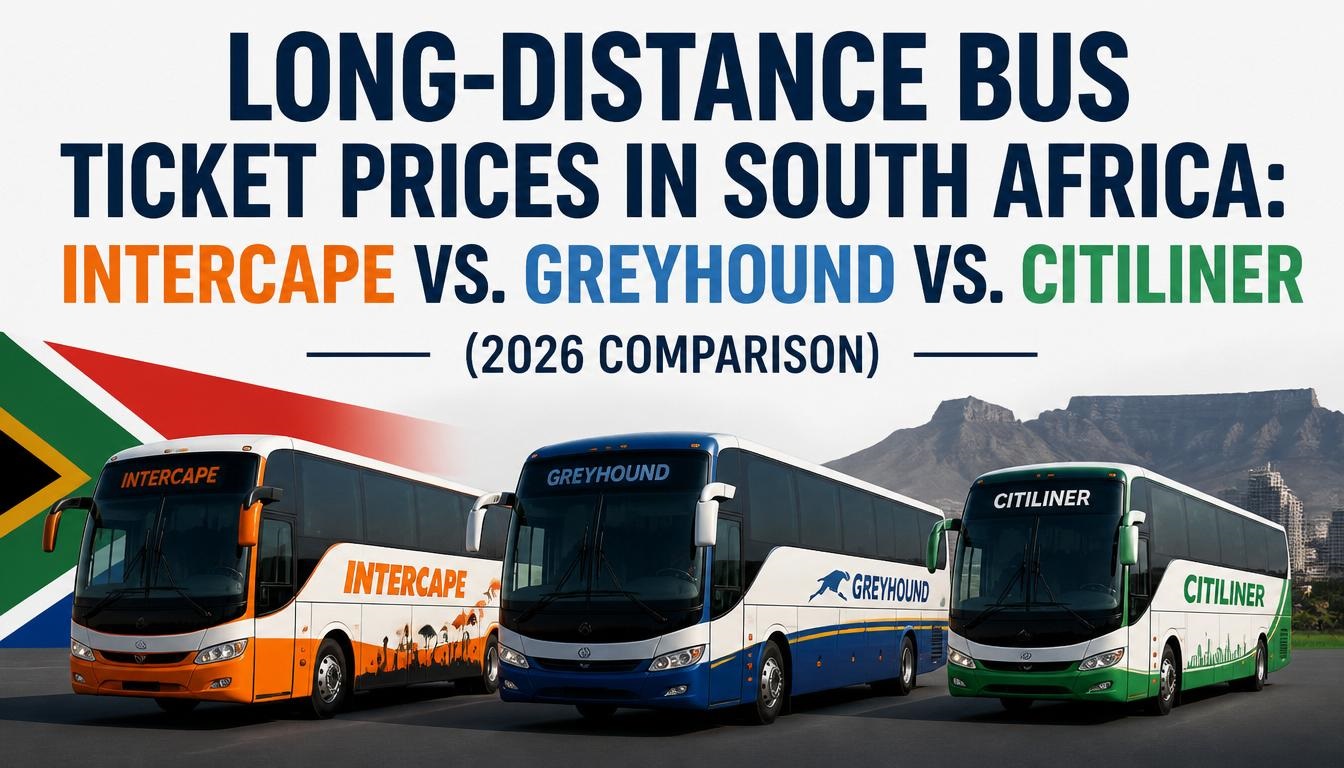
Among the dozen or so bus liners traversing our national highways—from the N1 through the Karoo to the N3 down to the KwaZulu-Natal coast—three names dominate passenger conversations: Intercape, Greyhound, and Citiliner.
While they all get you from Point A to Point B, their pricing structures, ticket flexibility, luggage allowances, and onboard comfort tiers could not be more different.
This deep-dive guide compares the current 2026 ticket prices, service tiers, hidden fees, and real-world seat comfort across Intercape, Greyhound, and Citiliner, helping you choose the exact coach for your budget and route.
At a Glance: 2026 Price & Service Comparison
Before diving into specific routes and onboard amenities, here is a quick direct comparison of how these three major South African coach operators stack up against one another.
| Feature / Criteria | Intercape | Greyhound | Citiliner |
| Market Positioning | Comprehensive National Coverage & Safety Leader | Premium Luxury & Express Comfort | Budget-Friendly Long-Distance Travel |
| Service Classes | Mainliner, Sleepliner, Express Budgetliner | Classic Luxury, Dreamliner | Express (Semi-Luxury) |
| Average Fare (JHB to CPT) | R650 – R1,150 | R780 – R1,350 | R580 – R850 |
| Average Fare (JHB to DUR) | R320 – R580 | R380 – R690 | R290 – R480 |
| Luggage Allowance | 1 bag up to 20 kg + 1 hand luggage | 2 bags up to total 30 kg + hand luggage | 1 bag up to 20 kg + 1 hand luggage |
| Reclining / Legroom | High (Sleepliner 150° recline) | Very High (Dreamliner extra wide) | Moderate (Standard intercity space) |
| Power & Wi-Fi | Charging ports on Sleepliner / Select Mainliner | USB charging at every seat, onboard media | Limited USB ports depending on coach |
| Ticket Flexibility | Saver, Flexi, Full Flexi tiers | Standard & Flexible tiers | Economy Saver / Standard |
| Route Reach | Over 100 cities, towns, and deep rural drop-offs | Major metros, provincial capitals, corridors | Major intercity economic routes |
1. Intercape: The Route King & Safety Specialist
Intercape is the giant of South African road transport. With over four decades of operational history, Intercape operates the largest route network across Southern Africa, extending deep into regional towns that other luxury lines skip entirely.
If you are travelling beyond major hubs—for instance, to places like Cradock, Graaff-Reinet, Mthatha, or up to the Namibian border—Intercape is often your primary or only premium option.
The Fleet Tiers
Intercape divides its operations into three distinct coach types, each tailored to different budgets and expectations:
-
Express Budgetliner: Designed strictly for price-conscious travellers. These double-decker or single-deck coaches focus on getting you there safely without luxury frills. Seats offer standard recline, air conditioning is fully operational, and onboard toilets are clean, but you won’t find individual charging ports or extended legroom.
-
Mainliner: The core workhorse of Intercape’s fleet. Mainliner coaches feature comfortable 2×2 reclining soft-cloth or leather seats, climate control, soft ambient lighting, and onboard toilet facilities. They strike a balance between affordability and long-distance durability.
-
Sleepliner: Intercape’s flagship service. Featuring extra-wide memory foam seats that recline up to 150 degrees with leg rests, the Sleepliner is engineered for overnight long-haul routes like Johannesburg to Cape Town or East London to Pretoria. Sleepliner coaches are equipped with 220V/USB charging points, dual-driver tracking systems, and smooth air suspension that absorbs the potholes along secondary routes.
Dynamic Pricing & Ticket Tiers
Intercape uses dynamic pricing similar to airline ticketing systems: as seats sell out, the price increases. They offer three ticket classes:
-
SAVER: The cheapest option. These tickets sell out weeks in advance and carry strict change or cancellation penalties (often non-refundable within 48 hours of departure).
-
FLEXI: Mid-range pricing that permits date changes up to 24 hours prior to departure for a minor admin fee.
-
FULL FLEXI: Premium pricing allowing last-minute rebooking and full refunds (less standard administration fees) up to 2 hours before boarding.
Greyhound remains an iconic benchmark in South African coach travel. After undergoing strategic restructuring and returning to South African roads under renewed management, Greyhound re-focused its fleet on high-comfort, direct corridor routes connecting major metropolitan centres like Johannesburg, Pretoria, Durban, Cape Town, Gqeberha, and Bloemfontein.
The Fleet Experience
When you step onto a Greyhound coach, you notice the focus on passenger space:
-
Premium Luxury Coaches: Equipped with plush leather seats, generous seat pitch (meaning your knees rarely touch the back of the seat ahead), individual reading lights, air-conditioning, and onboard restrooms.
-
Dreamliner: The top tier of Greyhound’s lineup. Featuring a 2×1 seating layout on the lower deck for extra aisle and shoulder room, alongside plush recline capabilities on the upper deck. Every seat includes dedicated USB charging ports, and the ride quality is notoriously smooth thanks to modernized vehicle stabilization systems.
Greyhound targets the traveller who does not mind paying an extra R50 to R150 over budget fares in exchange for quiet cabin environments, reliable climate control, and generous luggage allowances.
3. Citiliner: The Smart Semi-Luxury Budget Option
Operating under the same parent umbrella as Greyhound, Citiliner was created specifically to serve budget-conscious commuters without sacrificing mechanical safety or operational standards. Think of Citiliner as the low-cost carrier equivalent in long-distance bus travel.
What to Expect on Board
Citiliner coaches run primary intercity routes alongside Greyhound, often departing from the exact same bus terminals just minutes apart.
-
Semi-Luxury Layout: Citiliner utilizes high-density 2×2 seating configurations. While seat recline is somewhat limited compared to a Greyhound Dreamliner or Intercape Sleepliner, seats are fully padded and comfortable enough for 6-to-12-hour journeys.
-
Essential Amenities: Every Citiliner coach features air conditioning, driver tracking, and onboard toilet facilities. Extra frills like individual seatback screens or personal power points are omitted to keep ticket overheads low.
For students, budget solo travellers, and seasonal workers, Citiliner routinely delivers some of the lowest fares across major South African corridors.
Route-by-Route Breakdown & Real Price Comparison (2026)
Bus fares in South Africa fluctuate depending on peak travel seasons (school holidays, Easter weekend, December festive rush, and long weekends). The prices below represent typical off-peak and standard peak fare ranges across popular routes in South Africa.
Route 1: Johannesburg to Cape Town (Approx. 1,400 km | 18 – 20 Hours)
This is the ultimate long-haul test across the Great Karoo. Because you spend nearly a full day on board, seat comfort and air conditioning quality matter significantly.
-
Intercape (Express Budgetliner / Mainliner): R650 – R890
-
Intercape (Sleepliner): R920 – R1,250
-
Greyhound (Premium / Dreamliner): R790 – R1,350
-
Citiliner (Express): R580 – R820
Traveler’s Insight: On this 19-hour marathon, booking Intercape’s Sleepliner or Greyhound’s Dreamliner is well worth the extra R200-R300 if you plan to sleep overnight. The extended leg rests and wider recline angle drastically reduce leg swelling and fatigue by the time you reach the Cape Town station forecourt.
Route 2: Johannesburg to Durban (Approx. 570 km | 7 – 8.5 Hours)
The N3 corridor connecting Gauteng to KwaZulu-Natal is South Africa’s busiest highway route, especially ahead of long weekends.
-
Intercape (Mainliner): R340 – R520
-
Intercape (Sleepliner): R450 – R620
-
Greyhound (Premium Luxury): R380 – R680
-
Citiliner (Express): R290 – R450
Traveler’s Insight: Because this journey takes under 8 hours, saving money on Citiliner or an Intercape Mainliner ticket makes practical sense for daylight trips. However, if you are taking a midnight departure arriving in Durban at sunrise, a Greyhound or Sleepliner ticket lets you rest properly before your day begins.
Route 3: Pretoria / Johannesburg to Mthatha & Eastern Cape Towns (Approx. 850 km | 12 – 14 Hours)
Connecting Gauteng to the heart of the Eastern Cape, this route carries heavy passenger volumes year-round.
-
Intercape (Mainliner / Budgetliner): R520 – R780
-
Intercape (Sleepliner): R750 – R980
-
Greyhound (Premium): R590 – R850
-
Citiliner (Express): R480 – R690
Traveler’s Insight: Intercape offers the most comprehensive stop network across Eastern Cape towns, dropping passengers directly in towns like Butterworth, Queenstown (Komani), and Alice, whereas Greyhound and Citiliner tend to focus on primary drop-off points along main arterial routes.
Route 4: Cape Town to Gqeberha / Port Elizabeth via Garden Route (Approx. 750 km | 10 – 11 Hours)
A scenic coastal trek passing through George, Knysna, and Plettenberg Bay.
-
Intercape (Mainliner): R420 – R620
-
Greyhound (Premium Luxury): R460 – R690
-
Citiliner (Express): R380 – R550
Detailed Route Fare & Feature Matrix (2026 Averages)
| Route | Provider | Class | Average Off-Peak Fare | Average Peak Fare | Onboard Power Ports |
| JHB to Cape Town | Intercape | Saver Mainliner | R650 | R890 | Selected Seats |
| JHB to Cape Town | Intercape | Sleepliner | R920 | R1,250 | Yes (All Seats) |
| JHB to Cape Town | Greyhound | Dreamliner | R820 | R1,350 | Yes (USB) |
| JHB to Cape Town | Citiliner | Express | R580 | R820 | No |
| JHB to Durban | Intercape | Mainliner | R340 | R520 | Selected Seats |
| JHB to Durban | Greyhound | Premium | R380 | R680 | Yes (USB) |
| JHB to Durban | Citiliner | Express | R290 | R450 | No |
| Pretoria to Mthatha | Intercape | Mainliner | R520 | R780 | Selected Seats |
| Pretoria to Mthatha | Greyhound | Premium | R590 | R850 | Yes (USB) |
| Pretoria to Mthatha | Citiliner | Express | R480 | R690 | No |
A cheap ticket can quickly become expensive if you get caught out by baggage penalties or steep date-change fees at the terminal check-in desk. Here is how the rules differ between the three providers:
Luggage Rules & Excess Charges
-
Intercape: Passengers are allowed one main luggage item weighing up to 20 kg to be stowed in the under-bus hold, plus one small piece of hand luggage (backpack or handbag) to take onboard. Excess baggage is charged per kilogram at terminal check-in (typically R10 to R20 per extra kg depending on distance). If you are carrying large household items, tools, or commercial boxes, Intercape requires you to book them in advance through their dedicated Intercape Parcel Service rather than trying to check them in as passenger luggage.
-
Greyhound: Greyhound offers a slightly more generous allowance of two main bags totaling up to 30 kg combined, along with one hand luggage item. This makes Greyhound a favorite for students relocating for the academic term or travelers moving heavier personal gear. Overweight baggage fees apply if you cross the 30 kg limit.
-
Citiliner: Strictly enforces a 20 kg single-bag allowance per ticket holder. Because Citiliner operates on tight turnarounds, baggage marshals weigh bags strictly at major hubs like Park Station and Durban Station before issuing bag tags.
Ticket Changes, Cancellations, and Refunds
-
Intercape: Saver tickets are non-refundable and incur up to a 50% rebooking fee if changed close to departure. Flexi and Full Flexi tickets allow adjustments directly via the Intercape website or WhatsApp booking portal, making them a safer option if your travel dates might shift.
-
Greyhound & Citiliner: Tickets can be rebooked at company offices or authorized ticket agents (such as Computicket) up to 6 hours before departure for a nominal administrative fee plus any difference in ticket price. Refunds are generally issued as credit vouchers rather than cash payouts unless the service cancellation was initiated by the bus line.
Safety, On-Time Performance, and Boarding Experience
When comparing coach companies, safety standards and boarding procedures are just as critical as ticket prices.
Driver Fatigue and Fleet Tracking
-
Intercape: Known for its rigorous safety management infrastructure. Coaches are satellite-tracked 24/7 from a central operations room, enforcing strict speed limits (capped at 100 km/h). On routes longer than 6 hours, Intercape deploys dual-driver crews who rotate at mandatory rest stops along national highways.
-
Greyhound & Citiliner: Utilize modern telematics to monitor vehicle locations, driver engine hours, and braking behavior. Drivers undergo regular safety refreshers, and coaches undergo safety inspections prior to clearing main depot departures.
Bus Station Safety Tips in South Africa
Boarding long-distance buses often requires navigating busy urban transport hubs. Follow these practical guidelines to ensure a stress-free boarding experience:
-
Arrive Early: Always arrive at least 45 to 60 minutes prior to departure. Luggage tagging queues at major terminals like Johannesburg Park Station, Pretoria Bosman Street, or Cape Town Station can get very long during peak periods.
-
Keep Belongings Close: Never leave small hand luggage or personal electronics unattended on seating benches. Keep laptops, phones, passports, and ID documents in a small chest pouch or secure handbag that stays on your person at all times.
-
Use Official Porter Services: Only allow uniformed station staff or verified bus line attendants to handle your tagged hold luggage. Always double-check that the bag tag number given to you matches the sticker attached to your suitcase.
-
Confirm Bus Stops along Rural Routes: If you are disembarking at an en-route drop-off point rather than a central city station (such as a roadside filling station stop), inform the bus driver and steward when loading your bags so your luggage is placed in the accessible door-side compartment.
Insider Hacks: How to Get the Cheapest Bus Tickets in South Africa
If you want to stretch your Rand as far as possible, keep these expert booking strategies in mind:
-
Book 2 to 3 Weeks Ahead: Dynamic pricing algorithms kick in hard during the final 7 days before departure. Securing an Intercape SAVER tier ticket early can save you up to 40% compared to a last-minute ticket bought on the day of departure.
-
Travel Mid-Week: Tuesday and Wednesday departures are consistently R50 to R150 cheaper across all three operators compared to Thursday, Friday, and Sunday afternoon trips.
-
Use Aggregator & Supermarket Booking Counters: You don’t always have to book directly on individual bus websites. Services like Computicket, Busbud, and ticketing desks inside Shoprite, Checkers, and Pick n Pay allow you to compare real-time departure times and prices for Intercape, Greyhound, and Citiliner side-by-side.
-
Join Loyalty Programs: Intercape offers a loyalty program where frequent travellers earn points redeemable against future ticket purchases—ideal for students and regular long-distance commuters.
Final Verdict: Which Bus Operator Should You Choose?
-
Choose Intercape IF: You are travelling to regional or smaller towns, prioritize established 24/7 safety tracking systems, or want a near-flat sleeping experience on their premium Sleepliner coaches.
-
Choose Greyhound IF: You value generous luggage limits (up to 30 kg), extra seat width, and reliable onboard USB charging ports on major intercity routes.
-
Choose Citiliner IF: You want the absolute lowest ticket fare on major intercity corridors while maintaining peace of mind regarding vehicle roadworthiness and driver safety standards.
Community Discussion & Real Experiences
Now over to you! Travel experiences can vary depending on the specific route, driver, and time of year.
Which long-distance bus line do you rely on for your journeys across South Africa? Have you recently taken Intercape’s Sleepliner or Greyhound’s Dreamliner between Jozi and Cape Town? Drop your thoughts, questions, or recent ticket price updates in the comments below to help fellow travellers plan their next trip!

Joseph Mathebula is a consumer analyst and market researcher at Prices in South Africa. He specializes in tracking local service costs, retail pricing, and travel budgets, helping everyday shoppers navigate the market to secure the best value.