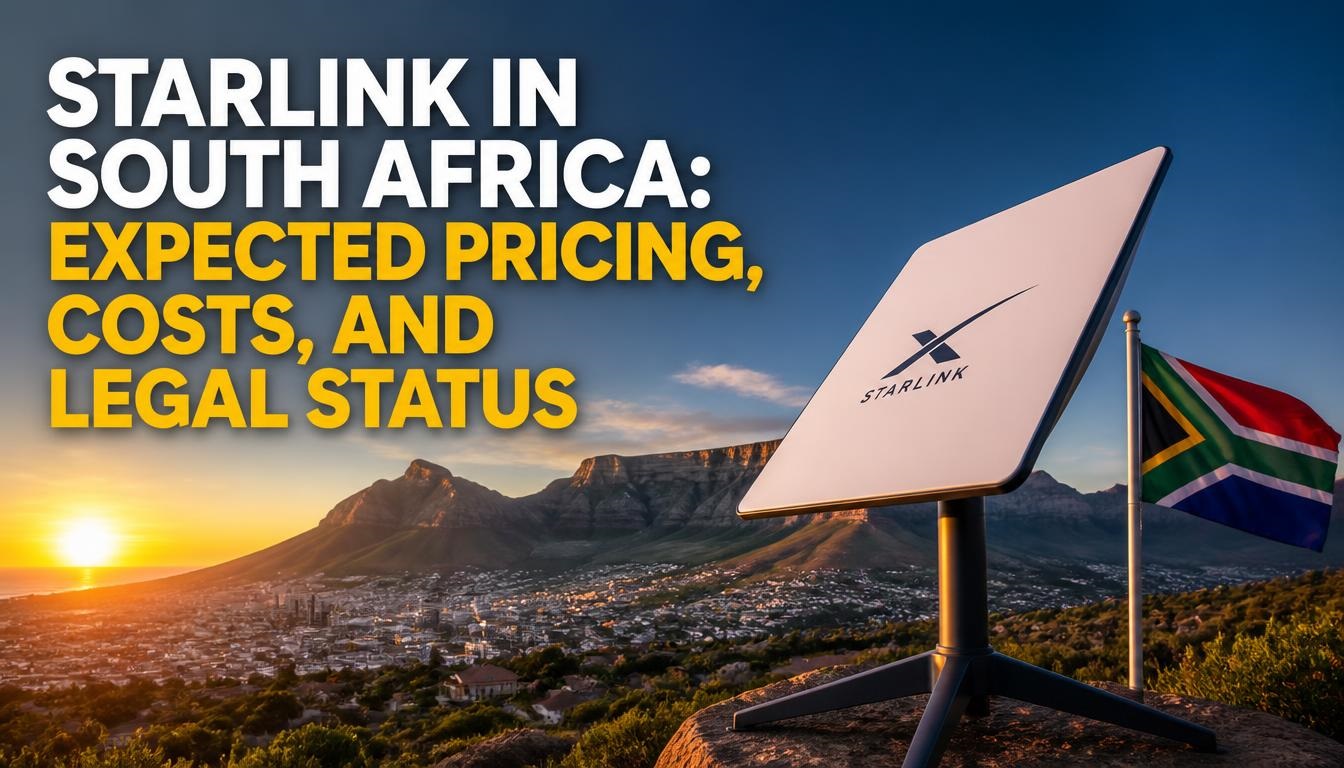
Farmers in the Karoo, lodge operators in the Bushveld, and off-grid homesteaders all face a common problem: zero reliable fiber or high-speed LTE options. SpaceX’s low-Earth orbit (LEO) satellite network promises fixed-line fiber speeds anywhere under the African sky.
Before importing hardware or paying cross-border subscription fees, you need to understand the true financial, technical, and regulatory reality of operating Starlink in South Africa.
Starlink South Africa Quick-Answer Summary
The Real Cost of Getting Starlink Up and Running in SA
Acquiring Starlink in South Africa isn’t as simple as ordering a dish off Takealot or Makro. Because SpaceX has not officially launched retail billing within South African borders, buyers rely on parallel imports, cross-border forwarding, or specialized importers.
Here is how the real costs break down across gray-market hardware acquisition, cross-border subscriptions, and structural accessories:
| Starlink Hardware & Plan Variant | Estimated Total ZAR Cost | Monthly Subscription | VAT / Taxes Included? | Value Rating | Market Link & Specs |
| Starlink Mini (Self-Imported) | R5,600 – R7,500 | ~R900/mo (Regional Roam 100GB) | Excludes import SARS duties | ★★★★☆ | Check Starlink Global Specs |
| Gen 3 Standard Kit (Local Importer) | R9,500 – R13,000 | ~R1,260/mo (Regional Roam Uncapped) | Includes reseller markup & VAT | ★★★☆☆ | View ICASA Spectrum Notices |
| Gen 3 Standard Kit (Direct Import) | R6,800 – R8,500 | ~R1,260/mo (Mozambique / Eswatini Billing) | Subject to 15% VAT + SARS clearance | ★★★★☆ | Review Customs Tariffs – SARS |
| High-Performance / Business Site | R35,000 – R48,000 | R2,500 – R5,000/mo (Priority Global Data) | Excludes customs duty & clearance | ★★☆☆☆ | Check Commercial Asset Finance |
ICASA, Licensing, and the 30% B-BBEE Hurdle
Why isn’t Starlink officially selling dishes directly to South Africans in Rand? The answer comes down to local telecommunications regulations.
Under the Electronic Communications Act (ECA), any entity operating a commercial communications network in South Africa must hold two primary authorizations from the Independent Communications Authority of South Africa (ICASA):
-
An Individual Electronic Communications Network Service (I-ECNS) License (to deploy network infrastructure and beam ground spectrum).
-
An Individual Electronic Communications Service (I-ECS) License (to sell internet services to end-users).
Historically, Section 13 of the ECA mandated that holders of individual licenses maintain a minimum of 30% ownership by historically disadvantaged groups (B-BBEE). SpaceX operates all international subsidiaries through direct corporate ownership, which created a regulatory deadlock.
While the Department of Communications and Digital Technologies issued policy directives allowing alternative Equity Equivalent Investment Programs (EEIPs), ICASA’s regulatory review remains ongoing. As a result:
-
No direct billing in ZAR: You cannot sign up using a South African physical residential address on the official Starlink map.
-
No local ICASA Type Approval: Gray-market imported dishes do not carry an official ICASA compliance sticker, which presents legal risks for registered corporate entities.
-
The “60-Day Roaming Restriction”: Starlink’s global terms stipulate that Regional Roam kits outside their home registration country must return home or update their billing address periodically. While users bypass this by changing foreign service addresses or using multi-country roaming, enforcement policies can change overnight.
Power Draw and Load-Shedding Survival
Starlink dishes are active phased-array antennas. Unlike passive satellite dishes, they continuously compute, track, and electronically steer beams toward orbiting satellites, which requires continuous power.
Average Power Consumption Profile
-
Gen 2 Actuated Dish: 45W – 65W (Idle/Standard) | 75W – 100W (Peak)
-
Gen 3 Standard (V4): 75W – 110W (Idle/Standard) | 120W – 150W (Peak)
-
Starlink Mini: 25W – 40W (Idle/Standard) | 50W – 60W (Peak)
During stage 4 to stage 6 load-shedding or extended grid failures, running a Gen 3 dish drawing 90W continuously will drain a basic 12V 100Ah Lead-Acid battery in under 5 hours.
Designing a Reliable Off-Grid Power Setup
To keep a Starlink unit running during power cuts:
-
LiFePO4 Power Station: A 512Wh to 1024Wh Lithium Iron Phosphate (LiFePO4) portable power station (such as an EcoFlow, Bluetti, or Gizzu unit) will run a Gen 3 dish for 6 to 11 hours.
-
Direct DC-to-DC Conversion: Running a dish through a standard 230V AC inverter introduces a 10% to 15% power conversion loss. Utilizing specialized 12V/24V to 48V/56V step-up DC converters lets you power the dish directly from off-grid solar batteries, cutting overall power consumption significantly.
-
Starlink Mini Efficiency: The Starlink Mini runs on standard USB-PD (Power Delivery) at 100W (20V/5A), allowing it to power directly off a high-capacity power bank in the field.
Extreme Heat, Dust, and Coastal Corrosion Tests
South Africa’s climate poses distinct environmental challenges for sensitive electronics:
1. The Bushveld & Karoo Thermal Test
In regions like Limpopo, the Northern Cape, and the Karoo, ambient summer temperatures regularly cross 40°C, with roof surfaces reaching over 60°C.
-
High internal temperatures cause the dish terminal to throttle throughput to protect its board, reducing speeds down to 5–10 Mbps.
-
Mitigation: Mount the dish on a pole elevated off iron roof sheets to ensure proper airflow underneath.
2. Coastal Salt-Air Corrosion (KZN & Western Cape)
Salt air along the coastline degrades standard mild steel mounting brackets within 12 to 18 months.
-
Standard hardware mounting bolts rust quickly near the sea.
-
Mitigation: Use 3CR12 stainless steel or marine-grade aluminum mounting brackets, along with silicone-sealed rubber boots on all exposed RJ45 ethernet connections.
3. Dust Ingress & Lightning Strikes
Highveld electrical storms bring massive voltage spikes, while dry dusty interior regions threaten unsealed cable entries.
-
Mitigation: Run all outdoor cables through UV-resistant conduit. Install inline ethernet surge protectors grounded directly to your building’s earth spike to guard against lightning-induced strikes.
Purchasing a Starlink setup involves several hidden expenses beyond the base price:
-
Overseas Base Price: e.g., $350 (~R6,300 ZAR)
-
Foreign Transaction Fees: 2% to 3.5%
-
Freight Forwarding / Express Courier: ~R1,200 – R2,200
-
SARS Customs Duty: 15% ad valorem
-
Local Import VAT: 15%
-
Total Landed SA Cost: R9,800 – R11,500 ZAR
Key Cost Traps to Watch
-
SARS Customs Tariff Duties: Communications equipment imported without appropriate clearance tags can be held by South African Customs (SARS) at OR Tambo or Cape Town International. Customs clearance fees, ad valorem duties, and 15% import VAT can quickly add 25% to 40% to your original purchase cost.
-
Reseller Overcharging: Local gray-market importers often mark up standard R6,800 kits to R13,000 or higher. While buying from a local reseller offers quicker delivery, it rarely includes a valid South African warranty. If the hardware fails, you must ship it back to the original country of registration for repairs.
-
Cross-Border Exchange Rate Fluctuation: Subscriptions billed in Mozambican Metical (MZN), US Dollars (USD), or Euro (EUR) fluctuate based on the ZAR exchange rate, causing your monthly internet bill to vary month-to-month.
Frequently Asked Questions
Can ICASA confiscate my Starlink dish?
ICASA has the legal authority under the Electronic Communications Act to seize non-type-approved radio equipment and issue fines to unauthorized operators. While enforcement historically targets large-scale unauthorized commercial providers rather than private home users, operating an unlicensed dish carries inherent legal risk.
Does the Consumer Protection Act (CPA) apply to gray-market Starlink units?
No. If you purchase a unit registered in a neighboring country or through an informal parallel importer, South Africa’s Consumer Protection Act (CPA) six-month implied warranty offers limited protection. Warranty claims must be handled directly through SpaceX in the original registration country.
Can I run a business off a Starlink Regional Roam package?
While many rural lodges, farms, and mines rely on Roam packages for daily operations, Roam data carries lower priority on the network than dedicated Fixed Residential or Business tiers. During peak hours (6 PM – 10 PM), roaming speeds may drop, which can impact video conferencing and heavy cloud backups.
How does Starlink compare to local 5G or Fixed-Wireless (LTE)?
If you have line-of-sight access to local MTN, Vodacom, or Rain 5G towers, local fixed-wireless options are generally cheaper (R499 – R899/mo), offer lower latency (15–30 ms), and operate fully legally. Starlink is best suited for locations where terrestrial mobile networks offer weak edge-of-coverage performance.
Local Community Discussion
Are you using Starlink on a farm, lodge, or mobile rig in South Africa? Share your current monthly subscription costs, foreign country of registration, and real-world speeds in the comments below.
Disclaimer: Prices fluctuate and reflect independent market research at the time of publication. We may earn a small affiliate commission through qualified links at no extra cost to you.

Joseph Mathebula is a consumer analyst and market researcher at Prices in South Africa. He specializes in tracking local service costs, retail pricing, and travel budgets, helping everyday shoppers navigate the market to secure the best value.