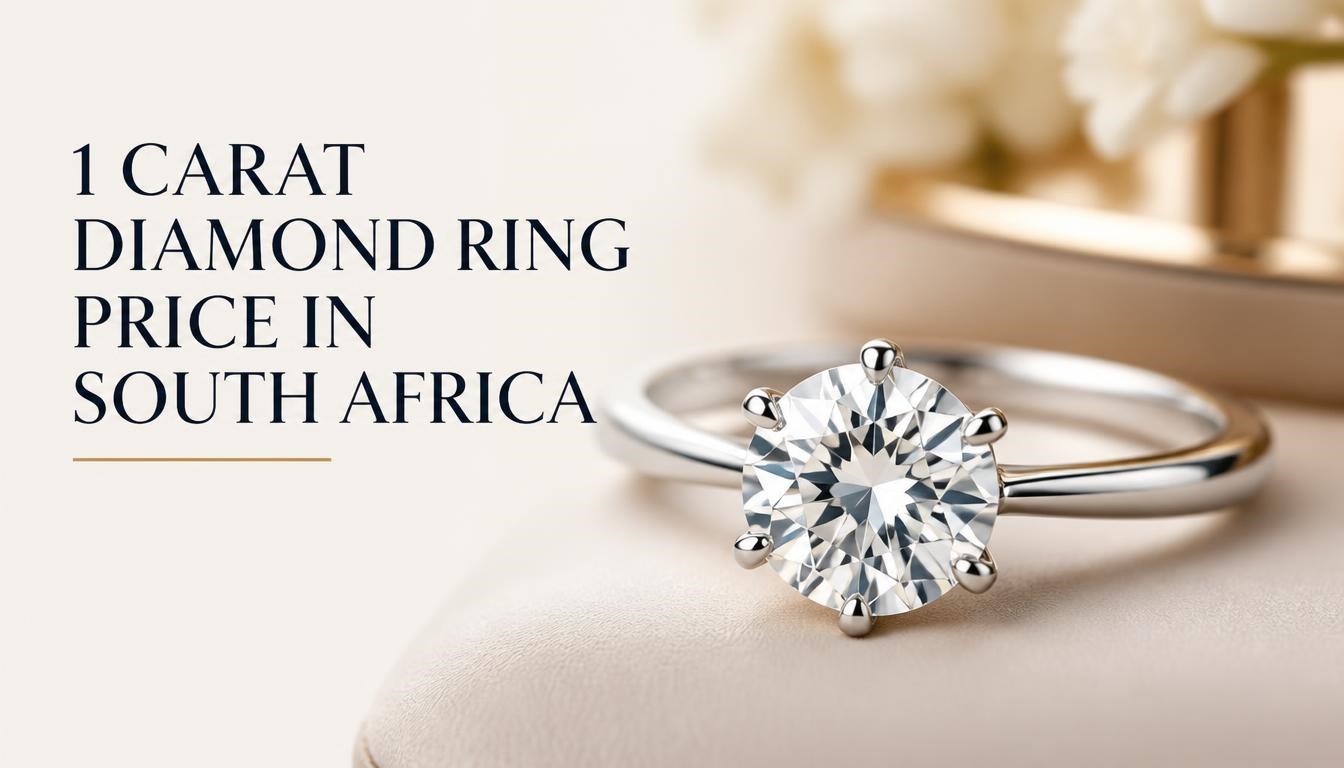
Buying a diamond ring in South Africa comes with a major price trap: retail brand markups and stone origin can swing your total cost by up to 400% for the exact same visual footprint.
Quick-Answer Pricing Summary
The Real Cost Breakdown: Natural Mined vs. Lab-Grown in ZAR
Evaluating a 1 Carat Diamond Ring Price in South Africa requires looking beyond retail glass counters in Sandton City or V&A Waterfront. The diamond market in South Africa has shifted dramatically as lab-grown stones match natural diamonds carbon-for-carbon at a fraction of the cost.
-
1.0ct Lab-Grown (VS/F): R18,000 – R32,000 — Exceptional Value / Smart Saver
-
1.0ct Natural (SI1/H): R85,000 – R135,000 — Classic Mined / Value Natural
-
1.0ct Natural (VS2/G): R145,000 – R210,000 — High-Tier Investment / Heritage
-
1.0ct Boutique Natural: R220,000 – R350,000+ — Luxury Brand / High Markup
Prices include 15% South African VAT. Metal choices like 18ct Gold or Platinum add between R6,000 and R15,000 to the base setting price.
2026 SA Diamond Pricing Matrix
Below is a direct market pricing breakdown across popular stone choices, settings, and certified options available across South Africa.
| Ring Configuration | Diamond Origin | Metal Choice | Build / Lead Time | Price (ZAR incl. 15% VAT) | Market Action Link |
| Classic Solitaire (1.0ct Round) | Lab-Grown (VS2, H) | 9ct White Gold | Ready / 3 Days | R17,950 – R22,500 | Ralph Jacobs Rings – View Details |
| Hidden Halo Solitaire (1.0ct Oval) | Lab-Grown (VS1, F) | 18ct Yellow Gold | 7–10 Business Days | R26,500 – R34,000 | Zermatt Diamonds – Check Category Specs |
| Classic 6-Prong (1.0ct Round) | Mined Natural (SI1, H) | 18ct White Gold | 10–14 Business Days | R89,000 – R115,000 | Diamond Corporation SA – View Details |
| Pavé Accent Band (1.0ct Cushion) | Mined Natural (VS2, G) | Platinum | Custom (14 Days) | R165,000 – R215,000 | Shimansky Collections – View Details |
| Vintage Trilogy (1.0ct + Accents) | Mined Natural (VVS2, E) | 18ct Rose Gold | Custom (21 Days) | R245,000 – R320,000 | Browns Jewellers – View Details |
What Drives the 1 Carat Diamond Ring Price in South Africa?
Understanding why one 1-carat diamond ring costs R20,000 while another costs R200,000 comes down to five key pricing variables:
1. The Origin Factor: Mined vs. Lab-Grown
-
Mined Diamonds: Extracted through heavy industrial mining (often in South Africa, Botswana, or Namibia). Natural scarcity drives up prices. A 1-carat natural diamond cut to ideal proportions retains high resale appraisal values, but requires a significant initial capital outlay.
-
Lab-Grown Diamonds: Created using Chemical Vapor Deposition (CVD) or High-Pressure High-Temperature (HPHT) processes. They possess identical chemical, physical, and optical properties to mined diamonds. In South Africa, lab-grown diamonds sell for 75% to 85% less than their mined counterparts.
2. The Cut Grade (The SA Brilliance Secret)
Never compromise on cut quality to save money on a 1-carat stone. A poorly cut 1-carat diamond will appear dark and lifeless under direct sunlight. Prioritize an Excellent or Ideal cut grade (GIA or IGI). A well-cut 0.90-carat diamond will often look larger and brighter than a poorly cut 1.00-carat stone.
3. Setting Metal & Coastal Corrosion Realities
-
9ct vs 18ct Gold: 9ct Gold (R4,000 – R8,000 setting cost) contains 37.5% pure gold, making it durable and budget-friendly. 18ct Gold (R9,000 – R16,000) contains 75% pure gold, offering a richer yellow tone or brighter white metal base.
-
Platinum: Highly recommended for coastal dwellers in places like Cape Town, Durban, or Port Elizabeth. Platinum is hypoallergenic, does not wear down over time, and resists tarnish from coastal air. Expect to pay a R3,000 to R7,000 premium over 18ct gold settings.
4. Import Tariffs & The Rand/Dollar Exchange Rate (USD/ZAR)
Unset diamonds are priced globally in US Dollars (Rapaport Diamond Report index). When the Rand depreciates against the Dollar, local stock replacement costs rise immediately. Buying from local manufacturing jewelers who maintain existing raw gemstone inventory can shield you from temporary exchange rate spikes.
Consumer Protections & Legal Safeguards in South Africa
Buying a diamond ring represents a significant financial investment. Ensure your transaction is fully protected under South African law:
-
Certification Standards: Demand a certificate from a recognized independent laboratory: GIA (Gemological Institute of America), IGI (International Gemological Institute), or EGL South Africa. Never accept an “in-house evaluation certificate” provided solely by the seller without independent verification.
-
Laser Inscription Check: A certified 1-carat diamond should have its certificate number microscopic laser-inscribed on its girdle. Verify this number under a gemological loupe or microscope at the store before finalizing payment.
-
The Consumer Protection Act (CPA): Under Act 68 of 2008, South African consumers are entitled to clear disclosures regarding stone origin (natural vs. lab-grown synthetic). Selling lab-grown stones without clear written disclosure is illegal.
-
Valuation Certificates for Insurance: Ensure your purchase includes a detailed insurance replacement valuation certificate listing the stone’s 4Cs, metal weight, and current ZAR value incl. 15% VAT. You will need this document to add the ring to your personal items insurance policy (e.g., via Santam, Outsurance, or Discovery Insure) before leaving the store.
Real-World SA Conditions: Wearing Your Ring Daily
Living in South Africa requires keeping practical lifestyle factors in mind when choosing a ring setting:
-
Safety & Everyday Wear: High-prong settings can catch on clothing or pull loose during active daily routines. Low-profile bezel settings or flush-set solitaire styles are ideal for daily wear in urban areas.
-
Water Quality & Cleaning: Hard municipal water or borehole water can build up mineral deposits behind the diamond’s pavilion. Clean your ring every few weeks using warm water, mild dishwashing liquid (like Sunlight Original), and a soft toothbrush.
-
Load-Shedding & Security: If you are visiting a local jeweler for custom sizing or diamond viewing, schedule appointments during guaranteed power hours or select studios equipped with solar/backup power to ensure high-grade gemological lighting and video loupe viewing remain operational.
Frequently Asked Questions (SA Buyer Guide)
Is a lab-grown diamond real, and will it pass a diamond tester in South Africa?
Yes. Lab-grown diamonds are 100% real diamonds (pure crystallized carbon). They pass standard thermal and electrical diamond testers used by South African jewelers. Only specialized gemological equipment can distinguish them from mined diamonds based on trace growth patterns.
How much should I spend on insurance for a 1-carat diamond ring in SA?
Insurance premiums generally range from 1.5% to 3% of the ring’s total appraised value per year. For an R100,000 natural diamond ring, expect your monthly insurance addition to be roughly R150 to R250 per month, provided it is specified under your home contents policy.
Can I travel overseas from South Africa with an expensive diamond ring?
Yes. However, if your ring is valued over R50,000, register it at SARS Customs at your departing airport (e.g., OR Tambo or Cape Town International) using a DA65 form before departure. This prevents customs officials from assessing import duty when you return to South Africa.
Local Community Discussion
Have you recently purchased or quoted a 1-carat diamond ring in Johannesburg, Cape Town, or Durban? Share your experience below!
-
What ZAR quotes have you received recently from local manufacturing jewelers vs retail chains?
-
Are you opting for a natural mined stone or a lab-grown diamond for your setting?
Leave your comments, questions, or regional stock updates below to help fellow South African shoppers make informed decisions!
Disclaimer: Prices fluctuate and reflect independent market research at the time of publication. We may earn a small affiliate commission through qualified links at no extra cost to you.

Joseph Mathebula is a consumer analyst and market researcher at Prices in South Africa. He specializes in tracking local service costs, retail pricing, and travel budgets, helping everyday shoppers navigate the market to secure the best value.