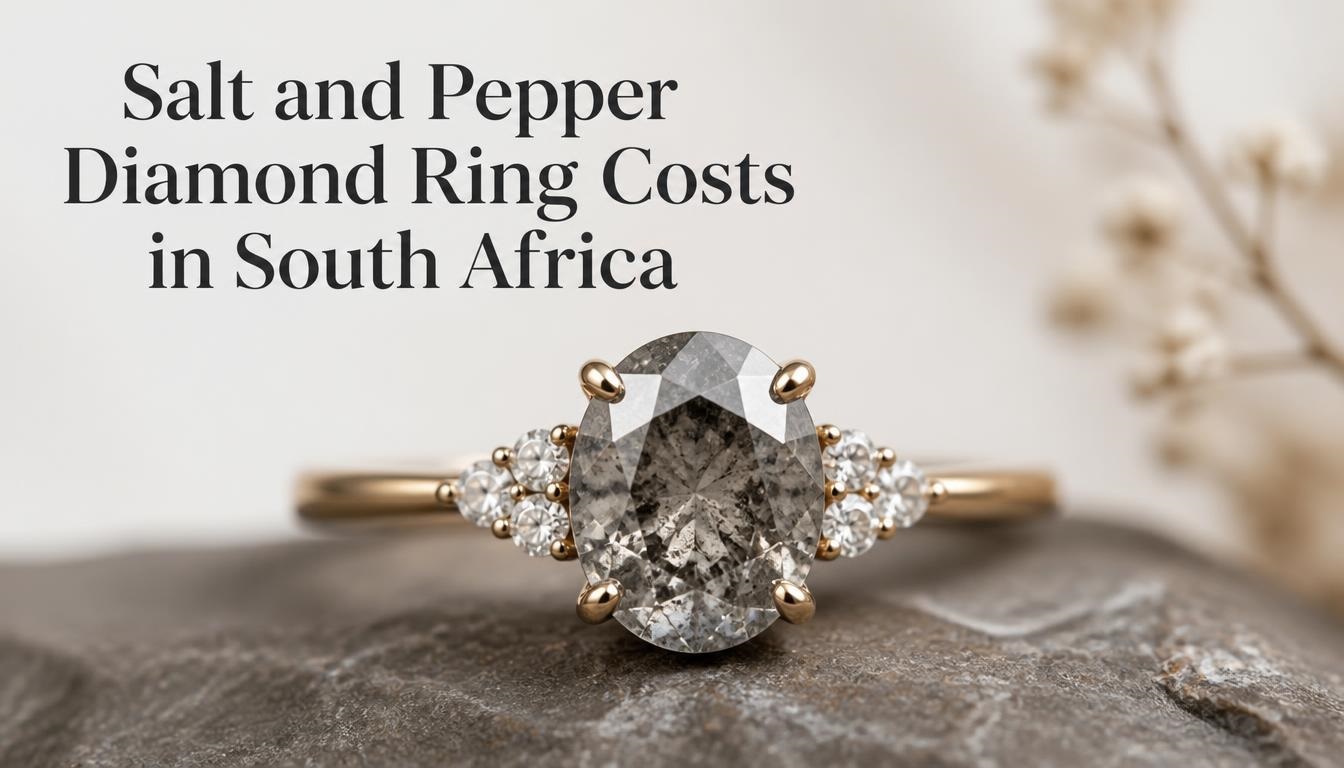
Traditional jewelers want you to believe that a flawless, colorless white diamond is the only acceptable symbol of commitment. But as diamond prices fluctuate and unique design aesthetics gain traction across Johannesburg, Cape Town, and Durban, the salt and pepper diamond ring has shifted from an obscure alternative to a mainstream favorite.
These stones feature heavy visible inclusions—black carbon spots (pepper) and white feathers or clouds (salt)—creating a galaxy-like effect inside the crystal. Because they skip the extreme refinement costs of traditional stones, they offer massive surface area per Rand.
Before visiting a design studio in Rosebank or ordering online from a Cape Town boutique, understanding how local goldsmiths price these gems, the structural risks involved, and where buyers get caught off guard ensures you get maximum value.
Salt & Pepper Diamond Quick-Answer Summary
SA Market Price Matrix: Salt & Pepper Diamond Rings
The following table reflects current retail and custom-manufacturing market rates in South Africa for completed salt and pepper diamond rings. Prices include 15% VAT and standard alloy settings.
| Ring Style & Carat Weight | Metal Choice | Average Lead Time | Typical Price Range (ZAR) | Value Rating | Quick Market Action |
| 0.3ct – 0.5ct Petite Solitaire | 9ct Yellow / Rose Gold | Ready-ship or 10-14 days | R8,500 – R14,000 | Exceptional | Check Category Specs |
| 0.8ct – 1.0ct Mid-Range Geometric | 9ct Gold / Sterling Silver | 14–21 working days | R14,500 – R22,000 | Excellent | View Local Artisans – View Details |
| 1.2ct – 1.5ct Statement Rose Cut | 14ct / 18ct Gold | 21 working days | R22,000 – R32,000 | Very High | Compare Stone Grades |
| 1.75ct – 2.0ct+ Hexagon/Kite Set | 18ct Gold or Platinum | 21–30 working days | R30,000 – R48,000+ | Moderate | Custom Design Inquiry |
| Gents Band with Salt & Pepper Accents | 9ct Gold / Titanium | 10–15 working days | R5,500 – R11,000 | Good | Check Category Specs |
What Drives the Real Cost of a Salt and Pepper Diamond Ring?
Unlike standard GIA-graded white diamonds that follow the rigid 4Cs (Carat, Cut, Color, Clarity), salt and pepper diamonds are valued on individual character, pattern symmetry, overall structural stability, and unique cuts.
1. The Carat Weight vs. Visual Footprint Trick
Salt and pepper diamonds are predominantly fashion-cut into rose cuts rather than traditional brilliant cuts.
-
Brilliant Cut: Has a deep pavilion (bottom cone) where 40% of the diamond’s weight is hidden underneath the setting.
-
Rose Cut: Features a flat bottom and a faceted dome top.
Because the weight is distributed horizontally rather than vertically, a 1.0ct rose cut salt and pepper diamond will often have the same outer visual diameter (roughly 6.5mm) as a 1.5ct brilliant cut white diamond. You are effectively paying for visual surface area rather than hidden carat depth, making your Rand stretch much further on the finger.
2. Metal Choice Matters (9ct vs 18ct vs Platinum)
The metal chosen for the setting heavily dictates total quote pricing in South Africa:
-
9ct Gold (Yellow, Rose, White): The most popular local choice. It is durable, hard-wearing, and cost-effective. A 9ct gold band typically adds R3,500 to R6,000 in metal and labor to the raw stone price.
-
14ct / 18ct Gold: Premium option with a richer yellow tone, adding R7,500 to R14,000 to the build.
-
Platinum: The densest precious metal, requiring specialized workshop casting equipment. It usually adds R9,000 to R16,000 to the custom build cost.
3. Fancy Shapes and Geometric Precision
Round salt and pepper diamonds are relatively common, but geometric shapes drive high demand in local boutique markets. Kite cuts, hexagons, trillions, and elongated pears require specialized lapidary work to navigate internal inclusions without shattering the rough stone during slicing. Expect to pay a 15% to 25% premium for clean, highly symmetrical kite or hexagon cuts compared to standard oval or round cuts.
Structural Mechanics: Spotting Dangerous Fractures Before Buying
Because salt and pepper diamonds owe their distinctive look to dark carbon deposits and structural feathery inclusions, not every stone is suitable for daily wear. Buying blindly online based on an edited studio photograph poses a distinct financial risk.
Internal Inclusions vs. Surface-Reaching Cracks
-
Internal Pepper/Clouds: Perfectly safe. These are trapped graphite and carbon minerals inside the diamond crystal lattice. They do not compromise structural durability.
-
Surface-Reaching Cavities & Cleavage Lines: Dangerous. If a dark carbon line runs all the way to the edge or surface of the stone, it creates a structural point of weakness. Under localized mechanical stress (such as knocking your hands against a steel gym dumbbell or marble kitchen counter), the diamond can split along that fracture plane.
Setting Selection for South African Lifespans
When commissioning a salt and pepper engagement ring, setting design is a critical structural safeguard, not just a style choice:
-
Bezel Settings: A thin wall of gold or platinum completely encases the outer rim of the diamond. This offers maximum protection against side impacts and completely shields fragile edges on kite or pear shapes.
-
V-Prongs: If you prefer open prongs on sharp-cornered shapes (like a chevron or kite cut), insist that your jeweler installs V-shaped prongs on the tips. Standard rounded claws leave corners exposed to impact chips.
South African Environmental & Operational Stress Test
South Africa’s specific climate, infrastructure, and active outdoor lifestyle place distinct demands on daily-wear fine jewelry.
Coastal Corrosion & Salt Air Resistance
If you live along the coast in Durban, Port Elizabeth, or Cape Town, airborne salt moisture slowly dulls low-karat alloys. While the diamond itself is immune to chemical corrosion, low-quality silver or unplated nickel-heavy white gold mounts will tarnish quickly. Opt for solid 9ct/14ct yellow gold or platinum to eliminate environmental oxidization.
Hand Sanitizer, Chemicals, and Off-Grid Heat
Salt and pepper diamonds withstand heat and household chemicals just like standard diamonds. However, thermal shock can expand internal carbon inclusions faster than the surrounding diamond matrix.
Avoid wearing your ring into hot springs or when using heavy industrial steam tools. Daily exposure to alcohol-based hand sanitizers will not harm the diamond or gold, though it may leave a film over rose-cut facets that requires gentle cleaning with warm water and soft dish soap.
Corrugated Roads and Active Lifestyles
For individuals who spend weekends in the bushveld or driving corrugated gravel roads in the Karoo, ring settings endure constant vibration. Micro-claw settings holding tiny halo diamonds can loosen over time. Ensure your local manufacturer performs a 12-month claw tension check to guarantee side stones remain secure.
Legal Protections, Certification, and eNaTIS Parallel Safeguards
Buying fine jewelry in South Africa involves specific legal rights and insurance verification processes.
Consumer Protection Act (CPA) Rights
Under Section 55 and 56 of the South African Consumer Protection Act (CPA), consumers have an implied warranty of quality. If a custom-made ring develops a material manufacturing defect (such as a cracked setting, poor casting porosity, or a loose stone due to faulty claw craftsmanship) within six months of delivery, the supplier is legally obligated to repair, replace, or refund the item.
Note that CPA protections do not cover accidental damage (e.g., dropping the ring onto tile or crushing it in a car door), which falls under personal short-term insurance.
Valuation Certificates for SA Short-Term Insurance
Before leaving the jeweler, secure a signed Valuation Certificate for Insurance Purposes detailing:
-
The exact metal purity (e.g., 9ct Yellow Gold, stamped 375).
-
Total gram weight of the finished ring.
-
Specific carat weight, dimensions, and shape of the salt and pepper center stone.
-
Replacement retail value inclusive of 15% VAT.
Most short-term insurers (Outsurance, Santam, Discovery Insure) require this document to list the ring under your specified portable possessions policy cover.
The Certification Reality for Salt & Pepper Stones
Do not expect a standard GIA or EGL diamond grading report for a salt and pepper diamond. Major international labs do not issue traditional clarity/color grades for heavily included stones, as they fall outside conventional color scales.
Instead, reputable South African manufacturing jewelers provide an in-house certificate of authenticity or an independent local laboratory report (from labs like DIA or EGL South Africa) verifying that the stone is a natural, earth-mined diamond and not a synthetic diamond or lab-grown treated imitation.
Smart Buyer Checklist: Avoiding Local Jewelry Price Traps
Before making an EFT payment or entering a lay-by agreement with a local boutique, run through these strategic buying steps:
-
[ ] Verify Stone Origin & Authenticity: Confirm in writing that the stone is a 100% natural earth-mined diamond, not a treated grey sapphire or lab-grown simulant.
-
[ ] Check Surface Feathers under 10x Loupe: Inspect the gem under magnification. Ensure dark inclusion lines do not split the outer edge of the stone where prongs apply pressure.
-
[ ] Insist on All-Inclusive Quotes: Verify that the written quote explicitly includes 15% South African VAT, metal casting, setting labor, sizing adjustments, and insured door-to-door courier freight.
-
[ ] Confirm First Free Resizing: Ensure your contract includes at least one free ring resize within 30 days of purchase—a standard policy among top-tier SA artisans.
-
[ ] Review Payment Terms: Compare cash/EFT discounts against flexible payment methods like PayJustNow, Happy Pay, or traditional lay-by arrangements.
Frequently Asked Questions About Salt & Pepper Rings
Are salt and pepper diamonds real diamonds?
Yes. They are 100% natural, earth-mined diamonds containing heavy concentrations of internal carbon deposits and wild mineral inclusions. They score a 10 on the Mohs hardness scale, making them just as scratch-resistant for daily wear as traditional white diamonds.
Why are salt and pepper rings so much cheaper than white diamond rings?
Traditional white diamond pricing is heavily inflated by the extreme scarcity of flawless, colorless stones and intensive refinement processing. Salt and pepper diamonds utilize raw diamond crystals that were historically overlooked by industrial mining giants, eliminating artificial supply markups while offering high visual surface area per Rand.
Can a salt and pepper diamond chip or break easily?
While a diamond is the hardest natural substance on earth, surface-reaching cleavage fractures can weaken a stone. Stones with edge-reaching fractures are vulnerable to chipping if struck hard against a rigid surface. Choosing protective bezel or V-prong settings minimizes this risk entirely.
How do I clean and care for my salt and pepper ring at home?
Clean your ring using warm water, a few drops of mild dishwashing liquid, and a soft-bristled toothbrush. Gently scrub beneath the setting where oil and soap residue collect. Avoid harsh industrial ultrasonic cleaners if your diamond has extensive open surface inclusions, as high-frequency sound waves can aggravate internal stress lines.
Community Discussion & Local Market Watch
Have you recently received a quote for a custom salt and pepper diamond ring from a boutique jeweler in Cape Town, Johannesburg, or Durban? Are you trying to decide between a 9ct rose gold geometric cut and a classic platinum bezel setting?
Share your quotes, custom design experiences, and builder feedback in the comments section below to help other South African buyers navigate current market rates!
Disclaimer: Prices fluctuate and reflect independent market research at the time of publication. We may earn a small affiliate commission through qualified links at no extra cost to you.

Joseph Mathebula is a consumer analyst and market researcher at Prices in South Africa. He specializes in tracking local service costs, retail pricing, and travel budgets, helping everyday shoppers navigate the market to secure the best value.