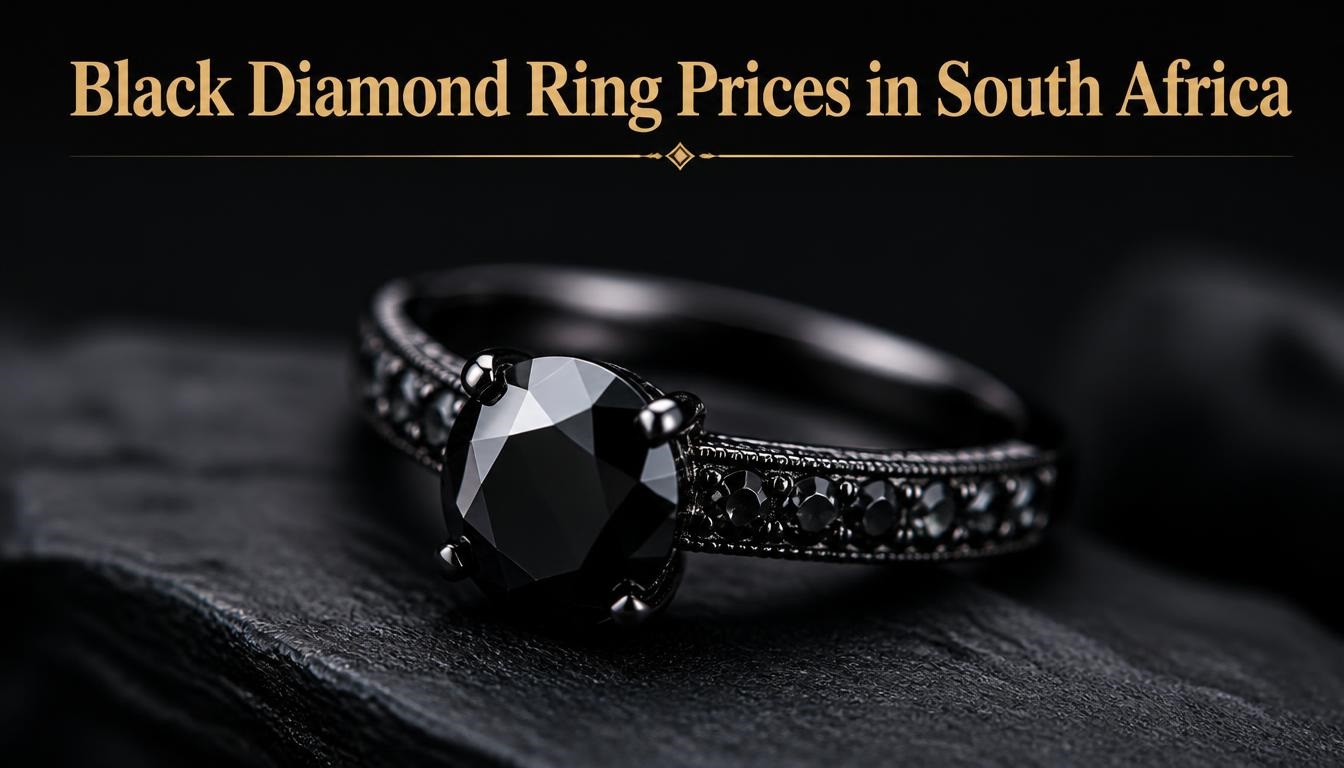
Buying a black diamond ring in South Africa has evolved from a niche gothic preference into a major mainstream statement. However, the local pricing landscape for black diamond ring prices in South Africa is notoriously tricky to navigate. Unlike conventional clear diamonds—where the international GIA “4 Cs” establish tight pricing corridors—black diamonds operate on completely different rules of clarity, treatment, and structural origin.
Before you drop serious money on a piece of jewellery, you need an honest breakdown of what you are actually paying for—whether that is a natural carbonado, a heat-treated natural diamond, or a lab-created alternative.
Black Diamond Ring Pricing & Spec Summary
SA Black Diamond Ring Price Comparison (2026 Market Rates)
The table below breaks down real retail and custom manufacturing estimates across South Africa. All prices include South Africa’s standard 15% VAT.
| Ring Configuration & Spec | Primary Stone Type | Metal Profile | Price Range (ZAR) | Est. Lead Time | Value Rating | Retail & Custom Links |
| Delicate Stacking / Accent Band (0.20ct – 0.40ct total) | Treated Black Diamonds | 9ct Gold (Rose/White/Yellow) | R8,100 – R13,900 | 3 to 7 Days | 4/5 | Afrogem Black Diamond Collection – View Details |
| Classic Solitaire Engagement Ring (1.00ct – 1.20ct) | Treated Natural Black Diamond | 9ct or 14ct White Gold | R14,500 – R24,500 | 1 to 2 Weeks | 5/5 | Manser Jewellery Black Diamond Rings – Check Category Specs |
| Black & White Diamond Halo Ring (1.50ct Center + Side accents) | Treated Black + Earth-Grown White Halos | 9ct / 18ct Rose Gold | R16,900 – R34,250 | 2 to 3 Weeks | 4.5/5 | Wolf Brothers Diamond Collection – View Details |
| High-End Custom Solitaire (2.00ct+ Oval / Cushion Cut) | High-Grade Treated Natural | 18ct White Gold or Platinum | R38,000 – R65,000 | 3 to 4 Weeks | 4/5 | Shimansky Black Diamond Range – View Details |
| Natural Un-Treated Carbonado (Rare Collector Grade 2.00ct+) | Fancy Natural Black (Carbonado) | Platinum or 18ct Yellow Gold | R60,000 – R120,000+ | Custom Order | 3/5 | Cape Diamonds Engagement Range – Check Category Specs |
Why Black Diamond Ring Prices Vary So Wildly in SA
If you browse local jewellers from Cape Town to Johannesburg, you will notice massive price gaps. A 1.5-carat black diamond ring might cost R12,000 at one place and R55,000 at another. Understanding the core factors behind black diamond ring prices in South Africa prevents you from paying top tier money for treated stones or getting ripped off on setting metals.
1. Treated vs. Natural Natural Black (Carbonado)
-
Heat-Treated / Irradiated Diamonds (Most Common): Over 95% of black diamonds sold in South African retail stores are natural earth-mined white or grey diamonds that have high inclusion levels. Jewellers subject them to high-temperature/high-pressure (HPHT) or irradiation treatments to turn the body completely opaque black. These give you real diamond hardness (10 on the Mohs scale) at a fraction of a white diamond’s price.
-
Natural Black Diamonds (Carbonado): Extremely rare natural polycrystalline diamonds formed with graphite inclusions. Genuine, untreated natural black diamonds command massive premiums, often fetching upwards of R30,000 to R50,000 per carat unmounted.
2. Choice of Metal Setting (9ct, 18ct, or Platinum)
Because black diamonds are opaque, the metal setting provides all the contrast.
-
9ct Gold: The most budget-friendly option in SA (R8,000 – R18,000 setups). 9ct gold is harder than 18ct due to higher alloy content, making it durable for daily wear, though it may require re-rhodium plating if you choose white gold.
-
18ct Gold & Platinum: Essential for high-end heirloom rings (R30,000 – R75,000+). Platinum adds significant weight and density, perfectly securing heavier 2.0ct+ stones.
3. Accent Stones & Contrast Halos
Black diamonds do not sparkle in the traditional sense; they emit a deep, metallic luster (adamantine shine). To create visual pop, local jewelers surround black center stones with pavé micro-set white diamonds. Adding a white diamond halo or accent band increases the price by R5,000 to R15,000 ZAR depending on the color (G-H) and clarity (VS-SI) of those accent stones.
Crucial Structural Safeguards for South African Buyers
A black diamond behaves differently than a clear brilliant-cut diamond. Because black diamonds are packed with graphite inclusions and micro-fractures, structural integrity is your biggest priority.
-
Surface Pit Inspection: Check for deep pits that weaken claws.
-
Metal Selection: Opt for 6-claw or Bezel settings for protection.
-
Certificate Proof: Confirm HPHT treatment vs. natural carbonado.
-
Valuation Certificate: Ensure replacement value includes 15% VAT.
Protection Against Impact Damage
Black diamonds can fracture along internal stress lines if hit directly against a hard surface.
-
Avoid Delicate 3-Claw Settings: For everyday wear, choose a robust 4-claw, 6-claw, or full bezel setting. Bezel settings encase the outer rim of the stone in metal, protecting it from accidental side impacts.
-
Inspect the Crown for Pitting: Inferior black diamonds have large surface pits created during the polishing process. Ensure the top table of the stone is smooth and uniform under a jeweler’s loupe.
CPA (Consumer Protection Act) and Valuation Certificates
Under the South African Consumer Protection Act (CPA), consumers have the right to fair value, full disclosure, and safe goods.
-
Mandatory Disclosure: The jeweler is legally required to disclose whether the black diamond has undergone HPHT/irradiation treatment. Selling a heat-treated black diamond as an “all-natural untreated gem” is a direct breach of the CPA.
-
Insurance Appraisals: Always request a formal Independent Jeweller Valuation Certificate specifying the retail replacement value (inclusive of 15% VAT). Major insurance providers (like Santam, Hollard, or Outsurance) require this certificate to insure the ring under specialized all-risk items.
Local Stress Test: How Black Diamonds Perform in SA Conditions
South Africa presents unique environmental and operational conditions that test fine jewelry:
-
Coastal Air & Salt Spray (KZN & Western Cape): White gold settings rely on rhodium plating to maintain bright silver shine. Sea air, skin acidity, and frequent swimming degrade rhodium plating within 12 to 18 months. If living along the coast, opting for Platinum or Unplated Yellow/Rose Gold saves you R650 to R1,200 ZAR per re-plating service.
-
High-Impact Daily Wear: Black diamonds hide dirt and oil buildup far better than clear diamonds, but dirt build-up behind the setting can loosen structural claws over time. A professional ultrasonic cleaning every 12 months at a local workshop keeps settings tight.
Frequently Asked Questions
Are black diamonds real diamonds?
Yes. Natural black diamonds share the exact same chemical structure (carbon) and 10 Mohs hardness scale rating as clear diamonds. The black coloration comes from heavy inclusions of graphite, hematite, or dark mineral clusters inside the crystal matrix.
Why are black diamonds cheaper than white diamonds?
Standard white diamonds are valued on purity, lack of color, and light refraction. Black diamonds are completely opaque and absorb light rather than reflect it. Because they are less traditionally sought after and easier to source as raw industrial-grade stones before heat treatment, their price per carat is significantly lower than clear white diamonds.
How do I care for and clean a black diamond ring?
Clean your ring using warm water, mild dishwashing liquid, and a soft-bristled toothbrush. Do not use harsh steam cleaners or home chemical dips, especially if your black diamond has surface-reaching fractures or micro-treatments, as extreme thermal shock can damage the stone.
Can a black diamond ring be resized easily by SA jewellers?
Resizing depends on the ring setting, not the diamond itself. Simple solitaire bands in 9ct, 18ct gold, or platinum can easily be resized by any qualified local manufacturing jeweller. However, full eternity bands set with black diamonds all around cannot be resized and must be custom-made to size.
Are you shopping for a black diamond engagement ring or custom band in South Africa right now? Have you received quotes from manufacturing jewellers in Sandton, Cape Town, or Durban?
Drop your questions, prices, and builder experiences in the comments below to help fellow South African buyers make informed choices!
Disclaimer: Prices fluctuate and reflect independent market research at the time of publication. We may earn a small affiliate commission through qualified links at no extra cost to you.

Joseph Mathebula is a consumer analyst and market researcher at Prices in South Africa. He specializes in tracking local service costs, retail pricing, and travel budgets, helping everyday shoppers navigate the market to secure the best value.