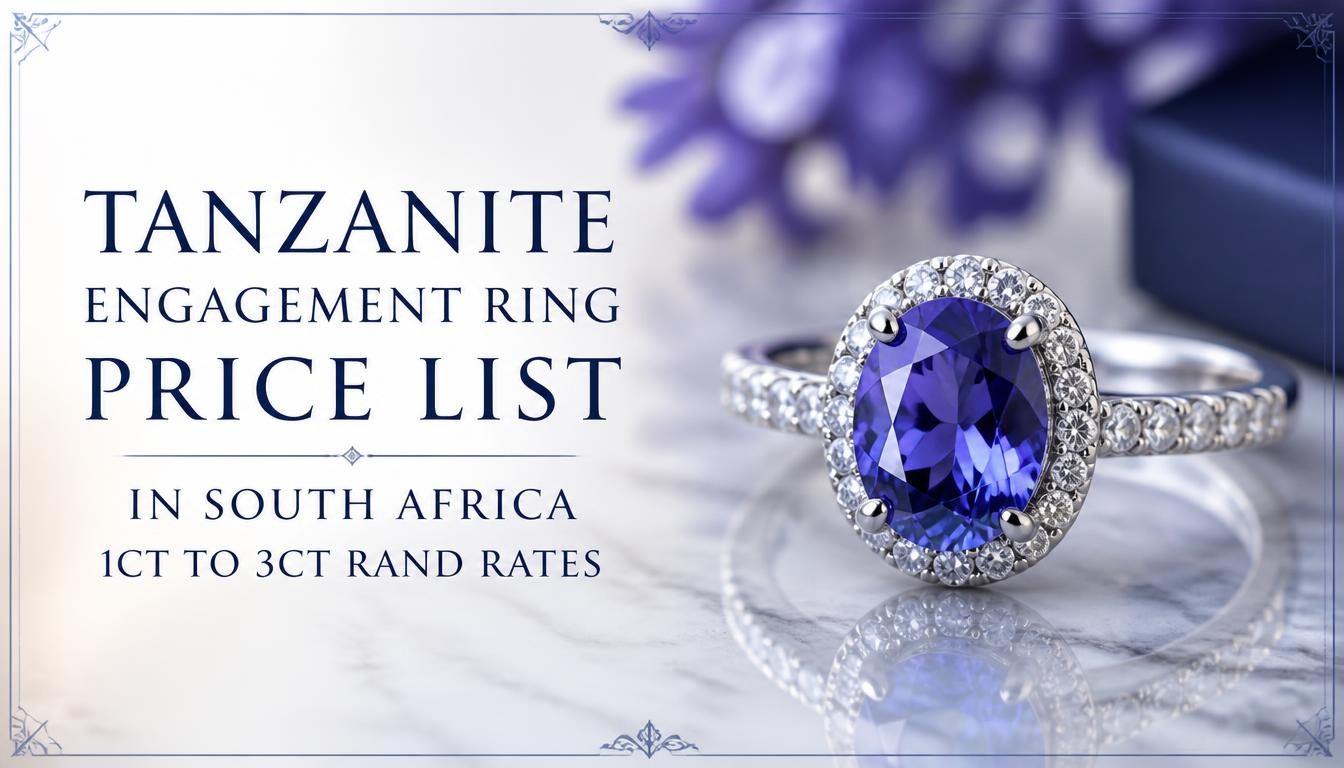
Buying a tanzanite engagement ring in South Africa ought to feel like a triumph. You are acquiring a geological anomaly found only in a tiny 7-square-kilometre strip near Mount Kilimanjaro. Yet, walk into a boutique shop in Sandton City or the V&A Waterfront, and you will quickly realize that pricing feels entirely arbitrary. One jeweler quotes R18,500 for a 1ct ring, while another demands R65,000 for what looks like the exact same carat weight.
The Tanzanite Engagement Ring Price List in South Africa varies drastically because chain retailers frequently package pale, commercial-grade gemstones into expensive 18K gold settings to inflate margins. Meanwhile, direct-from-mine diamond and gemstone cutters price rings according to color saturation (vivid deep violet-blue vs. watery lavender) and origin certification.
South African Tanzanite Market Summary
2026 Tanzanite Engagement Ring Price Breakdown (1ct to 3ct ZAR Rates)
The following matrix compares realistic retail and bespoke manufacturing prices across South Africa. All figures include 15% South African VAT.
| Carat Weight & Grade Tier | Average ZAR Price Range | Metal & Setting Style | Typical Lead Time | Local Value Rating | Official Market Reference |
| 1.0ct AA Grade (Medium Violet-Blue) | R12,500 – R19,500 | 9K/14K Gold Solitaire | Stock (2–4 Days) | Good (Entry Level) | Shimansky Tanzanite Range – View Specs |
| 1.0ct AAA Grade (Vivid Royal Blue) | R22,000 – R35,000 | 18K White Gold / Micro-Pavé | 5–10 Business Days | Excellent (High Saturation) | Afrogem Loose & Set Specs – Check Catalogue |
| 2.0ct AA Grade (Medium Deep Violet) | R28,000 – R42,000 | 14K Gold Halo or Trilogy | 7–14 Business Days | Very Good | Cape Town Diamond Museum – View Standards |
| 2.0ct AAA Grade (Rich Deep Royal Blue) | R48,000 – R78,000 | 18K Gold / Platinum Diamond Halo | 10–14 Business Days | Exceptional (Best Seller) | Jewel Africa Custom Builds – View Details |
| 3.0ct AA Grade (Deep Violet Accent) | R62,000 – R92,000 | 18K Gold Cathedral Setting | 14 Business Days | Good (Large Finger Presence) | Shimansky Masterpiece Sets – View Specs |
| 3.0ct AAA/Block D Investment (Intense Blue) | R95,000 – R165,000+ | Heavy Platinum / Diamond Accent | Custom Build (3 Weeks) | Premier (Collector Grade) | South African Diamond Council – Check Regulatory Standards |
The “Block D” Price Trap: How Gemstone Saturation Drives ZAR Value
When buying a diamond, carat weight is the primary driver of cost. With tanzanite, color saturation dictates up to 70% of the gemstone’s actual retail value.
-
A Grade (Pastel Lavender): Lightest color saturation, highly abundant.
-
AA Grade (Medium Violet-Blue): Good everyday depth, strong commercial availability.
-
AAA Grade (Deep Royal Velvet Blue): High saturation, vivid pleochroism.
-
Investment / Block D (Intense Deep Blue-Violet): Premium collector grade, top 1% of yield.
Many high-street commercial jewelry outlets sell 1ct or 2ct tanzanite rings featuring A or AA-grade light lavender stones. Because raw tanzanite in lighter shades is far more abundant, cut stones sell wholesale for under R3,500 per carat. However, once set into a gold band with small diamond accents, these rings are tagged at R25,000+ in shopping centers.
By contrast, AAA and Block D tanzanite exhibits a velvety, deep royal blue with violet undertones under daylight, shifting to warm reddish-purple under incandescent light (known as pleochroism). These vivid gems represent less than 1% of total production at Merelani. A 2.0ct AAA stone alone demands R35,000 to R55,000 before adding metal or setting work.
Estimated Loose Gemstone Price per Carat (ZAR)
| Gem Grade | 1.0ct – 1.99ct Price Range | 2.0ct – 3.0ct Price Range |
| A (Pastel Lavender) | R3,200 – R4,800 | R5,000 – R7,500 |
| AA (Medium Blue-Violet) | R6,500 – R9,500 | R11,000 – R16,500 |
| AAA (Vivid Royal Blue) | R14,000 – R22,000 | R24,000 – R38,000 |
The Mohs Hardness Reality: Setting Your Ring for SA Daily Wear
Tanzanite registers 6.5 to 7.0 on the Mohs hardness scale. By comparison, diamonds sit at 10, and sapphires at 9. This physical characteristic impacts how you should design and wear an engagement ring in South Africa.
Because tanzanite is softer and exhibits distinct cleavage directional planes, a sharp blow against a granite kitchen counter or steering wheel can chip or fracture an exposed stone.
-
Vulnerable Settings (Prongs): Standard 4-prong claw solitaire settings expose the gem’s girdle to direct lateral impacts. If your partner lives an active lifestyle, works out frequently, or does hands-on outdoor work, 4-prong designs require constant caution.
-
Protective Settings (Bezel or Halo): A full metal bezel setting completely encases the stone’s perimeter in 14K/18K gold or platinum, shielding the edge from impacts. Alternatively, a diamond halo provides a buffer zone, absorbing accidental bumps before they reach the center gem.
-
Metal Choice & Thermal Stress: South African manufacturing jewelers generally recommend 14K White Gold or 18K Yellow/Rose Gold. Platinum is exceptionally durable and hypo-allergenic, but its density adds roughly R4,500 to R9,000 to the total setting cost compared to 14K gold.
Legal Rights, VAT Refunds, and Certification Safeguards in South Africa
Navigating the high-end jewelry market requires strict verification of authenticity and consumer protection compliance.
The Consumer Protection Act (CPA) & Warranties
Under Section 55 and 56 of the South African Consumer Protection Act (Act 68 of 2008), all goods sold carry an implied 6-month warranty of quality. If a manufacturing jeweler supplies a ring with structural defects—such as loose claw tolerances, porous metal castings, or an undisclosed cracked gem—you have the legal right to request a repair, replacement, or full refund.
Note: The CPA covers manufacturing flaws, but does not cover accidental damage caused by dropping or knocking a 6.5 Mohs gemstone against hard surfaces. Always insure your ring through a local all-risks personal items policy immediately upon purchase.
Exporting & Tourist 15% VAT Refunds
If you are purchasing an engagement ring in South Africa to take overseas (or buying as an international visitor), you are eligible to claim back the 15% Value Added Tax (VAT) at OR Tambo International, Cape Town International, or King Shaka International Airports.
-
Ensure the jeweler issues a Tax Invoice explicitly showing the business name, VAT registration number, your passport details, and an itemized breakdown of the ZAR amount.
-
Present the unworn ring along with the tax invoice to the Tax Refund Administrator (TRA) office before passing through border control security.
Certification Audit Check
Never purchase a loose tanzanite or complete ring without an independent certificate from recognized gemological laboratories such as EGL (European Gemological Laboratory), GIA (Gemological Institute of America), or an accredited certificate from reputable local cutting houses (e.g., Shimansky Certified Tanzanite). The certificate must detail:
-
Carat Weight (measured to two decimal places).
-
Cut Geometry & Dimensions.
-
Color Saturation Rating (A, AA, AAA, or Investment Grade).
-
Clarity Grade (Eye Clean vs. Included).
Local Stress Test: How Tanzanite Holds Up in the SA Climate
Before making a five-figure investment, consider how your ring will endure daily conditions across South Africa’s diverse regions:
| SA Regional Factor | Physical Threat to Tanzanite | Recommended Preventive Strategy |
| Coastal Humidity | Salt spray tarnishing lower karat gold | Select 18K Gold or Platinum; avoid 9K alloys. |
| Ambient Heat | Thermal shock from sudden temp swings | Never clean stone in hot water after air-con exposure. |
| Water Quality | Borehole/Hard water chemical film build | Wash exclusively with mild soap and micro-cloth. |
| Power & Home Security | Ultrasonic cleaner power surges | Avoid home ultrasonic units; use manual soaking. |
-
Thermal Shock Avoidance: Tanzanite does not tolerate rapid temperature changes. If you step out from an air-conditioned building into a 40°C Limpopo or Karoo summer afternoon, or immerse your hands in boiling dishwater immediately after handling ice, the internal crystalline lattice can stress-fracture.
-
Chemical Exposure & Cleaning: Never submerge tanzanite rings in aggressive chemical jewelry cleaners, harsh domestic bleach, or pool chlorine. To clean at home, use warm tap water, a few drops of neutral dishwashing liquid, and a soft-bristled baby toothbrush. Avoid cheap home ultrasonic cleaners, as sudden voltage fluctuations or uncalibrated frequencies can shatter sensitive gemstones.
Frequently Asked Questions
Is tanzanite a good choice for a daily engagement ring in SA?
Yes, provided it is mounted in a protective setting (such as a bezel or diamond halo) and worn with mindfulness. While diamonds are more forgiving of rough treatment, a 1ct to 3ct AAA tanzanite offers a striking, regal aesthetic at roughly 20% to 30% of the cost of a comparable blue diamond or fine sapphire.
What is the price difference between loose tanzanite and a finished ring?
Setting a loose gem adds R5,500 to R12,000 for a custom 14K/18K solitaire band, or R12,000 to R28,000+ if you add a micro-pavé diamond halo and platinum setting. Buying a loose stone from a certified South African lapidary cutter and commissioning a bespoke jeweler often yields better stone saturation for the same total ZAR budget.
How do I verify if a tanzanite gem is natural or synthetic?
Synthetic tanzanite is rare, but imitation materials like colored cubic zirconia, blue glass, or synthetic forsterite frequently flood informal online marketplaces. Authentic tanzanite exhibits strong pleochroism—showing distinct blue, violet, and burgundy/bronze flashes when rotated under directional light. Always insist on a physical gemological certificate from an independent lab before transferring funds.
Have you recently sourced a tanzanite engagement ring in Johannesburg, Cape Town, or Durban? Are you trying to evaluate a quote from a local manufacturing jeweler against loose stone market rates?
Drop your questions, carat specs, ZAR pricing quotes, or builder experiences in the comment section below to help fellow South African buyers make informed investments!
Disclaimer: Prices fluctuate based on the ZAR/USD exchange rate, global gemstone demand, and raw gold bullion prices at the time of publication. We may earn a small affiliate commission through qualified links at no extra cost to you.

Joseph Mathebula is a consumer analyst and market researcher at Prices in South Africa. He specializes in tracking local service costs, retail pricing, and travel budgets, helping everyday shoppers navigate the market to secure the best value.